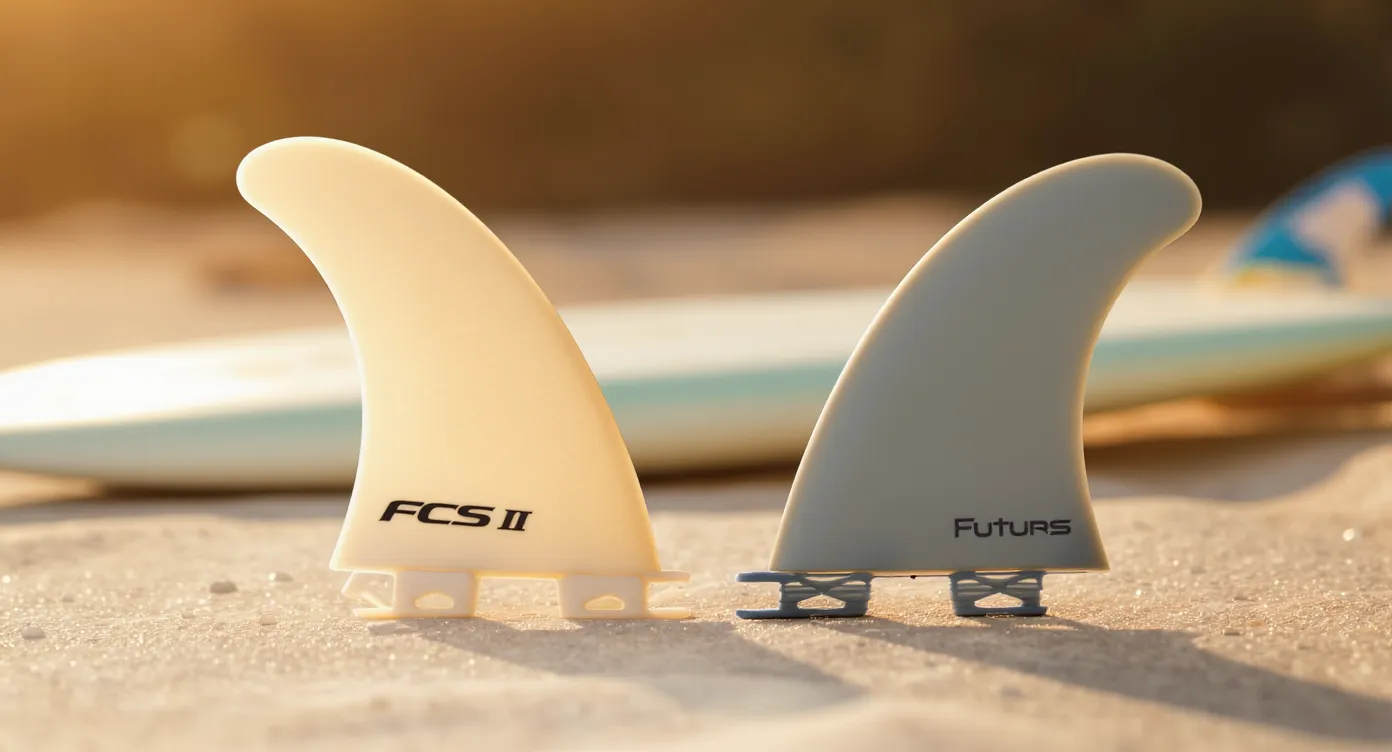
You're standing in the shop with two boxes in your hands. FCS II H4 on the left. FCS II Reactor on the right. Both thruster sets. Both performance-level fins. Both cost roughly the same. The guy behind the counter says "they're both great" and goes back to waxing a board. Helpful.
Here's the thing. These two fins attack a wave from completely different angles. One wants to hold a line and power through sections. The other wants to snap, pivot, and stay tight in the pocket. For punchy beach breaks, that difference isn't academic. It's the difference between making the section and watching it close out in front of you.
Two Templates, Two Personalities
The numbers tell the story before you even get wet. The H4's side fins sit at 38.3 degrees of sweep. The Reactor? Just 31.9 degrees. That's a massive gap in fin geometry, and you feel every degree of it.
More sweep means the fin wants to drive forward, hold through longer arcs, and keep speed through drawn-out carves. Less sweep means tighter pivots, quicker direction changes, and a tail that releases when you ask it to. Neither is wrong. But one is almost certainly better for the waves you're surfing.
The H4 was designed in collaboration with Swiss engineering (yes, really) and features a hatchet-like tip profile that locks in at speed. The Reactor runs a more traditional upright template with a smaller center fin built specifically for increased pivot and tail release. Two completely different ideas about what a thruster should do.
The H4 on a Punchy Beach Break
You paddle out at a wedgy peak, something like HB Pier on a solid south swell. Chest-high, punchy, fast walls with a couple of bowl sections. You drop in on the H4 and the first thing you notice is the drive. The board shoots out of the bottom turn with this locked-in feeling, like the fins are gripping the face and pulling you forward.
On a longer wall, this is pure gold. You set a rail line and the H4 carries you through sections that would stall a lesser fin. The extra sweep generates speed without pumping, and that hatchet tip profile keeps the board tracking true even when the wave throws a wobble at you.
But then the section pitches. A fast, hollow closeout section that demands you snap off the top and redirect in about two feet of space. And here's where the H4 gets honest with you. That 38.3 degrees of sweep that felt so good on the open face? It fights you in tight quarters. The turn radius is wider than you want. You make the snap, but it feels like you're steering a slightly longer car than you need for this parking lot.
The H4 isn't bad on beach breaks. It's just better suited to beach breaks that produce longer, more open walls. Think Lowers on a good day, where you've got room to draw lines and project through sections. It rewards surfers who surf with flow and commitment to their arcs.
The Reactor Where It Was Born to Surf
Same peak, same swell. You click in the Reactors and everything changes.
The first bottom turn feels different. Less drive off the bottom, sure, but when you push through the turn and redirect up the face, the board just goes where you point it. No negotiation. No wide arc. You push, the tail releases, and you're already heading back down before the lip even throws.
That 31.9-degree sweep angle keeps the fins more upright, which means tighter turning arcs and quicker transitions from rail to rail. On a punchy beach break where sections fold fast and you've got maybe three moves before the wave shuts down, this is everything. You're not drawing out long carves. You're snapping, redirecting, snapping again.
The smaller center fin on the Reactor adds to this feeling. More tail release means the board pivots around the rear fins instead of the center. It's a subtle difference until you're trying to fit into a tight pocket on a hollow section, and then it's not subtle at all. The board rotates. The section makes. You kick out grinning.
Where the Reactor struggles is on longer walls with more power. If your beach break occasionally produces overhead, down-the-line runners, the Reactor can feel a little sketchy. Less hold in the bottom turn when the wave has real push. Less drive when you need to project through a flat section. That upright template that pivots so well in the pocket gets twitchy when the wave demands commitment.
The Spec Breakdown
Here's how the medium sets compare side by side. These numbers matter, so pay attention.
| Spec | H4 (Medium) | Reactor (Medium) |
|---|---|---|
| Side Fin Base | 4.48" | 4.34" |
| Side Fin Depth | 4.45" | 4.57" |
| Side Fin Area | 15.07 in² | 14.96 in² |
| Sweep (Rake) | 38.3° | 31.9° |
| Best For | Speed, hold, open faces | Tight turns, pocket surfing |
| Construction | PC Carbon | PC / PC Carbon |
The H4 runs a wider base (4.48" vs 4.34"), which generates more drive off the bottom. The Reactor is taller (4.57" vs 4.45"), which gives it more bite when you're vertical on the face. The area is nearly identical, so the difference isn't about how much fin is in the water. It's about where the rake puts that fin relative to your turns.
So Which One Do You Actually Buy?
This is where most comparisons cop out and say "it depends on your style." That's true but useless. Let me be specific.
Buy the Reactor if: You surf punchy, hollow beach breaks most of the time. Your sessions are at spots like Blacks, Lowers, or any wedgy peak where the wave pitches fast and you need to stay in the pocket. You like snappy, progressive surfing. You want to work on airs. You ride a performance shortboard with moderate-to-low rocker. For 80% of Southern California and East Coast beach break sessions, the Reactor is the better fin.
Buy the H4 if: Your beach break produces longer walls and you tend to draw bigger lines. You surf with more flow than snap. You want a fin that holds when the swell picks up and the waves get overhead. You're the surfer who makes three big turns per wave rather than six quick ones. Or if you travel to point breaks and reef setups regularly and want one set that handles a wider range of conditions.
For pure punchy beach break performance, the Reactor wins. It was literally designed for this. The H4 is the more versatile fin across different wave types, but versatility isn't always the point. Sometimes you want the specialist.
A Note on Construction
Both fins come in PC (Performance Core) builds. The H4 also comes in PC Carbon, which adds targeted carbon layup for a stiffer, more responsive feel. If you're going H4, the carbon version is worth the upcharge. The extra stiffness complements that driven, hold-everything template. For the Reactor, the standard PC version is plenty responsive for most surfers. The carbon version tightens things up even more, which can make the tail feel almost too quick in small surf.
If you're still weighing which fin template matches your surfing, or you're not sure whether your board even wants an upright or raked fin, the FinFinder recommender can sort through the variables for you. Takes about a minute and it's way more useful than the guy at the shop telling you both are great.
Key Takeaways
- The Reactor's 31.9-degree sweep makes it faster and tighter in punchy, hollow beach breaks where quick direction changes win
- The H4's 38.3-degree sweep delivers more drive and hold, better for longer walls and overhead conditions
- For most surfers at most beach breaks, the Reactor is the better fit for how those waves actually break
- The H4 is the more versatile all-conditions fin if you want one set for beach breaks AND point breaks
- Both fins share similar total area, so the performance difference comes entirely from template shape and how that shape interacts with your board
Helpful Resources
Ready to Find Your Perfect Fins?
Use our expert fin recommender tool to get personalized suggestions based on your needs.
Try Fin Recommender