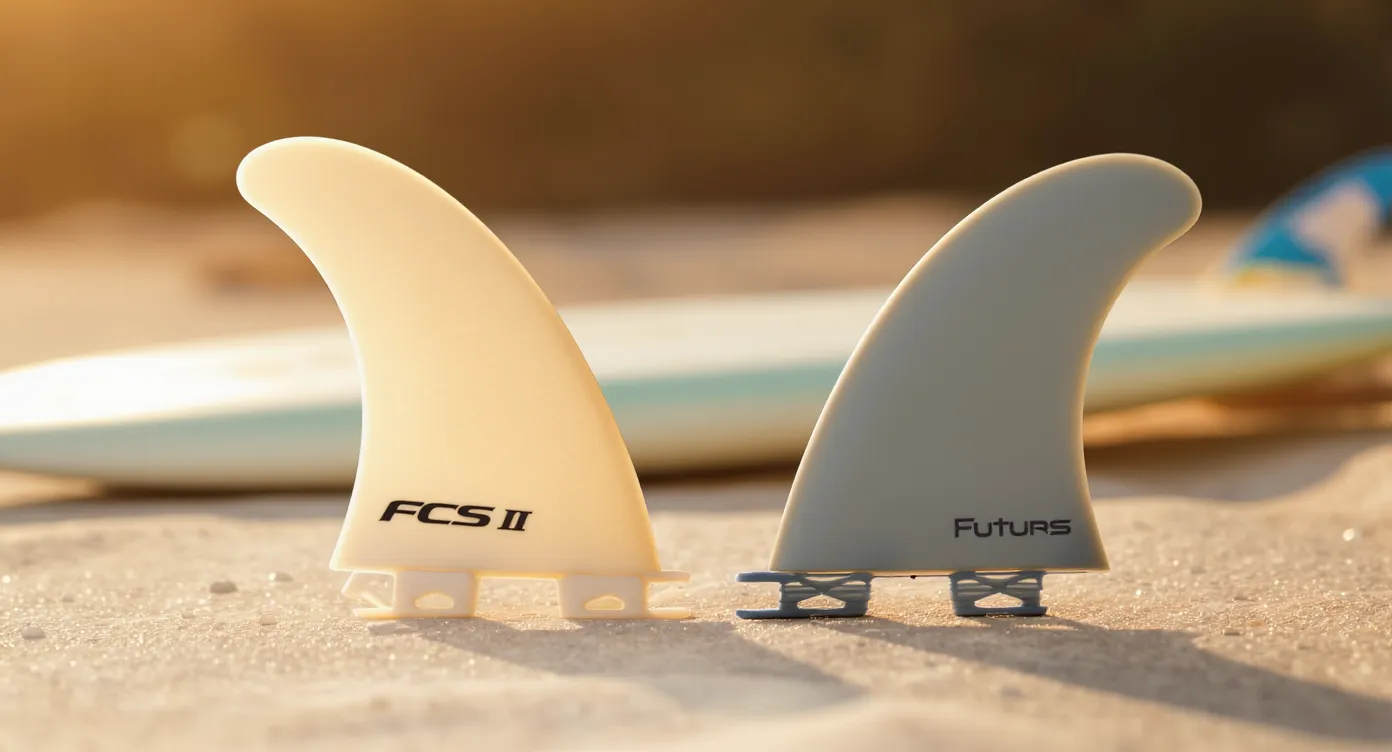
You're standing in the surf shop with two boxes in your hands. Left hand: Futures Alpha. Right hand: FCS II Accelerator. Both are roughly the same price. Both promise to be the only fins you'll ever need. Both have that vaguely premium look that makes you feel like a better surfer just holding them.
You've been here before. And you left with the wrong ones.
These two fin sets are the Toyota Camry and Honda Accord of the thruster world. Reliable, versatile, solid performers that work in almost everything. But "almost everything" hides some real differences that matter when you're actually in the water. I've ridden both extensively through a Southern California winter, from 2-foot Scripps mush to overhead Blacks, and they're not as interchangeable as the marketing suggests.
The Specs That Actually Matter
Let's get the numbers out of the way. In medium sizes, these fins are eerily close on paper.
The Futures Alpha F6 (medium) has a 4.35-inch base, 4.56-inch height, and 15.12 square inches of area. Flat foil. The FCS II Accelerator (medium) comes in at a 4.39-inch base, 4.58-inch depth, 15.28 square inches of area, with 33.7 degrees of sweep. Also flat foil.
On paper, that's basically identical. Four hundredths of an inch difference in base length isn't something any human can feel. But the template shapes tell a different story, and that's where the ride diverges.
Where the Alpha Wins: Light, Snappy, Everyday Surfing
The Futures Alpha is built with C6 composite, which is carbon and air infused. Translation: these fins are legitimately light. Pick one up and compare it to a standard fiberglass fin and you'll notice immediately. That weight difference shows up in the water as quicker response times and less drag when you're generating speed.
The Alpha runs a neutral template. Not too upright, not too raked. It's the Switzerland of fin outlines. And that neutrality is actually its superpower in everyday conditions.
Paddling out at Trestles on a clean 3-foot day, the Alphas feel alive from the first wave. You drop in, set a bottom turn, and the board responds before you finish the thought. There's this immediacy to the connection between your back foot and the fin that comes from the Futures single-tab system. No play, no flex at the base. Just direct energy transfer. You push, the board goes. That simple.
In small, gutless waves, the Alphas shine brightest. The lighter construction means less mass to overcome when you're pumping down the line. They generate speed from minimal input. You're three sections ahead of where you would normally be, and you didn't have to work for it.
The Alpha's Weak Spot
Push these fins into solid overhead surf and you start feeling their limits. The neutral template and lighter construction means less hold when you're really leaning into a steep bottom turn. They don't wash out, but there's a moment of uncertainty on the steepest faces where you want more grip. More bite. The Alphas politely suggest you take a wider line instead.
Where the Accelerator Wins: Power, Control, Bigger Surf
The FCS II Accelerator has a fuller tip and more sweep than the Alpha. That extra rake gives you longer, more drawn-out turning arcs. It holds through powered-up bottom turns where the Alpha starts to feel nervous.
The Accelerator in PC Carbon construction is stiffer and more responsive than the standard Performance Core version. The carbon inserts add recoil to the flex pattern, so the fin loads up through a turn and then snaps back with energy. You feel it as a little burst of acceleration coming off the top. It's subtle, but once you notice it, you miss it when it's gone.
Surfing overhead days at a punchy beach break is where the Accelerator earns its keep. You set your rail on a steep drop, the fuller template grabs the face, and there's zero question about whether the fins will hold. You commit to the bottom turn and the board tracks like it's on rails. That quiet confidence that lets you go harder because you trust what is under your feet.
The FCS II click-in system also means you can swap fins in the parking lot without a key. Convenient? Sure. But that toolless connection introduces a tiny amount of play at the base that some surfers notice as a softer, more forgiving feel. Whether that's a feature or a flaw depends on what you want.
The Accelerator's Weak Spot
In small, weak surf, the Accelerator feels heavy-footed. That extra sweep and area that gives you hold in bigger waves becomes excess drag in 2-foot mush. You're pumping harder to maintain speed, and quick direction changes in the pocket feel sluggish compared to the Alpha. The Accelerator wants a longer wall to work with. Give it a short, fat section and it'll make you look slow.
The Real Verdict: It Depends on Your Home Break
Most comparison articles cop out here with "it depends on your style." I'm not doing that.
If you surf mostly small to medium waves (waist to head high), the Futures Alpha is the better fin. Period. The lighter construction, neutral template, and direct Futures connection give you more out of average conditions. And average conditions are 80% of your sessions. Be honest about that.
If you regularly surf overhead-plus or you're a bigger, more powerful surfer who generates a lot of speed through turns, the FCS II Accelerator in PC Carbon is the move. It handles power better, holds through steeper faces, and rewards committed surfing.
But here's what gets overlooked: your fin box system has already made this decision for you. If your board has Futures boxes, you're riding Alphas. If it's FCS, you're riding Accelerators. And honestly? Both are excellent. You're not losing sleep-worthy performance either way. The difference between these two fins matters less than whether you've got the right size for your weight.
What About Price?
The Alpha tri set runs about $130-150. The Accelerator PC Carbon sits around $140-160. The standard Accelerator in Performance Core is cheaper at $90-110, but it's a noticeably different fin. The PC Carbon is the real competitor to the Alpha.
Both are mid-premium fins. Not the cheapest option, not the boutique-level stuff. For most surfers, this is the price bracket where the money actually makes sense. You get real materials and real performance without diminishing returns.
The Environmental Angle
Worth mentioning: the Futures Alpha uses NetPlus material from Bureo, made from recycled fishing nets collected in Chile. It's not greenwashing. The material genuinely performs. FCS has their Neo Glass Eco line using bio-resin, but the Accelerator PC Carbon doesn't use recycled materials. If that matters to you, the Alpha wins on sustainability without sacrificing performance.
Key Takeaways
- The Futures Alpha is lighter, quicker, and better in small to medium waves thanks to C6 carbon-air construction and a neutral template.
- The FCS II Accelerator PC Carbon holds better in powerful surf, with more sweep and a fuller tip that rewards committed power surfing.
- On paper the specs are nearly identical, but template shape and construction create noticeably different rides.
- Your fin box system largely makes this choice for you. Both are excellent all-rounders in their respective ecosystems.
- Fin sizing matters more than which of these two you pick. Get the right size before stressing about template.
Not sure which template fits your surfing? Plug your details into the recommender and it'll sort out whether you need neutral or raked, and what size to start with.
Helpful Resources
Ready to Find Your Perfect Fins?
Use our expert fin recommender tool to get personalized suggestions based on your needs.
Try Fin Recommender