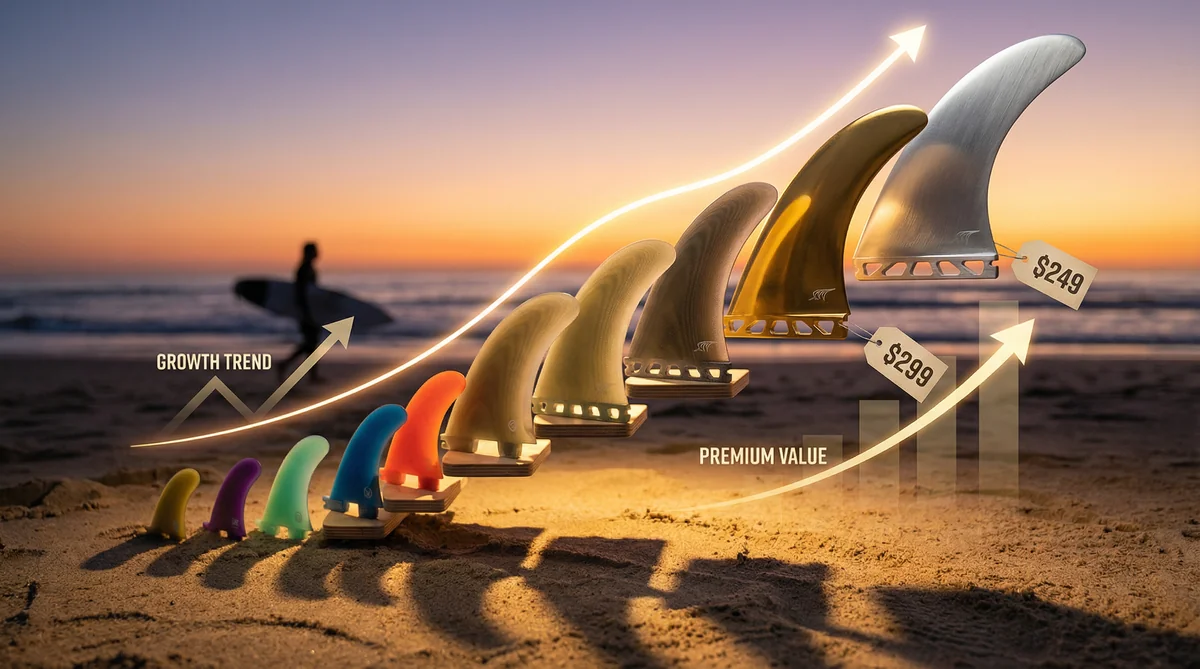
You noticed it. Your buddy mentioned it. Probably cursed at your screen when you checked prices for new fins. I've been updating my affiliate links and watching fins that used to cost $80-$100 now sitting at $110-$120. Some premium sets I've seen are pushing $300. That's insane.
Let that sink in. $300 for fins. That's what you used to pay for an entire damn surfboard not that long ago. A legit used shortboard, glassed, shaped, ready to rip. Now that same money gets you three pieces of molded composite that slot into your existing board.
It's not your imagination, it's not inflation hitting everything equally, and it's definitely not just greed from manufacturers trying to squeeze extra cash out of the community. Something real happened, and it's worth understanding before you commit to your next purchase.
Here's the reality: since early 2024, surfboard fin prices have surged between 25-30% on average. Most solid fin sets that used to run $80-$100 are now $110-$150. Premium options easily hit $150-$200, with some specialized setups climbing even higher. But unlike general inflation that hit lots of products across the board, fins got hit harder. The problem isn't one thing. It's a perfect storm of tariffs, material shortages, shipping chaos, and supply chain disruptions that specifically targeted an industry that was already fragile. And if you're running an affiliate site, you're watching your margins compress while prices climb. Let's break down exactly what happened, why it matters, and what surfers actually have for options right now.
The Tariff Bomb: The Single Biggest Price Driver
Here's the most direct answer: tariffs are crushing the market. Starting April 4th, 2025, Global Surf Industries implemented a minimum 25% price increase directly tied to U.S. government tariffs reaching up to 61.5% on imported surfboards and components. That's not theoretical damage. That's a tariff hitting harder than anything the industry has seen in recent memory.
The context: most surfboard fins are manufactured in China, Vietnam, and a handful of other Asian countries. When the U.S. slapped those tariffs on imported goods, the cost of bringing fins into America exploded overnight. Retailers had to absorb those costs or pass them to customers. Most passed them to customers.
Even more brutal: China tariffs alone climbed to 145% as of April 2025 on certain goods, though reduced rates of 30% are still being applied to surfing equipment. That's not a small bump. That's a fundamental shift in the economics of the business.
What does this mean for you? If you're comparing prices from a year ago to now, a significant chunk of that increase is pure tariff pass-through. It's not the cost of making a better fin. It's government policy making imported goods more expensive.
Material Costs Got Real, Real Expensive
Beyond tariffs, the raw materials themselves are pricier. Foam blanks, fiberglass, resin, and carbon fiber all experienced real cost increases driven by supply chain disruptions and increased demand. When you're making fins, you're buying materials from suppliers who are also dealing with higher costs across the board.
According to data from the Surf Industry Manufacturers Association (SIMA), the average price of a high-performance surfboard increased 8% in 2023 alone, jumping from $695 to $750. That's before the 2024-2025 tariff shock. Fins are following the same trajectory because they use similar materials.
Carbon fiber fins especially have become luxury goods. The material itself costs more, manufacturing tolerances are tighter for performance, and quality control is stricter. You're not getting ripped off, you're just paying for actual material costs that have climbed significantly.
Shipping Just Added Insult to Injury
Add shipping on top of everything else. Getting a fin from China to a distribution center in California costs real money, and those costs climbed substantially over the last 18 months. Shipping a single board can cost $100-250 depending on size and destination. Those costs get baked into the retail price.
When you buy a fin, you're not just paying for the fin. You're paying for the container ship, the fuel, the port fees, the truck that delivered it to the warehouse, and the logistics chain that got it to your local shop or your Amazon order. Every step in that chain costs more now than it did in 2024.
The Real Pain Points Surfers Are Feeling Right Now
Let's be honest about what this means for the actual crew:
Your quiver costs way more to build: If you're trying to build a solid 3-4 fin setup for different conditions, you're now spending 30% more. That's the difference between a $300 investment and a $390 investment. For casual surfers on a budget, that's real money.
Budget brands disappeared: Some of the affordable options that used to fill the gap between cheap garbage and premium performance fins just aren't competitive anymore. The margin squeeze killed off a lot of mid-market offerings.
You can't ignore fin choice anymore: When fins were cheaper, experimenting with different setups was easier. Now you have to be more deliberate. Getting the wrong fins for your style and conditions is a $150 mistake, not a $70 mistake.
Premium prices feel unjustifiable: Surfers are looking at a $250 premium fin set and asking, "Are these really worth $80 more than last year?" Often the answer is no. The performance didn't improve. The tariffs did.
The Market Response: What Brands Are Actually Doing
Smart manufacturers are adapting. Some brands are exploring manufacturing in Vietnam and Thailand to dodge tariffs. Others are consolidating offerings and making fewer SKUs to reduce complexity. A few are absorbing costs and taking margin hits, but that's unsustainable for smaller brands.
The result: the market is actually getting cleaner. You've got fewer fin options overall, but the ones that survive are either genuinely good or backed by strong branding. Dead weight got cut.
What You Can Actually Do: Honest Options from Budget to Premium
Here's the real talk on what works:
The Budget Play (Under $60): Cheap fins that actually perform exist, but you're sacrificing something. Plastic or basic composite fins from no-name brands on Alibaba work for learning, but they're sluggish and don't hold edges well in anything but perfect mush. They're fine for beginners or beaters, but don't expect performance.
The Smart Mid-Tier Play ($80-$120): This is where value actually lives right now. Mid-tier brands like HyperFins, Kinetik Project, and house brands from solid retailers are making genuinely functional fins. They're not boutique status symbols, but they work. They hold foils that deliver real performance, materials are decent, and they won't break your bank. If you're building a quiver, this is where you'd put your money. These brands aren't household names, but surfers who've tested them know they deliver.
The Established Middle Ground ($120-$180): This is where brands like FCS II, Futures, and Pyzel sit right now. These are solid, proven fins with real performance characteristics. You're paying for consistency, warranty support, and the fact that pros actually use these setups. Not everyone needs this tier, but if you're serious about your surfing and want fins that won't fail you, this is the bandwidth to shop in.
The Premium Tier ($200-$300+): Custom-shaped fins, high-end carbon fiber, ultra-specialized designs. Some of these are genuinely better. Some are just expensive. The truth: if you're not a competitive surfer or someone who's dialed in your exact style, premium fins deliver diminishing returns. That said, if you're ripping and you know your style, a premium set built specifically for you will perform noticeably better than mid-tier options.
The Real Talk: Most recreational surfers would be perfectly happy with mid-tier fins ($100-$140 range). You get real performance, decent materials, and you're not overpaying for branding. The jump from budget garbage to mid-tier is huge. The jump from mid-tier to premium is real but smaller.
The Elephant in the Room: Are Prices Actually Justified?
Some of the price increase is legitimate. Material costs are real. Tariffs are real. Shipping is expensive. But have fins actually gotten 25-30% better in the last year? No. The performance improvements in fins happen in increments, not in one-year jumps.
What that means: if you have fins from 2023 or 2024, they're still very good. Upgrading for marginal performance gains when prices are inflated isn't a smart financial move. If you need new fins because yours are damaged or worn out, then yeah, pay the new prices. If you're upgrading just to upgrade, consider whether the performance difference justifies the cost increase.
How FinFinder.ai Helps When Prices Are This Messy
Here's where things get practical. With prices this volatile and the market this fragmented, knowing exactly which fins work for your specific setup is more important than ever. Guessing wrong now costs more money.
This is where having a tool that knows your style, your board, your weight, and the conditions you actually surf makes all the difference. Instead of spinning your wheels trying 3-4 different fin setups and eating the cost of expensive mistakes, you get direct recommendations tailored to what you're actually working with.
When tariffs are crushing your options and prices are making every purchase count, having clarity on what actually works for you isn't a luxury. It's the difference between a smart purchase and an expensive learning experience.
Get personalized fin recommendations based on your actual setup and conditions. Stop guessing, stop making expensive mistakes, and start surfing fins that actually work for the way you ride.
What You Should Actually Do Right Now
Step 1: Check Your Current Fins Are they still working? Performing well? If yes, don't upgrade just to upgrade. You're paying a tariff premium for marginal gains.
Step 2: Know Your Style Before you buy, understand what you're actually asking the fins to do. Small waves? Big waves? Turns? Hold? Speed? Different conditions need different geometry. Getting this wrong is expensive right now.
Step 3: Shop Mid-Tier First The value bandwidth is $100-$140. You're not sacrificing performance, and you're not overpaying for premium branding. This is where smart money goes right now.
Step 4: Buy in Batches If You Can If you're building a quiver, buy all your fins at once rather than piecemeal. You'll catch sales and volume discounts better than buying one set at a time.
Step 5: Consider Your Box System FCS II or Futures? That decision locks you into an ecosystem. Make sure you're picking the right system for your needs because switching later is expensive and annoying.
Key Takeaways
- Surfboard fin prices jumped 25-30% since 2024, with some premium sets pushing $300
- Tariffs are the biggest culprit, but material costs and shipping added fuel to the fire
- Some of that increase is legitimate, but not all of it
- The market is getting cleaner, with fewer options but more solid performers
- Mid-tier fins ($100-$140) represent the best value right now
- Premium fins deliver diminishing returns for most recreational surfers
- Budget fins still exist but sacrifice real performance
- Your current fins from 2023-2024 are still solid if they're working
- Don't upgrade for marginal gains when prices are inflated
- $300 used to buy you a whole board. Now it buys you three fins. Times have changed.
Final Thoughts
Surfing has gotten more expensive. That's real, and it's frustrating. But the good news: the quality of available fins has actually improved. You're not paying more for worse products. You're paying more for tariffs and supply chain realities, which is different. Once you understand that distinction, shopping becomes clearer. Buy smart, know your style, and don't chase performance gains that cost more than they're worth. Your wallet (and your bank account) will thank you.
Helpful Resources
Ready to Find Your Perfect Fins?
Use our expert fin recommender tool to get personalized suggestions based on your needs.
Try Fin Recommender