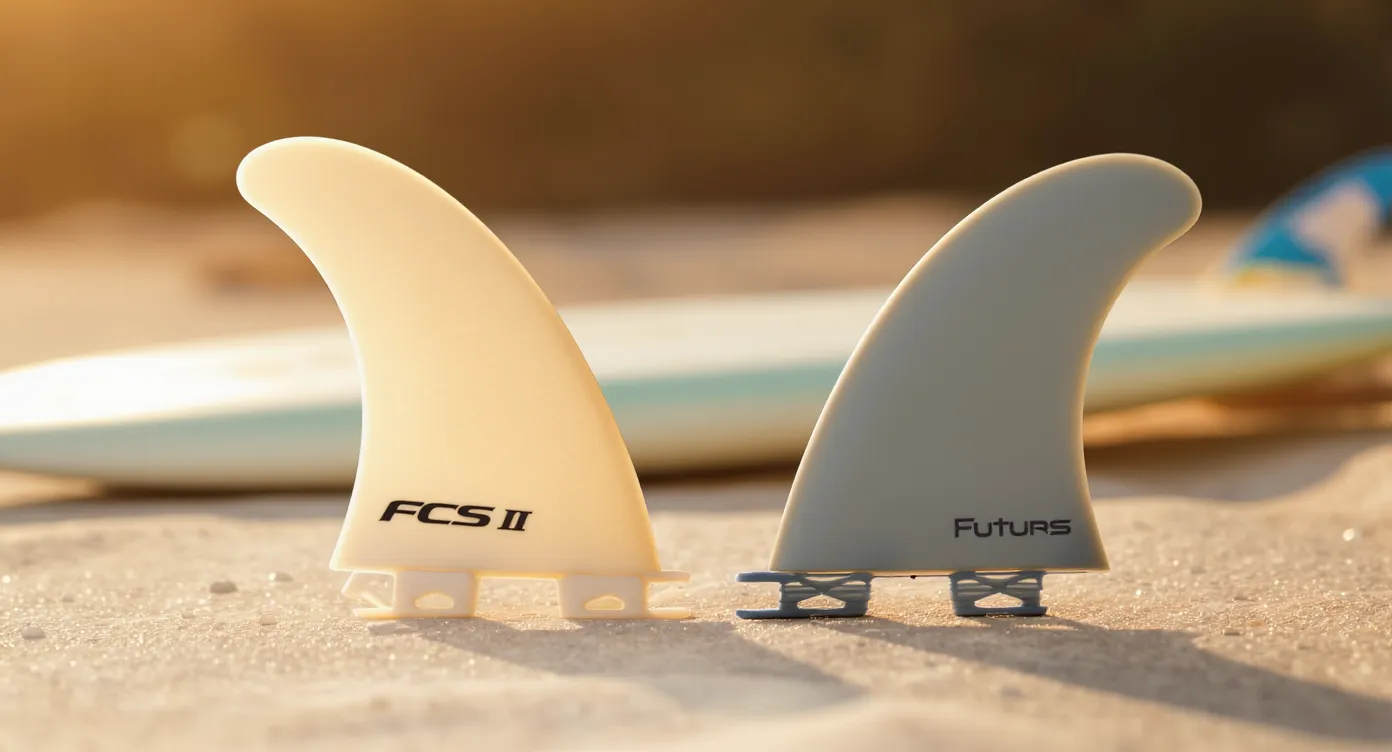
You walk into a surf shop in Encinitas. The fin wall stretches halfway to the ceiling. There's a section with a photo of John John mid-air, a section with Mick Fanning racing down a Snapper point, and a third with Carissa cracking a top turn. Each one has a fin set next to it with their name printed on it and a price tag that hurts.
Which of those are real? Which are stickers?
Both, depending on the fin. And you're allowed to be skeptical about which is which.
Some Signature Fins Are Real. Most Are Sponsorship Math.
The pro fin signature game splits into two camps. In one camp, the fin on the shelf is genuinely the template the athlete won titles on. In the other, it's a marketing collab where the surfer's name went on a fin they barely ride in jerseys.
Both can perform fine for you. A solid template is a solid template no matter whose face is on the packaging. But you should know which you're buying before you drop $130 on it.
The JJF Alpha: When the Signature Is the Real Deal
Futures markets the JJF Alpha as the template John John Florence rode to back-to-back WSL world titles in 2016 and 2017. According to Futures, this is genuinely the template. Same neutral-template shape, same flat symmetric foil, same 6.5-degree base angle. They sell it in XS through L so groms and giants can both ride the same shape.
What does it feel like? Neutral templates split the difference between a stiff, drivey carving fin and a loose, releasey shortboard fin. You drop in, set your rail, and the board holds without arguing. Pump down the line and it doesn't feel like you're dragging a parachute. Throw a snap and the tail breaks loose at exactly the moment you wanted it to.
It's not a magic fin. It's a really good neutral template that JJF happens to win on. That's the bar.
Mick's MF Template and the Plot Twist Nobody Mentions
The FCS II MF is Mick Fanning's signature. It sits in the Carver family with a high sweep angle, an elongated tip, and a refined foil with a bevel on the leading edge. Mick used it for most of his life on tour and it became one of FCS's best-selling fin sets ever.
Here's where it gets interesting. Carissa Moore has her own FCS II signature, a hybrid of Performer and Accelerator elements designed for everyday surfers and a wide range of conditions. When she's drawing lines in a final, though, she's been seen riding the Mick Fanning MF template instead of her own.
So you can buy two fins with the words "Carissa Moore" written somewhere on the packaging. One she helped design for the surfers who buy fins. The other is what she actually competes on. Both are good. They are not the same fin.
When the Signature Is Just a Sticker
Plenty of signature fins are existing templates with a pro's name printed on a new colorway. The fin underneath is something the brand was already selling. The collaboration is a brand exercise, not an engineering one.
That doesn't make the fin bad. The FCS II Performer is one of the most successful surfboard fins ever made and it has zero pro signatures on the packaging. Templates win or lose on their own merits. A logo doesn't change the foil.
What it does mean: you're paying a premium for the photo. If your budget is tight, skip the sticker and buy the underlying template in a no-name colorway. Same fin, twenty bucks less.
The Pros Who Actually Ride What They Sell
Some pro signatures genuinely trace back to that surfer's competitive setup. The MR twin keel really is what Mark Richards rode to four world titles in the early 80s, and the fin you can buy from FCS today still respects that geometry. The Greenough 4A really is the template that triggered the modern shortboard.
The JJF Alpha really is what John John was riding when he locked the 2016 and 2017 world titles. That kind of provenance is rare. When it shows up, it's worth taking seriously.
Other signatures are pure marketing. The packaging shows the surfer doing an air. The fin is a slightly tweaked Performer with a different graphic. That's not a scandal. It's just useful to know before you reach for your card.
How to Read Through the Marketing
You don't need to memorize every athlete's deal. You need three filters.
One: Does the brand explicitly say "this is the template they won on"? Futures says this about the JJF Alpha. FCS makes a similar claim about the MF. When the brand makes the claim publicly, they have a reason to back it up.
Two: Does the spec sheet match a unique template, or is it just an existing family with a fresh graphic? Pull up the brand's family chart. If the signature lives inside a category like Carver or Neutral with no notes on tweaks, it's likely a colorway move.
Three: What template did the surfer ride in their last winning heat? This takes thirty seconds on YouTube. If the pro's signature is in a different category from what's actually in their board on tour, you have your answer.
The Verdict
Buy pro signature fins when the template earns the price. The JJF Alpha is a legitimate carving thruster worth the money if neutral templates fit how you surf. The MR twin keel is iconic and still rips on a small-wave fish. The MF is a legitimate carver fin and not just a sponsorship move.
Skip the signature when it's a paint job. If the underlying template is a Performer, just buy a Performer in the cheaper colorway. Your surfing won't get better because the box has a famous name on it. Your wallet will.
The template matters. The sticker doesn't. Reading the actual fin specs is more useful than reading the marketing copy on the back of the box, and it takes about the same amount of time.
Key Takeaways
- Some pro signatures are genuinely the template the athlete won on. The JJF Alpha and the MR twin keel are two examples worth the price.
- Others are existing templates with a celebrity sticker and a $20 markup. The fin under the graphic is what you're actually buying.
- Carissa Moore competes on the Mick Fanning MF template, not her own signature. The signature was built for everyday surfers, not her finals heats.
- Check the spec sheet, not the photo. If the base, sweep, and foil match an existing template, it's a colorway play and you can save money.
- Templates win or lose on their own merits. A name on the packaging doesn't change the foil under the resin.
If you're stuck between three signature fins at the shop and the photos all look the same, our fin recommender will sort out which template actually fits your board and the waves you ride, regardless of whose name is on the box. The foil is the point. The sticker isn't.
Helpful Resources
Ready to Find Your Perfect Fins?
Use our expert fin recommender tool to get personalized suggestions based on your needs.
Try Fin Recommender