You're paddling out on a waist-high summer morning at San Onofre. Glassy, barely breaking, the kind of day where half the lineup is on longboards and the other half is sitting there wondering why they bothered. But you brought the groveler.
Wide nose, extra volume, swallow tail. Built for exactly this.
Then you drop in and the board feels... dead. Sluggish off the bottom, no pop through turns, dragging through sections you should be flying through. You're pumping like your life depends on it and barely making it past the first section.
The board isn't the problem. Your fins are.
Why Standard Fins Kill Your Groveler's Potential
Most surfers grab their daily driver fins and stick them in whatever board they're riding. That works fine when your shortboard and your groveler have similar outlines. But grovelers are fundamentally different machines.
Wider tails, more volume, flatter rocker. They need fins that match.
Standard performance fins (think FCS II Performers or Futures F6) are designed for boards with narrower tails and steeper rocker. They've got more area, more rake, and they're built to hold in powerful waves. Stick those in a groveler and you're adding drag to a board that's already fighting low-energy waves for every ounce of speed.
It's like showing up to a go-kart race in steel-toed boots. Technically functional. Practically terrible.
What Groveler Fins Need to Do Differently
In weak waves, the ocean isn't doing the work. You are. Your fins need to help you generate speed from flat sections, release through turns without bogging, and keep the board loose enough to stay in the pocket on waves with zero push.
That means three things:
Wider base for drive. A fin with a bigger base gives you something to push against when you pump. In mushy surf, that initial acceleration off the bottom is everything. Without it, you're chasing sections you'll never catch.
Less area overall. Counterintuitive, but smaller fins mean less drag. Your groveler already has extra volume for flotation. You don't need massive fins to keep it stable.
Drop a size from your normal thruster set and the board wakes up.
More flex. Stiff fins are great in powerful surf because they hold under pressure. In two-foot mush, that stiffness just deadens the board.
A flexier fin loads up energy as you pump and releases it back, basically giving you free speed. It's the difference between bouncing on a trampoline and jumping on concrete.
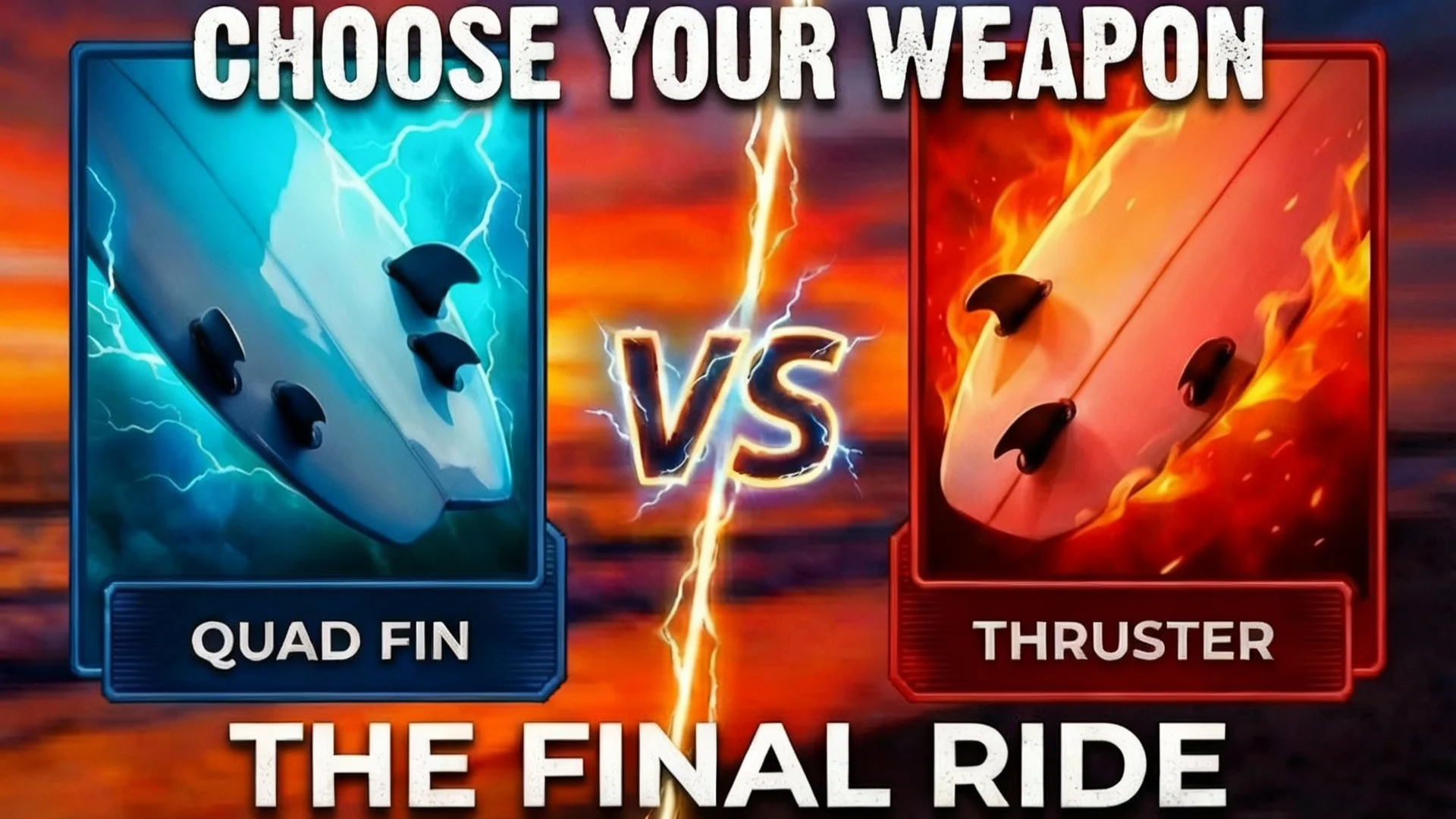
Thruster, Quad, or Twin on a Groveler?
This matters more than most surfers think. Your groveler's fin setup changes the entire personality of the board.
Thruster: The Safe Bet
If your groveler has five-fin boxes (most do), running it as a thruster keeps things predictable. You get pivot from the center fin, control through turns, and a feel that's close to your normal shortboard. The trade-off: that center fin creates drag. In tiny waves, drag is the enemy.
If you go thruster, size down. Medium fins on your shortboard means small-medium on the groveler. And pick something with flex.
The Futures Blackstix AM1 in a small is a legit groveler thruster fin. The carbon tips flex and spring back, generating speed on pump. That springy release feels alive under your feet, like the board wants to go even when the wave doesn't.
Quad: The Speed Machine
Quads on grovelers are borderline cheating. No center fin means no drag brake, and you get four fins gripping the face when you're on rail.
In waist-high surf at Trestles, a quad groveler feels like you've got a motor. You drop in, set a line, and the board just goes. No pumping required for the first two sections.
The Machado Quad set was basically designed for this exact scenario. Rob Machado shaped the Seaside as a small-wave fish, and the matching quads have front fins with extra rake for drive and upright rears for release. They're smooth, fast, and you can carve long arcs that would stall a thruster.
FCS II Reactor quads are another strong pick. More upright template, less sweep, which means quicker direction changes in the pocket. When the wave is barely shoulder-high and you've got three seconds to fit a turn before it dies, that responsiveness matters.
Twin: The Fun Factor
If your groveler has a fish-style outline with a wide swallow tail, twins are the move. Keel fins or upright twins both work. The board gets skatey and loose, speed comes easy, and every session feels like you're messing around even when you're trying.
The Captain Fin CF Keel sets are affordable and rip in small surf. Around $65 for fiberglass keels that generate speed through flat sections like they're on rails. Check out our roundup of underrated fin brands for more options in this range.
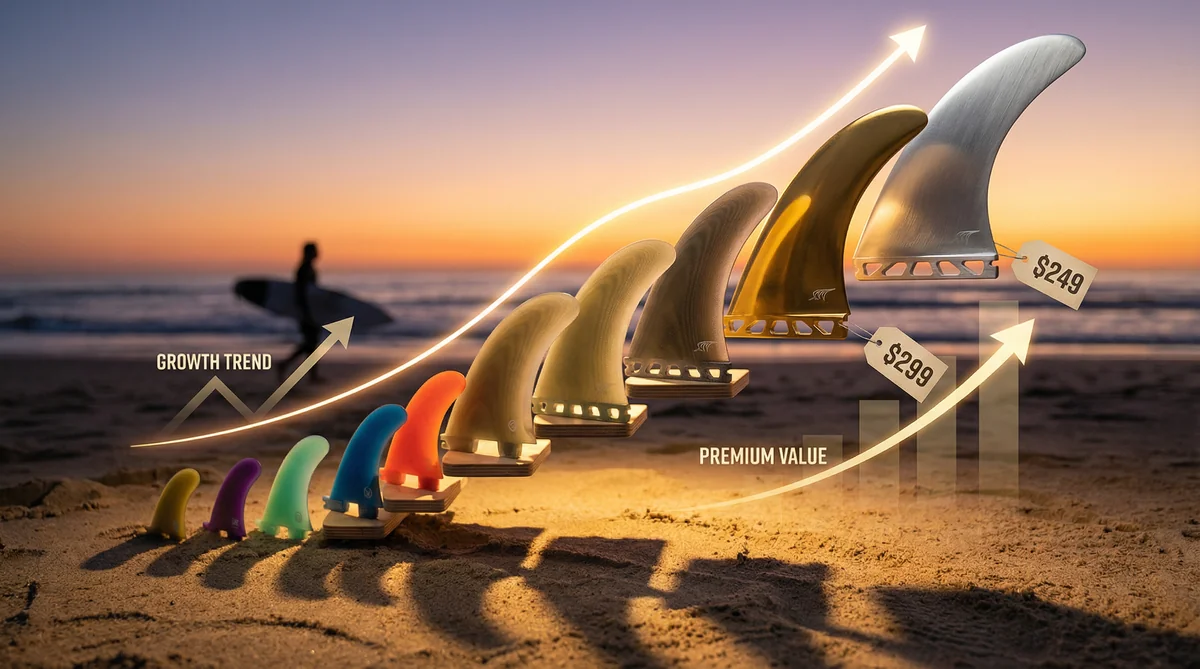
The Best Groveler Fins by Budget
Under $80: Get the Job Done
FCS II Performer Neo Glass (Small): The all-rounder in a downsized package. Neo Glass construction gives you medium flex at a fair price. Not the most exciting fin on this list, but reliable in every sense. Around $65.
Futures F4 Thermotech: Smaller template, flexible composite construction. Won't blow your mind but won't hold you back either. About $45, which makes them the cheapest functional groveler fin out there.
$80-$130: The Sweet Spot
Futures AM1 Blackstix (Small): Al Merrick designed the template. The Blackstix construction has carbon fiber tips that flex and rebound, generating speed when you need it most.
The V2 concave foil on the inside face makes the board feel loose and lively in gutless waves. You drop into a knee-high wall and the fins find speed that isn't there. Around $110.
FCS II Reactor PC (Small): Upright template for quick pivots, Performance Core construction for controlled flex. These turn a groveler into a pocket rocket. Best for surfers who want to stay tight in the critical zone rather than draw big lines. Around $100.
Machado Quad Keel Set: If you're running your groveler as a quad or twin, these are hard to beat. Designed specifically for wide-tailed small-wave boards. The upright template offers more pivot than traditional keels while keeping the drive. Around $120.
$130+: Performance Premium
Futures AM1 Alpha (Small): Carbon-air construction makes these featherweight. You feel the weight difference in small surf because there's less mass to get moving. Snappy, responsive, and they hold better than you'd expect from a flexy fin. Around $160.
FCS II H4 PC Carbon (Small): For the surfer who wants their groveler to feel like a high-performance shortboard in miniature. Stiffer than other options on this list, so they're best in small-but-punchy conditions rather than dead mush. Around $140.
The Sizing Rule Nobody Follows
Size down on your groveler. Period.
If you ride medium fins on your performance shortboard, go small-medium or small on the groveler. The board already has extra volume holding you up. You don't need the stability that bigger fins provide. What you need is less drag and more maneuverability in weak surf.
Matt Biolos from ...Lost has said it straight: wider boards with more volume need less fin area, not more. The board's outline is already doing the stability work. Let the fins focus on speed and release.
Check our fin sizing guide if you want to dial in the exact numbers for your weight.
Most surfers are over-finned on their grovelers. They wonder why the board feels stiff and slow, when the answer is sitting right there in the fin boxes.
Flex Matters More in Small Waves
In overhead surf, stiff fins hold. They resist the force of the wave and keep you locked in. That's what you want when the ocean is trying to rip the board out from under you.
In two-foot mush, stiff fins are dead weight. There's no wave energy to push back against, so all that rigidity just makes the board feel wooden and unresponsive. You pump and nothing happens. The board tracks straight like it's on training wheels.
Flexier fins store energy when you pump and release it as forward momentum. It's subtle but real.
You feel it as a little kick of speed at the end of each pump, like the fins are helping you instead of just being along for the ride. The Blackstix line from Futures and the Neo Glass line from FCS both nail this. They're not noodle-soft, but they've got enough give to stay alive in gutless conditions.
One Board, Two Fin Sets: The Groveler Hack
If your groveler has five-fin boxes, buy two sets. A small thruster set for days with a little push (waist to chest-high, some shape to the waves) and a quad set for the truly tiny stuff (knee to waist-high, barely breaking).
Swap takes 30 seconds with FCS II or Futures. That's two completely different boards for the price of one set of fins.
On a summer morning when the buoys read 1.5 feet at 12 seconds, pop the quads in. When a small south swell fills in with some actual shape, switch to the thrusters.
This is the kind of thing that sounds obsessive until you try it. Then you wonder why you surfed the same setup in every condition for years.
Key Takeaways
- Standard performance fins add unnecessary drag to grovelers. Size down and go flexier.
- Quads are the fastest setup for truly small waves because there's no center fin acting as a brake.
- The Futures AM1 Blackstix (Small) and FCS II Reactor PC (Small) are the best all-around groveler thruster fins in the $100-$110 range.
- Flex generates free speed in weak waves. Stiff fins belong on your step-up, not your groveler.
- Five-fin boxes let you run two completely different setups on one board. Use that.
If you're not sure which size or template fits your groveler, plug your details into our fin recommender. It matches your weight, board dims, and wave conditions to specific fins. Takes about a minute and saves you from the $100 guessing game.
Helpful Resources
Ready to Find Your Perfect Fins?
Use our expert fin recommender tool to get personalized suggestions based on your needs.
Try Fin Recommender