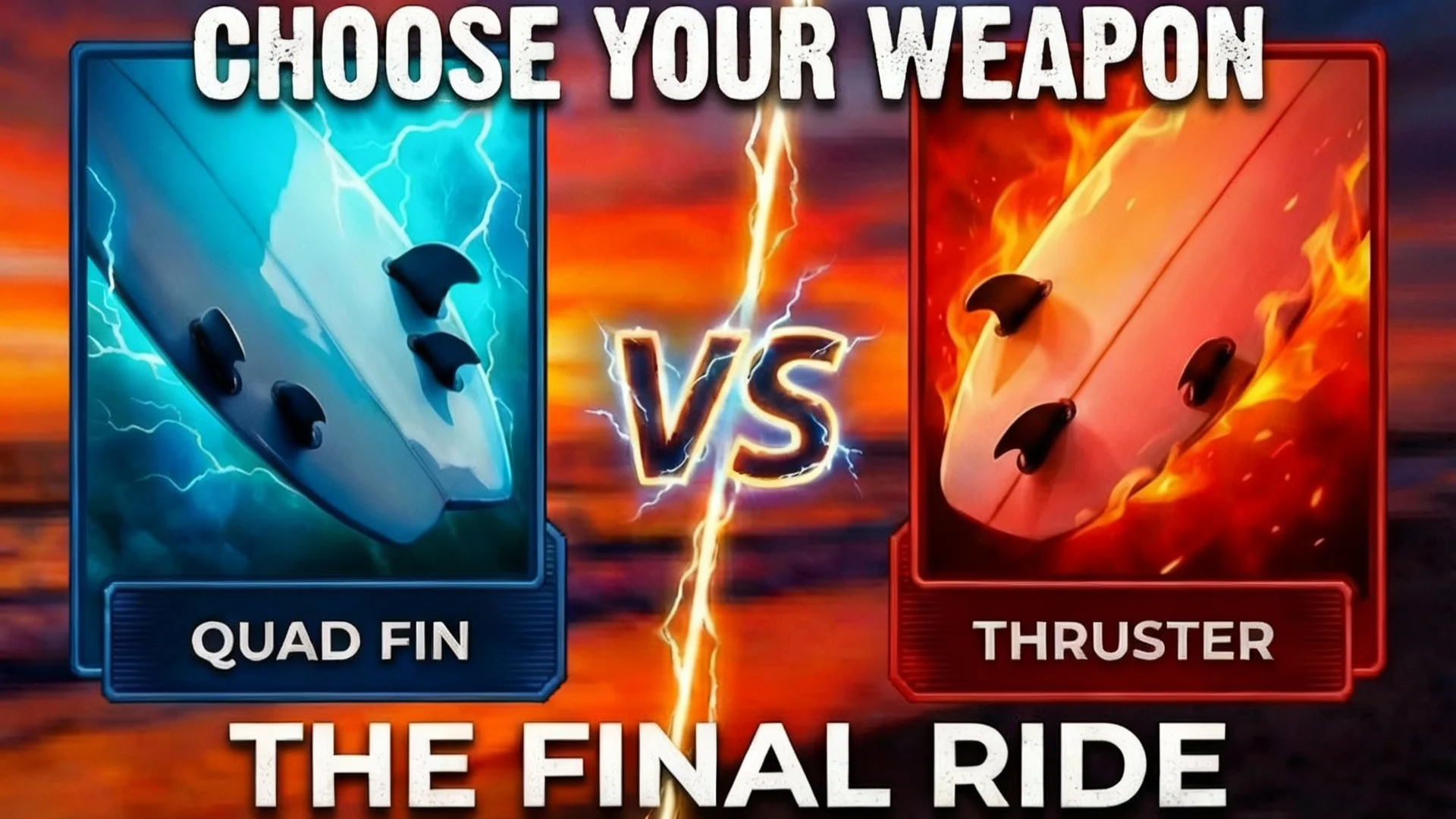
You're staring at the forecast showing 1-2 foot at 12 seconds and debating whether it's even worth waxing up. Your buddy texts: "It's fun on the quad." You show up, and he's gliding through sections that would've killed your momentum on a thruster. Same garbage waves. Completely different session.
We covered the full quad vs thruster breakdown already. This isn't that. This is about dialing in the right quad setup for when the waves barely break. Because "run quads in small surf" is only half the answer. Which quads, what size, what template? That's where it gets interesting.
Why Quads Own Mushy Waves
The physics are simple: no center fin means less drag, more speed. But in small surf, the advantage compounds. A thruster's center fin creates resistance every time you go straight. In powerful waves, the wave's energy offsets that drag. In 2-foot mush, there's nothing to offset it. You're just slow.
Quads eliminate that brake. You take off and the board just goes. No frantic pumping, no wrestling momentum out of a flat section. Water flows clean under the tail and you carry speed through parts of the wave where a thruster would've stalled.
The sensation is borderline unfair. You drop into a waist-high dribbler, set a lazy bottom turn, and suddenly you're three sections ahead of where you'd normally be. Your brain hasn't caught up to the speed your board is generating. That's the quad advantage in weak surf, distilled.
What Makes a Small Wave Quad Setup Work
Not all quads are built for mush. Some are designed for barrel speed at Teahupo'o. Others are meant for punchy beach breaks. If you need a refresher on how fin setups affect your surfing, that's worth reading first. For gutless surf, you want three specific things.
Smaller Rear Fins
This is the single biggest variable. Smaller rear fins give you a looser, skateier feel and let the tail release easier. In small waves, you need that looseness because the wave isn't providing enough energy for aggressive rail-to-rail transitions. Smaller rears let you pivot and redirect without fighting the board.
The rule: your rear fins should be about 60-70% the height of your fronts. Most quality quad sets come properly sized, but if you're experimenting, that ratio is your target.
Moderate Rake on the Fronts
Highly raked (swept back) front fins generate drive through long, drawn-out arcs. For small waves, moderate rake is the sweet spot. You want enough sweep to carry speed through turns but not so much that the board won't pivot in tight pockets.
Something in the 30-35 degree range works. Upright fins feel too twitchy. Highly raked fins feel like you're driving a bus through a parking lot.
Medium Flex
Stiff fins respond to power. In weak waves, there's no power to respond to. Medium-flex fins store energy through turns and release it as speed. You pump once and the fin flexes, springs back, and pushes you forward. It's like a second engine you didn't pay for.
The Setups That Actually Deliver
I've ridden a lot of quad setups in Southern California summer slop. Some were forgettable. These weren't.
Rob Machado Seaside Quad (FCS II / Futures) ~ $160
Machado designed these for his Seaside model, which is basically a small wave machine. The 2025 version got a serious upgrade: handmade in South Africa with carbon interlayers and bamboo, 15% lighter than the originals. Fast, responsive, forgiving.
The feel: you take off on a knee-high wave and instead of that familiar bog where the board stalls, it just accelerates. Smooth, effortless forward motion. The flex pattern is dialed for exactly the kind of lazy, flowing surfing that small waves demand. Best for fish shapes and hybrids with volume.
FCS II Performer PC Quad ~ $176
The Performer is FCS's all-rounder, and the quad version is genuinely good in small surf. The rounded tip and high surface area across all four fins give you exceptional acceleration off the takeoff. You're generating speed before you've even thought about your first turn.
What surprised me: these aren't just fast in a straight line. The inside foil technology gives you a trustworthy feel through turns, like a confident handshake from the board. You can break the line and carve a tight arc when the wave steepens without sacrificing down-the-line speed in flat sections.
Futures Alpha Quad ~ $150
Made in Huntington Beach from recycled fishing nets (Bureo's NetPlus program), these are the eco-friendly pick that doesn't sacrifice performance. The wide base generates drive through flat sections, and the flex at the tips adds power in small to medium surf.
The limitation is real: these are purpose-built for sub-overhead waves. Take them into solid surf and the flex becomes unpredictable. But in the 1-4 foot range? The board responds to everything you give it, like the fins are amplifying your inputs instead of dampening them. That alive feeling is addictive.
Captain Fin Co. Quad Sets ~ $80-100
The budget option that doesn't feel budget. In today's tariff-inflated market, $80-100 is genuinely affordable for four fins. You won't get the refined flex patterns of the Machado or Performer sets, but they're solid, predictable, and they generate speed in small waves without weird handling quirks.
If you're trying quads for the first time and don't want to drop $160+ on fins you might not love, start here.
Dialing the Details
Size Down From Your Thruster Fins
If you ride Medium thruster fins, go Small-Medium on the quad. Four fins provide more total surface area than three, so keeping the same size makes the board feel stiff and overfinned. Sizing down gives you the looseness that makes quads magic in small surf. The fin sizing guide breaks this down by weight if you want specifics.
Board Shape Matters More Than You Think
Quads in small waves work best on boards with wider tails. Fish shapes, round tails, squash tails. Anything that puts volume in the back third where those four fins can grip.
Pulled-in tails need larger rear fins to compensate, which partially defeats the purpose. If your daily driver has a narrow tail, a different fin configuration might serve you better than forcing quads.
Don't Mix Sets
Tempting as it is to throw two FCS fronts with two random rears. Don't. Quad sets are designed as matched systems with specific foils, rakes, and flex patterns that work together. Mixing creates imbalance and unpredictable handling. Buy the set.
Where Quads Fall Short in Small Surf
Quads aren't perfect in mush. They're worse than thrusters for tight, snappy pocket turns. If your local wave gives you a steep section to hack at, you'll miss that center fin pivot point. Dane Reynolds can make a quad go vertical in 2-foot surf, but Dane Reynolds can do a lot of things you and I can't.
The other thing: quads feel different. The first few sessions, you might hate it. The tail feels loose, turns feel uncommitted, and you're not sure if the board is about to slide out. Give it three sessions. Your body needs time to recalibrate to the different feedback. By session four, you won't want to go back to the thruster in small waves.
Key Takeaways
- Quads eliminate center fin drag, the single biggest speed killer in mushy surf
- Look for smaller rear fins, moderate front rake, and medium flex for weak wave performance
- The Machado Seaside Quad and FCS II Performer PC are the standout performers right now
- Size down from your thruster fins when running quads
- Wider tail shapes (fish, squash) pair best with quads in small waves
- Give the setup three sessions before you judge it
Still not sure which quad setup fits your board and your waves? Plug your specs into FinFinder and let it sort the details. Takes a minute, saves you from buying the wrong set.
Helpful Resources
Ready to Find Your Perfect Fins?
Use our expert fin recommender tool to get personalized suggestions based on your needs.
Try Fin Recommender