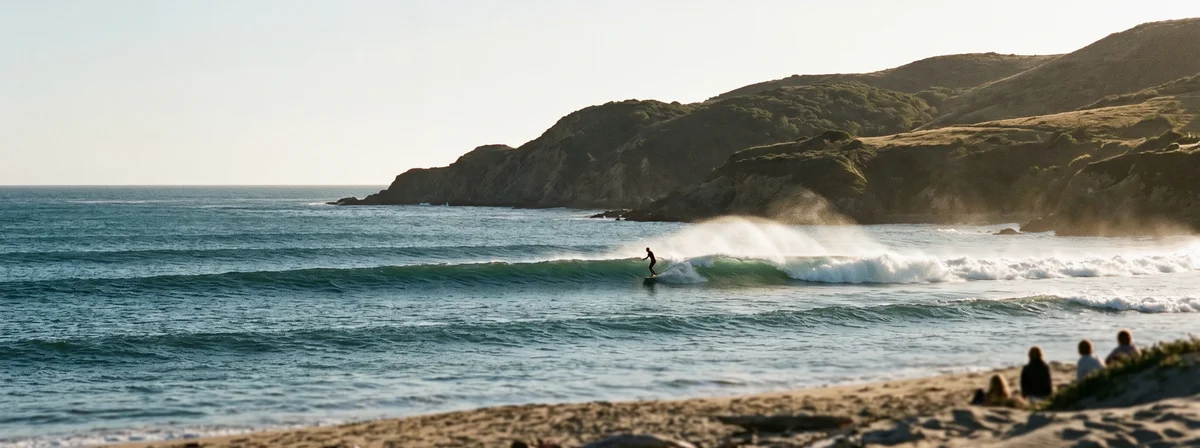
You're at San Onofre on a clean waist-high morning and a guy paddles out on a 7'6 midlength carrying five fins. Two pairs of tiny runners up front, one bigger fin at the tail. You watch him take three waves and absolutely fly. Faster than the longboarders. Smoother than the shortboarders. The board does things you've never seen a midlength do.
That's a Bonzer. And it predates the thruster by more than a decade.
The Setup Nobody Talks About
The Campbell Brothers, Malcolm and Duncan, built the first Bonzer in Oxnard in 1970. The original was a three-fin design: one center fin and two angled side runners flanking deep double concaves through the back third of the board. Eleven years before Simon Anderson glassed the first thruster and rode it to victory at Bells Beach in 1981.
The pitch was hydrodynamic, not stylistic. Channel water through the concaves, focus it past the side runners, and you get thrust without drag. Less keel area in the water, more directional energy out the tail. Surf films of the early 1970s featured Duncan ripping on one and the design moved through California shops fast.
Then the thruster happened. Within five years, every shaper from Newport to San Diego was glassing tris. The Bonzer didn't die. It just got pushed into the corner where the cult-of-the-quirky hangs out alongside finless boards and Greenough kneeboards.
What the Bonzer 5 Actually Does
The modern Bonzer 5 carries four small side runners (two on each side, stacked front-to-back) plus one larger center fin. The runners are usually under three inches tall. They sit canted in toward the stringer at sharp angles, almost lying flat against the bottom of the board. The center fin does most of the steering. The runners are doing physics.
Here's the gist. Water entering the deep double concaves gets squeezed and accelerated by the runners on its way out the tail. You get drive without the drag profile of an upright fin. Imagine a thruster that converted half its side fins into Venturi channels. That's the Bonzer.
The feel is unlike anything else. Long drawn-out turns. A glide that doesn't quit on the flats. The board doesn't pivot off the tail like a thruster from the standard three-fin setup. It carves like it's on rails, then releases when you ask it to. Taylor Knox, who rode Bonzers for years, talks about them in terms of effortless speed. That's an annoyingly accurate way to describe it.
Why It Almost Disappeared
Three reasons.
One, the thruster won the contest war. Once the WSL (then ASP) tour standardized around three fins, every aspiring pro was shaping their boards around what would win heats. Bonzers don't pivot fast enough for the tail-snap cosmetics that judges reward.
Two, the Bonzer requires specific bottom contours. You can't just drop runners on a flat-bottomed shortboard and call it good. The concaves are part of the system. Most production board factories weren't going to retool for a niche template, especially when the thruster paid the bills.
Three, marketing. The Campbell Brothers were craftsmen, not brand-builders. While FCS and Futures sold accessibility through plug systems and pro endorsements, the Bonzer stayed cottage. You ordered one from a shaper or you didn't ride one. That kept the design pure but kept it small.
Why It's Quietly Back
Walk into Christenson Surfboards in Encinitas right now and ask about Bonzers. They'll show you a rack. Same at Sweet Potato up the coast and at Mandala in Bolinas. The midlength revival pulled the Bonzer back into relevance because midlengths are exactly the boards that benefit from drive-without-drag math.
Devon Howard rides them. So does Karina Rozunko. Tom Curren has been seen on Christenson Bonzers more than a few times in the last three years. The 1970s aesthetic is part of it (anything that looks vintage is back), but the surfing is the real reason. When you're riding a 7'2 with a chest-high wave that wants to die on the inside, a Bonzer keeps you connected to the wall longer than a single fin or a 2+1.
I borrowed a friend's 7'4 Bonzer at Cardiff last month. Glassy, head-high, soft west swell. The first wave I caught I overcompensated on the bottom turn because I was expecting the pivot of a single. The board ignored my input and kept arcing wide, holding through the carve like a drawn-out signature. Took two more waves to recalibrate. By the fourth I was carrying speed across sections I'd normally have to pump through. Made me cranky to give it back.
How It Compares to a Thruster
Different tools, different jobs. A thruster gives you tight pivots, vertical attack, and tail release on demand. It rewards the up-the-face surfer. The Bonzer rewards the across-the-face surfer. You sacrifice radical short-arc snaps for a smoother, faster-through-flat-sections ride.
If your reference points are Italo Ferreira airs and Filipe Toledo whips, the Bonzer will feel sleepy. If your reference points are Tom Curren bottom turns and Joel Tudor noseriding, it'll feel like home. Most surfers fall somewhere in between, which is part of why this setup has its small but loyal cult.
Who Should Ride One
If your daily driver is a thruster shortboard and you only surf punchy beach breaks, this isn't your setup. The Bonzer rewards long lines. It rewards waves with shape. It rewards surfers who'd rather draw a turn than snap one. Read up on how fin templates change board behavior before you commit, because the Bonzer is the most context-dependent setup on the market.
It works best on:
- Midlengths from 6'8 to 8'0 with deep double concaves
- Step-ups in chest-to-overhead point breaks
- Single-fin-style boards looking for more drive
- Retro shapes designed around the system
It doesn't work for:
- Hollow beach breaks needing instant tail release
- Standard performance shortboards (the bottom contour is wrong)
- Surfers chasing air sections and short-arc snaps
The Setup You Can Actually Buy
Campbell Brothers still makes the original Bonzer 5 set, glass-on or removable. True Ames produces officially-licensed Bonzer fins in FCS and Futures bases. Christenson partners with True Ames on most of their Bonzer-equipped builds. Captain Fin Co. carries a few related templates, though they call them by different names.
Expect to pay 90 to 150 dollars for a five-fin set. The runners use less material than thruster sides, so the per-fin cost tracks. Don't bother with sketchy unlicensed knockoffs from the usual marketplace suspects. The angle and cant on Bonzer side runners is part of what makes the system work, and cheap reproductions get the geometry wrong.
The Bottom Line
The Bonzer is what happens when you ignore competition pressure for fifty years and just keep refining a good idea. It's not faster than a thruster in critical sections. It's not looser than a quad. It's a third thing entirely. A fin setup that makes a midlength feel like a sportscar and a step-up feel like it has another gear.
If you've been bored of your standard quiver, this is the lateral move worth making. Find a shaper who builds the bottom contour right, get a real licensed fin set, and try a session on something nobody else is riding. Or if you want to know whether your current board geometry could even handle a Bonzer setup, our fin recommender will sort that out before you commit any cash.
Key Takeaways
- Campbell Brothers invented the Bonzer in 1970, eleven years before Simon Anderson's thruster
- Five-fin Bonzers use four small side runners plus a center fin to channel water through deep double concaves
- The setup creates drive without drag, ideal for midlengths and step-ups in waves with shape
- Modern revival is led by Christenson Surfboards, True Ames, and surfers like Devon Howard and Tom Curren
- Doesn't work on standard performance shortboards because the bottom contour isn't right
- Real licensed sets cost 90 to 150 dollars; avoid unlicensed knockoffs with bad geometry
Helpful Resources
Ready to Find Your Perfect Fins?
Use our expert fin recommender tool to get personalized suggestions based on your needs.
Try Fin Recommender