You and your buddy paddle out at the same break. Same board size, same weight, same tide. You're on a set of tall, narrow thrusters. They're riding something short and wide with a big sweeping base. By the end of the session, you've both surfed entirely different boards.
That's aspect ratio talking.
Aspect ratio is one of those spec-sheet numbers most surfers scroll past. The big brands bury it under marketing copy about "drive" and "release." But it's the single measurement that explains why two fins with nearly identical footprints at the base can feel like different species underwater.
What Fin Aspect Ratio Actually Means
Aspect ratio is height squared divided by area. In plain English, it tells you how tall a fin is relative to how much water it moves.
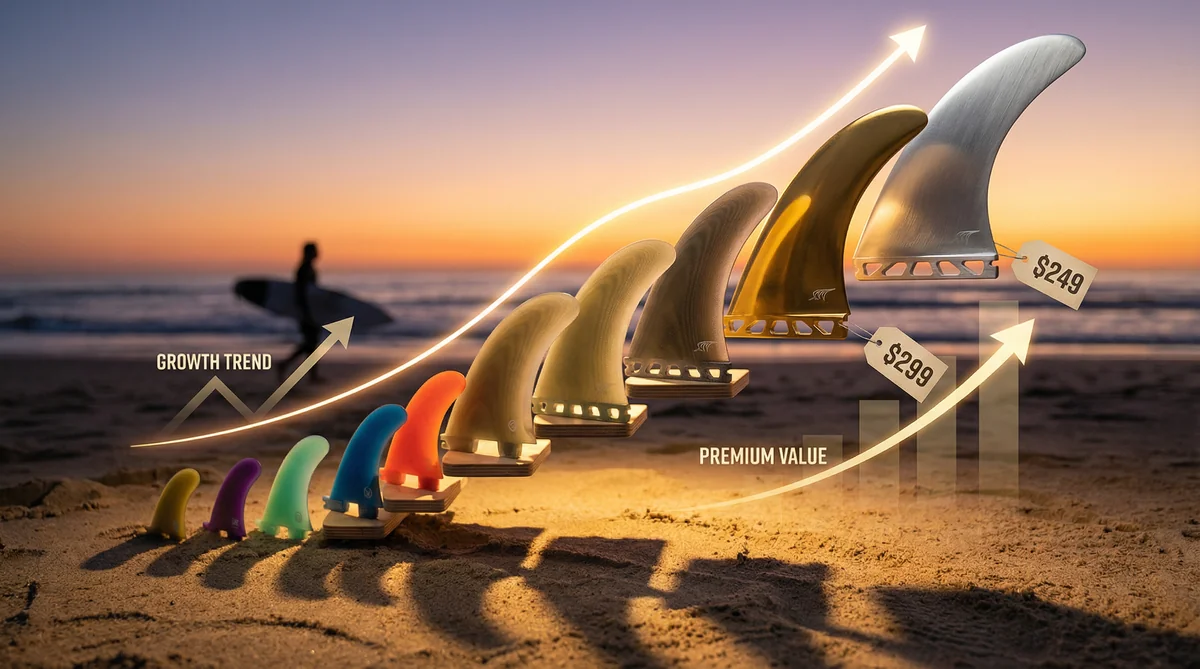
A tall, skinny fin has a high aspect ratio. Think of a sailplane wing. A short, chunky fin has a low aspect ratio. Think of a hang glider.
The same base length can produce very different numbers depending on where the mass sits. Two fins with identical bases and similar depths can still have different aspect ratios if one packs more area into the middle and the other keeps the outline lean. Area matters. So does the silhouette.
Why should you care? Because high-aspect fins and low-aspect fins behave in physics-opposite ways. One holds. The other releases. One stores energy through long turns. The other sheds it for speed in the flats. Mixing them up is how you end up blaming your board for a session where the problem was three square inches of fin shape.
High Aspect Ratio: Tall, Narrow, Holds Like a Vice
Picture an upright, pin-tipped thruster template. Long vertical edge, lean silhouette, not much width. That's a high-aspect fin.
In the water, it feels locked in. You set a rail on a clean bottom turn, the fin bites into the face, and the board tracks an arc with zero chatter. It's that quiet confidence you want when you're committed to a line. The FCS II Performer, the FCS II Reactor, and most of the Futures V-flex series skew tall and pinned for exactly this reason.
The tradeoff? Releasing the tail takes effort. High-aspect fins resist breaking free. You'll pump a section and feel the drive build, but throwing a snap off the lip requires a committed hip drop. The fin doesn't want to let the tail drift. It wants to hold.
That's a feature in overhead surf. In waist-high mush, it's dead weight.
Low Aspect Ratio: Short, Wide, Skates Like Butter
Now picture a Machado keel or an MF Twin. Big, squat, wing-shaped. Short vertical, lots of area pushed out wide. That's low aspect.
These fins carry their drive in the base. You push on the tail and the fin grips through the bottom half of the turn, then releases cleanly as you come off the top. The feel is skatey, loose, fast in the flats. You pump less and glide more because there's less vertical surface fighting the water.
Asher Pacey's twin-fin throw-downs at Lennox? Low aspect. The retro keels Rob Machado glues into a fish for summer pointbreaks? Low aspect. There's a reason '70s templates all skewed this direction. Old shapers weren't stupid. They were solving for speed in waves that don't have much energy to give.
The tradeoff is hold. Drop into a steep head-high face on low-aspect fins and you'll feel the tail want to slide out. Not always a bad thing. But it's a conversation, not a handshake. The board asks if you really mean it every time you commit.
Why Two Similar Fins Can Feel Totally Different
Here's the part most spec sheets don't explain. Two fins can measure close on base length and depth and still behave opposite because of where the aspect ratio falls.
The FCS II Accelerator has a medium-large outline with a fairly balanced aspect ratio. The FCS II Reactor, roughly the same size, leans taller and narrower. Same box. Same compatibility. Different universe underwater. One surfer rides both and tells you the Reactor "turns tighter." What they're feeling is the higher aspect locking the rail sooner in the arc.
This is also why reading a fin spec sheet without understanding aspect ratio is cargo-culting. Base length alone tells you nothing. Depth alone tells you nothing. The relationship between them is the whole story.
How to Pick Based on Aspect Ratio
Forget specific models for a second. Pick the shape that matches your conditions and how you want to surf.
Go High Aspect When:
- Your home break is shoulder-high or bigger
- You surf points, reefs, or any wave with a real face
- You want drive through long, drawn-out arcs
- You're heavier (over 180 lbs) and need the hold to not blow out turns
- You prioritize predictability over playfulness
Go Low Aspect When:
- You surf small, mushy, or fat waves most of the time
- You want a looser, skatier feel
- You ride twins, quads, or anything retro-inspired
- You're under 160 lbs and have trouble generating speed
- You'd rather shred the inside bowl than draw lines on the shoulder
Most surfers live somewhere in the middle. That's why balanced templates like the FCS II Performer and the Futures AM2 exist. They split the difference and let you cover 80% of what you surf on one set.
What Pros Actually Ride
Look at the WCT circuit and you'll see the aspect ratio argument settled in real time.
John John rides tall, pin-tipped templates for Pipeline and Teahupoo because holding the line in a heaving barrel is non-negotiable. Filipe's air game runs on a slightly lower-aspect setup that lets him release for rotations. Italo's sabotage-the-tail airs wouldn't work on high-aspect blades. Stephanie Gilmore's drawn-out rail surfing does.
It's not that one category is better. The best surfers in the world match aspect ratio to what they want to do on the wave. Most amateurs never think about it, then wonder why their board feels stuck.
The Verdict
If you've been riding the same stock fins since the board came home and every session feels flat, aspect ratio is probably where you're losing. Swap to something taller and narrower when the waves get serious. Drop to something shorter and wider when you're in summer mush. One quiver shouldn't try to do both.
This is the geometry you don't want to calculate in your head at the shop. Tell our fin recommender what you ride and where you surf and it'll sort the aspect ratio for you. Takes about a minute.
Key Takeaways
- Aspect ratio is height squared divided by area. It tells you how tall a fin is relative to how much water it moves.
- High aspect (tall, narrow) fins hold through long arcs but resist releasing. Best for overhead waves and drawn-out lines.
- Low aspect (short, wide) fins generate speed in weak waves and release loose off the top. Best for small, fat, or retro-style surf.
- Two fins with the same base length and depth can still feel completely different if their aspect ratios diverge.
- Most surfers are better served by two sets that bracket the aspect-ratio range than one set trying to do everything.
Helpful Resources
Ready to Find Your Perfect Fins?
Use our expert fin recommender tool to get personalized suggestions based on your needs.
Try Fin Recommender