You're pumping down the line on a waist-high right, pushing hard through your bottom turn, and something about the fin flex feels dead. Not slow exactly. Just lifeless. Like the fins are made of concrete and the wave is made of syrup.
Next session, same board, different fins. You load up the same bottom turn and this time something pushes back. The fins bend, store energy, and snap you out of the turn with speed you didn't generate yourself.
That's flex. And it matters way more than most surfers think.
What Fin Flex Actually Does
Flex is how much a fin bends under pressure. When you push into a turn, the water pushes against the fin. A flexible fin bends, stores that energy, and releases it as you exit the turn.
Think of it like a diving board. Load it up, spring off.
A stiff fin doesn't bend. It holds its shape, gives you a direct connection to the water, and transfers your input immediately. No delay, no spring, no forgiveness.
Neither is better. They're different tools for different jobs.
Stiff Fins: When You Want Control
Stiff fins excel in powerful surf. When the wave has real energy behind it, you don't need your fins generating speed for you. You need them holding a line.
Set your rail on a head-high wall at your local reef break and stiff fins grip like they're bolted to the face. There's zero wobble, zero chatter, just a locked-in feeling that lets you drive through the bottom turn with full commitment. The board goes exactly where you point it.
This is why CT surfers overwhelmingly ride stiff fins in competition. John John Florence's Futures Techflex fins use carbon in the base and tip for a firm, responsive feel. When you're surfing Pipe or Teahupoo, you want your fins to hold, not flex.
The trade-off? Stiff fins are unforgiving. If you don't generate enough speed through good technique, they won't help you. They reward power surfing and punish lazy feet.
Flexible Fins: When You Want Speed
Flexible fins are the great equalizer. They generate speed even when the wave isn't giving you much to work with.
Drop into a soft, gutless 2-footer and push through a turn. A flexible fin loads up under your weight, bends through the arc, then whips back to its original shape. That snap-back creates a burst of acceleration. It's like getting a free pump out of every turn.
FCS calls this the "whipping effect" in their Neo Carbon line. It's real. You can feel it. The board surges forward out of turns in weak surf where stiff fins would leave you dead in the water.
The downside: flexible fins feel loose and unpredictable in bigger surf. When the wave has power, that same flex becomes a liability. The fin bends when you need it to hold, and your turns lose precision.
The Real Innovation: Tip Flex
Here's where modern fin design gets clever. The best fins aren't uniformly stiff or uniformly flexible. They have graduated flex patterns: stiff at the base, flexible at the tip.
The stiff base keeps the fin planted. It gives you drive and stability through the bottom turn. The flexible tip lets you break the tail loose when you want to redirect off the top or snap through a cutback.
This is what separates a $30 plastic fin from a $150 performance fin. The plastic fin flexes everywhere. It's mushy. A performance fin flexes exactly where the designer intended and stays rigid everywhere else.
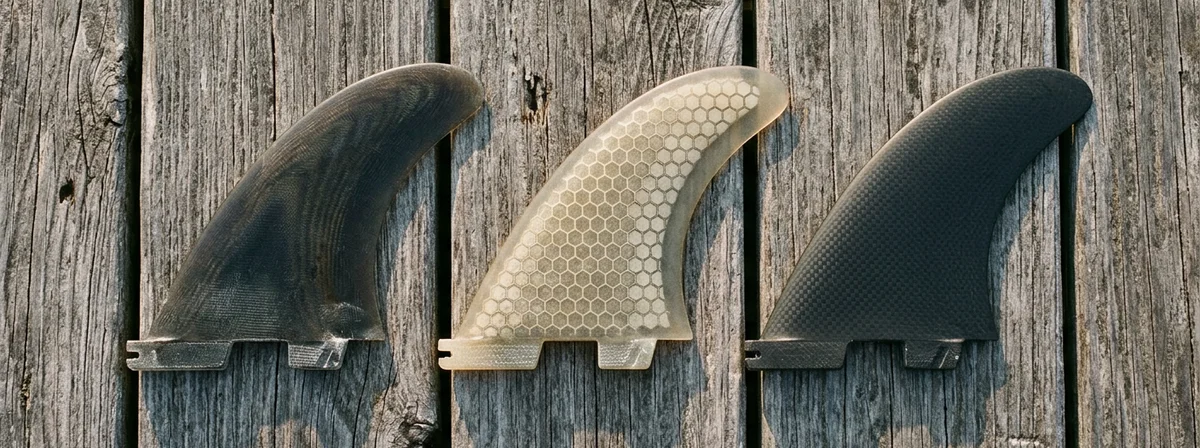
FCS Performance Core fins nail this. The resin transfer molding creates a flex pattern that runs progressively from base to tip. Futures Honeycomb does something similar with a hexagonal foam core that reduces weight while keeping the base stiff and letting the tip breathe.
Material Matters: How Construction Changes Flex
Same fin template, different materials, completely different ride. Here's the breakdown.
Plastic/Composite
The fins that came with your board. They flex too much everywhere and the flex pattern is random. Cheap, functional, forgettable. If you've never upgraded from stock fins, you're leaving performance on the beach.
Fiberglass
The classic. Solid fiberglass fins are stiff and responsive with minimal flex. They track well, hold in powerful surf, and give you a direct feel. The standard for thruster setups in good waves.
Honeycomb
A fiberglass shell with a lightweight hexagonal core. Less weight than solid fiberglass, slightly more flex. It's the Goldilocks construction: not too stiff, not too soft, works in a wide range of conditions. This is what most intermediate surfers should probably be riding.
Carbon
Carbon fiber strips add targeted stiffness. Base panels prevent the fin from twisting under load. Tip inserts add snap.
The result is a tuned flex pattern that's lighter and more responsive than fiberglass alone. Premium price, premium feel.
Neo Carbon / Techflex
Brand-specific constructions from FCS and Futures that blend carbon reinforcement with engineered flex zones. FCS Neo Carbon is spring-loaded and light, built for generating speed. Futures Techflex uses carbon base and tip with a softer mid-section for all-around performance.
How to Pick the Right Flex for You
Forget the marketing. Here's what actually matters.
Your weight and power. Heavier surfers and powerful surfers need stiffer fins because they generate more force. A 200-pound surfer on flexible fins will over-flex them and lose control. A 140-pound surfer on stiff fins won't be able to load them up enough to get any response. Check the fin sizing guide for weight-to-stiffness recommendations.
Your wave conditions. If you surf mostly small, weak waves, go more flexible. If your home break pumps head-high-plus regularly, go stiffer. If you surf both, buy two sets.
Your skill level. Beginners and intermediates generally benefit from more flex because it's more forgiving and generates speed more easily. Advanced surfers who can generate their own speed usually prefer stiffer fins that respond precisely to their input.
Your board. Wider, flatter boards with less rocker pair well with stiffer fins. Curvy boards with more rocker already have built-in looseness, so stiffer fins can help balance them out. There's no universal formula, but the complete fin guide covers the interaction between board design and fin selection.
Key Takeaways
- Stiff fins hold and control in powerful surf but won't generate speed for you. They reward good technique and punish lazy surfing.
- Flexible fins create speed through snap-back energy, making them ideal for small, weak waves. They lose precision when the surf gets powerful.
- Tip flex is the modern sweet spot: stiff base for drive, flexible tip for release. This is what separates stock fins from performance fins.
- Material determines flex pattern. Plastic flexes randomly. Fiberglass is stiff. Honeycomb is the all-rounder. Carbon adds targeted stiffness where you need it.
- Match flex to your weight, your waves, and your ability. There's no single right answer, but there's definitely a wrong one for your setup.
Not sure whether your current fins match how you actually surf? Throw your details into FinFinder and get a flex recommendation that fits your weight, board, and conditions.
Helpful Resources
Ready to Find Your Perfect Fins?
Use our expert fin recommender tool to get personalized suggestions based on your needs.
Try Fin Recommender