You're standing in a surf shop staring at a wall of fins behind the counter. The sales guy is pushing a $180 carbon set that some CT surfer rides. You've got $200 to spend and two very different sessions ahead of you this week: Tuesday's waist-high mushburger at Tourmaline and Saturday's overhead south swell at Blacks.
One set of fins won't handle both well. But buying two premium sets means spending $300 or more.
You don't need two premium sets. You need two smart sets.
Why Two Sets Changes Everything
Most surfers ride one set of fins in every condition. That's like wearing the same shoes to run a marathon and play basketball. It works, technically. But you're leaving performance on the table every single session.
A small-wave set and a good-wave set covers about 90% of what any coast with mixed conditions throws at you. The trick isn't spending more. It's spending differently.
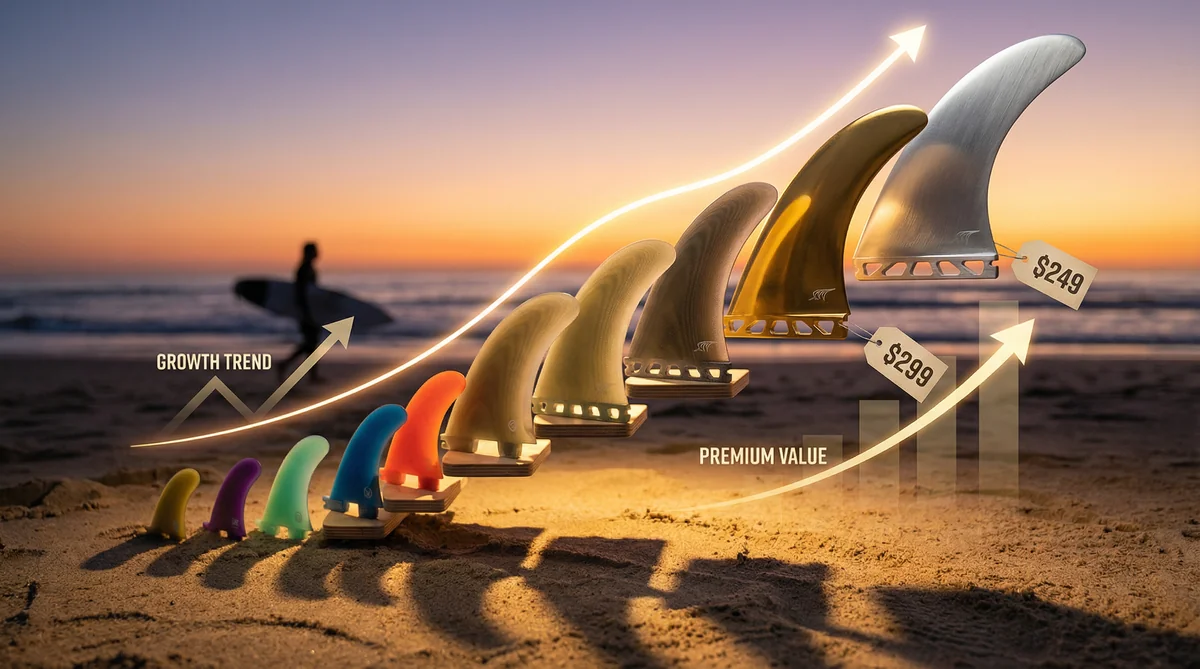
And the performance gap between a $45 Thermotech fin and a $160 carbon fin is way smaller than the gap between having the right template for the conditions and having the wrong one. Template matters more than material. That's the cheat code for building a quiver on a budget.
Set One: Your Small-Wave Fins
Be honest with yourself: how many of your sessions are actually overhead and clean? For most surfers, it's maybe 15%. The rest is waist-to-chest-high and variable. This first set is the one you'll use most.
For small waves, you want fins that generate speed without you having to pump like you're on a StairMaster. That means a shorter base for quick pivot, less overall area for reduced drag, and moderate flex that returns energy through turns.
Futures: F4 or F6 Thermotech (~$45)
The F4 is a small-template fin made in Huntington Beach with Futures' Thermotech construction. It's not fiberglass. But unlike the stiff plastic fins that came with your board, Thermotech has a consistent flex pattern that actually responds to input.
You drop into a shoulder-high right at Cardiff and the board just goes. No pumping, no fighting for speed. The reduced area means less drag, and the flex pattern gives you this little slingshot sensation out of each bottom turn. It's not going to feel like a $150 carbon set. But for forty-five bucks, it feels like stealing.
The F4 works best for surfers under 155 lbs. If you're heavier, grab the F6 (same construction, medium template, same price). Check our fin sizing guide if you're between sizes.
FCS: Performer Neo Glass (~$95)
If you're in the FCS system, the Performer Neo Glass is the move. It's the Honda Civic of the FCS lineup. Reliable, predictable, works in everything from two-foot slop to solid four-foot walls. Nobody's writing poetry about it, but nobody's complaining either.
The Neo Glass construction uses 50% glass and bio-resin. It flexes more than the PC (polycarbonate) version, which translates to more speed generation in weaker waves. You set your rail on a small wall at San Onofre and the fins respond with more projection than a $95 fin has any right to produce.
At $95, this eats most of your budget for Set One. But it's genuinely one of the best value-for-money fins in surfing right now.
Set Two: Your Good-Wave Fins
When the swell picks up and the waves have actual push behind them, you need fins that hold. More area, stiffer flex, deeper profile. This is the set that keeps your board locked in when the wave is doing the work.
Futures: JJF Alpha (~$75)
John John Florence rides these. Not the marketing version of "rides these" where the pro touched them once for a photo shoot. He actually surfs these in competition. The Alpha template sits in the middle of Futures' range: enough hold for overhead surf, enough release for progressive surfing.
The construction is stiffer than Thermotech but lighter than honeycomb. You paddle into a head-high set wave at Trestles, commit to a late drop, set your bottom turn, and the fins grab with this quiet confidence. Like the board knows exactly where it's going and you're just along for the ride.
For $75, you're getting a competition-tested template in a construction that punches way above its price point.
FCS: Carver Neo Glass (~$95)
The Carver template is FCS's answer for powerful, drawn-out turns. Higher sweep than the Performer, more hold off the bottom, and an elongated profile that tracks through carves on open faces.
Where the Performer is your everyday all-rounder, the Carver is what you reach for when the waves have some juice. Overhead days at Swamis, solid south swells at Rincon, anything where you need the fins to grip rather than release. You lean into a bottom turn on a steep face and instead of sliding out, the board locks in and drives you back up with authority.
Same Neo Glass construction, same price point. The difference is all template.
The Math: Two Combos Under $200
Here's how it shakes out.
Futures surfers:
- Set 1: F4 or F6 Thermotech ($45)
- Set 2: JJF Alpha ($75)
- Total: $120
That's $80 under budget. Spend the leftover on a fin key and a six-pack.
FCS surfers:
- Set 1: Performer Neo Glass ($95)
- Set 2: Carver Neo Glass ($95)
- Total: $190
Tighter, but under the wire. And you've got two genuinely different fins covering the full range of conditions you'll see in a typical month.
What About Quads?
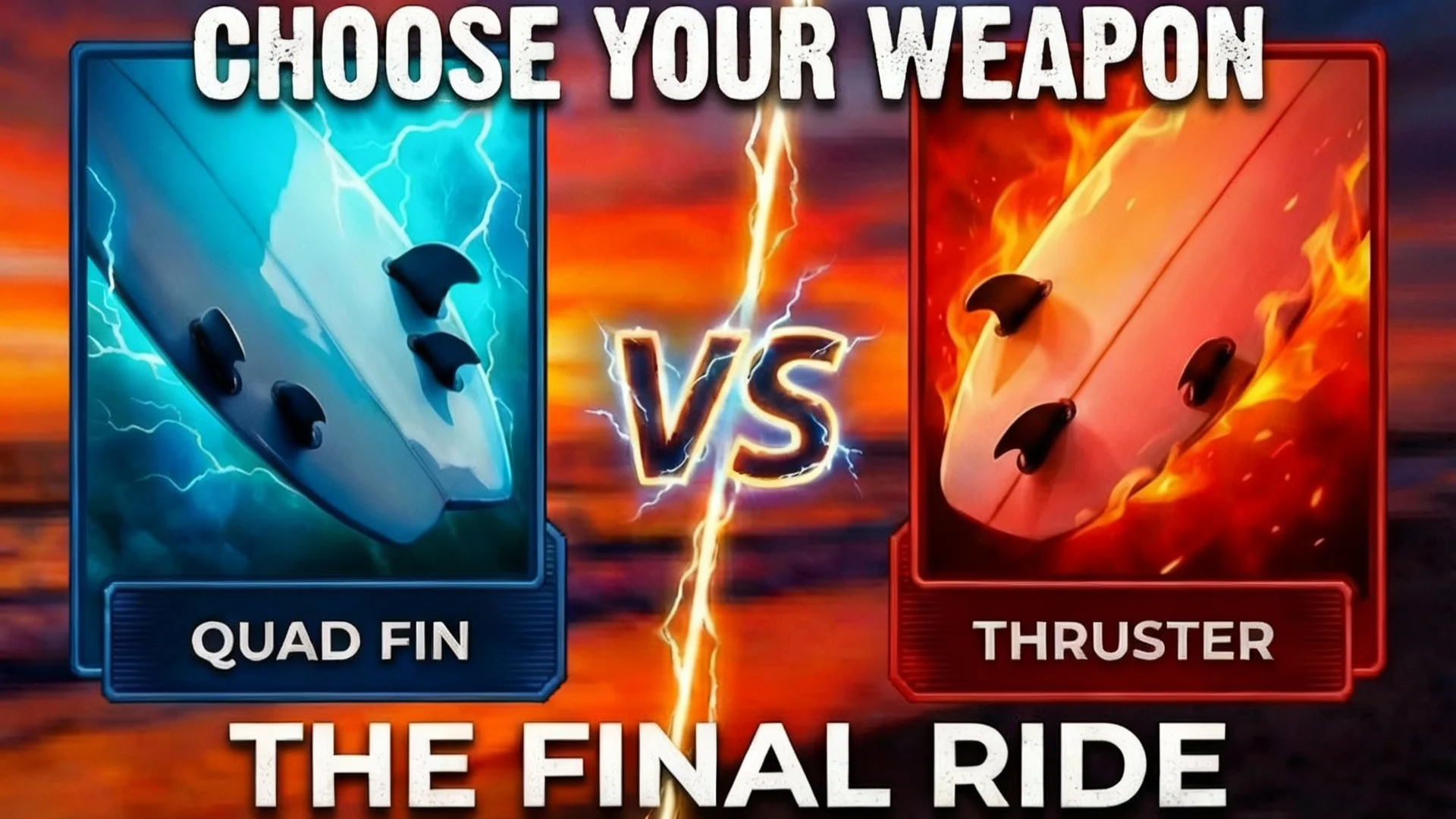
If your board has five-fin boxes, you might be tempted to buy a thruster set and a quad set instead. Quads are monsters in small waves because there's no center fin acting as a brake. The fin setups guide breaks down when quads make sense.
But if you're building your first two-set quiver, stick with thrusters. They're more versatile, and you'll learn way more about how fin changes affect your surfing when you're comparing two thruster templates. Swapping from a Performer to a Carver teaches you what sweep and area do. Swapping from a thruster to a quad changes too many variables at once.
Once you've got the thruster game dialed, then start exploring quads. Walk before you run.
Skip These (Seriously)
Stock plastic fins. The ones that came with your board. They're heavy, stiff in all the wrong places, and they're holding you back more than you think. Even a $45 Thermotech set is a massive upgrade. You'll feel the difference the first wave you catch.
Carbon fins under $100. If you see carbon fins for $60, they're not real carbon. Or the carbon layer is so thin you'd be better off with quality fiberglass. Legit carbon starts around $130 per set. If you can't afford real carbon, you're better off with Thermotech or Neo Glass at their honest price points.
No-name Amazon fins. Some are fine. Most are inconsistent. The flex varies between fins in the same set, the foils aren't always symmetrical, and the tabs might not seat properly in your boxes. For $10-15 more, you get something from a brand that actually tests their fins in the water.
Key Takeaways
- Two sets of fins covers 90% of conditions. A small-wave set and a good-wave set is the minimum viable fin quiver.
- Futures surfers can build a legit two-set quiver for $120 with the F4/F6 Thermotech and JJF Alpha.
- FCS surfers can do it for $190 with the Performer and Carver in Neo Glass.
- Template matters more than material. Having the right shape for the conditions beats having expensive construction in the wrong shape.
- Skip stock plastic fins, fake carbon, and no-name Amazon sets. The cheap upgrade from a real fin brand is the biggest performance jump per dollar in surfing.
If you're not sure which two sets fit your board and your local waves, FinFinder's recommender handles the matching. Sixty seconds, no spec sheets, no squinting at packaging.
Helpful Resources
Ready to Find Your Perfect Fins?
Use our expert fin recommender tool to get personalized suggestions based on your needs.
Try Fin Recommender