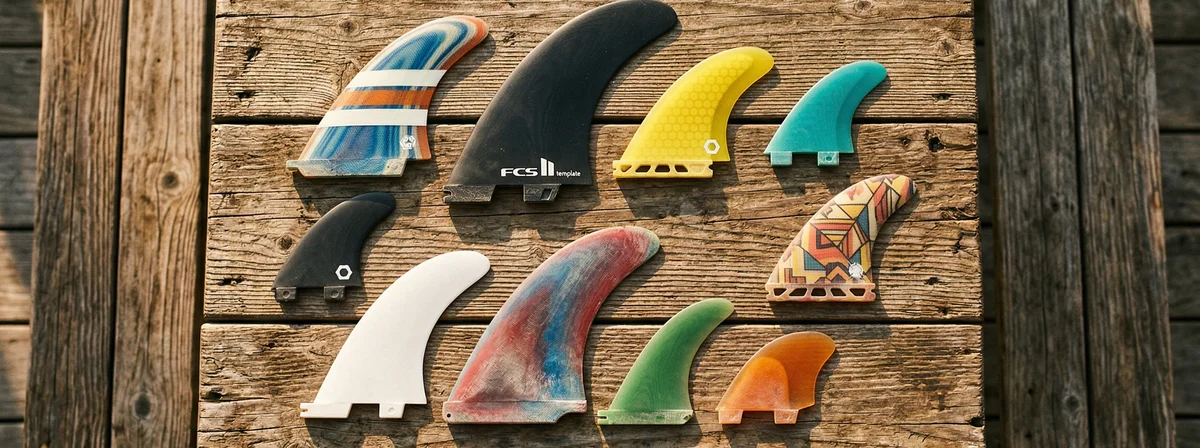
You're standing in the surf shop staring at a wall of fins. You already know your size. Medium. You've settled on Performance Core because the guy behind the counter said fiberglass is overkill for your local beach break. But there are still eight boxes on the shelf that technically fit your board. Performer. Reactor. Accelerator. Carver. Each one shaped a little different. And the guy's already helping someone else.
This is where most surfers grab the Performer and call it a day. That's not wrong. But understanding fin templates is the difference between a board that works and a board that works for you.
The Template Is the Part That Actually Changes How You Surf
Size gets all the attention. Material gets the marketing budget. But the fin template is the outline shape of the fin, and it's the single biggest variable in how a fin performs under your feet. Two medium fins made from the same carbon layup will ride completely differently if one is a Performer and the other is a Reactor.
Template controls three things: how wide the base is (drive), how tall the fin stands (hold), and how far back the tip sweeps (turning radius). Change any one of those and your board becomes a different animal. Change all three and you might as well be on a different board.
Here's what the major templates actually do, stripped of the marketing language.
FCS II Performer: The Honda Civic
Base: 4.37". Depth: 4.55". Sweep: 33.7 degrees. Area: 14.81 square inches (medium).
The Performer sits dead center on every spectrum. Moderate base for decent drive. Moderate sweep for turns that aren't too tight or too drawn out. FCS calls it their "all-round" template, which sounds boring until you realize boring is exactly what most surfers need 80% of the time.
You drop in on a chest-high right at your local and the Performer just works. It doesn't wow you. It doesn't fight you. You pump down the line and there's consistent speed. You bottom turn and the fin holds without feeling sticky. You hit the lip and there's enough release to redirect without the tail sliding out from under you.
The Performer's Inside Foil Technology (concave on the inside face) helps water flow attach cleanly, which gives you that predictable, smooth feel through transitions. It's not exciting. But it's the fin that makes every other fin make sense, because once you know what neutral feels like, you can actually tell what the others are doing differently.
Best for: daily driving, inconsistent conditions, surfers who haven't figured out their template preference yet.
FCS II Reactor: The Pocket Rocket
The Reactor goes low sweep and upright. That means the fin tip doesn't reach as far back, so the board pivots on a shorter arc. Where the Performer draws a smooth, medium-radius turn, the Reactor whips through a tight one.
Think about surfing Huntington on a punchy south swell. The waves are steep, the sections are short, and you've got maybe two seconds to snap off the top before the foam ball catches you. The Reactor is built for exactly that kind of surfing. You set your rail, the fin bites immediately, and the release is quick enough to redirect before you run out of face.
The trade-off is real though. In long, open-face point surf, the Reactor feels twitchy. It wants to turn when you want to trim. Surfers who ride Malibu or Rincon regularly will hate this fin on those walls. It's like putting a sports exhaust on a car you drive on the highway. Fast doesn't mean better when the road is straight.
Best for: steep beach breaks, hollow waves, surfers who live and die in the pocket.
FCS II H4: The Surgical Instrument
The H4 is weird and that's a compliment. FCS gave the side fins and the center fin completely different templates. The sides have a lower profile with a hatchet-style tip for acceleration and grip. The center fin runs a high-rake elliptical outline that cuts drag when you're going straight.
On paper, that sounds like a design committee got too creative. In the water, it feels like the board has two modes. When you're trimming, the center fin's long rake keeps you locked in and fast, like a car on rails through a sweeping highway turn. When you engage the rail for a hard carve, the side fins take over with that hatchet grip and the board bites into the face with surgical precision.
Jordy Smith rode a version of this template for years. In overhead-plus surf with open walls, the H4 is tough to beat. You set your line off the bottom and the board accelerates through the turn instead of bleeding speed. That feeling of gaining momentum mid-carve is addictive.
But the H4 needs a wave with some juice. In waist-high mush, those different templates don't have enough water pressure to do their thing. The fin set feels dead. Like a Formula 1 car in a parking lot.
Best for: overhead point and reef surf, open-face carving, power surfers who push hard against their fins.
Futures AM (Al Merrick): The Shaper's Pick
Al Merrick didn't just stamp his name on a generic template. The AM series was designed to match the rocker and outline curves of Channel Islands boards, and it shows. The AM1 is the medium, the AM2 slightly smaller, and they share a philosophy: moderate-to-high rake with a clean foil that rewards smooth, linked surfing.
Where the Reactor wants you to snap and redirect, the AM wants you to draw lines. Long bottom turns that connect into open-face carves. Top turns where you push through the lip instead of hacking at it. Filipe Toledo made the switch to a similar Futures template because it supported the kind of rail-to-rail surfing that scores high at Bells and J-Bay, waves where flow matters more than flash.
You feel it immediately at a spot like Trestles. You take off on a solid right, drop in late, and set your rail for a deep bottom turn. The AM holds through the arc with this quiet confidence, like the fin is saying "keep leaning, I've got it." You come off the bottom with speed you didn't pump for. That stored energy from the turn just translates into forward momentum.
The downside? The AM needs a wave to work with. In gutless two-foot slop, the template's higher rake means you're pushing against a fin that wants to draw turns you can't physically complete on a short, weak face. For true small-wave groveling, the Futures F4 template is a smarter pick.
Best for: quality waves chest-high and up, CI boards, surfers who prioritize flow and linked turns over vertical snaps.
The Accelerator and Carver: Worth Knowing
Two more FCS templates that round out the lineup. The Accelerator is an oversized Performer with a fuller tip and more sweep. More area means more hold, which makes it the pick for bigger surfers or anyone who feels like medium Performers wash out on hard turns. If you weigh over 185 pounds and the Performer feels loose, try the Accelerator before sizing up. More template area is often a better fix than jumping to a Large fin.
The Carver goes the other direction from the Reactor. Maximum sweep, elongated template, designed to draw out turns on open walls. Think of it as the anti-Reactor. The Carver wants long, arcing cutbacks and committed bottom turns at spots like Sunset Beach. One reviewer put it simply: these fins "hold no matter how hard you push them." That's the vibe.
So Which Template Do You Actually Need?
This is the part where most guides say "it depends on your style." True, but useless. Here's a more direct framework.
If you surf mostly beach breaks with short, punchy waves: Reactor. If you surf a mix of everything and don't want to think about it: Performer. If you surf quality point breaks and reefs where turns connect: AM or Carver. If you surf overhead-plus and want maximum control at speed: H4.
And if you're not sure? Start with the Performer. Surf it for a month. Then try one of the others. You'll feel the difference in three waves. That's not an exaggeration. Template swaps are the most noticeable change you can make to a board without changing the board itself.
Key Takeaways
- Fin template (the outline shape) changes your surfing more than material or construction. It controls drive, hold, and turning radius.
- The FCS Performer is the neutral baseline. Every surfer should ride it once so they understand what "center" feels like.
- The Reactor pivots fast for steep, hollow waves. The Carver draws long arcs for open faces. They're opposite ends of the same spectrum.
- The H4 uses different templates for side and center fins, which gives it a two-mode feel that excels in overhead-plus power surf.
- The Futures AM is shaped to complement CI board designs and rewards smooth, rail-to-rail surfing in quality waves.
Still not sure which template matches how you surf? Plug your board, your weight, and your usual conditions into the FinFinder recommender and it'll narrow it down in about a minute. Beats staring at a wall of boxes.
Helpful Resources
Ready to Find Your Perfect Fins?
Use our expert fin recommender tool to get personalized suggestions based on your needs.
Try Fin Recommender