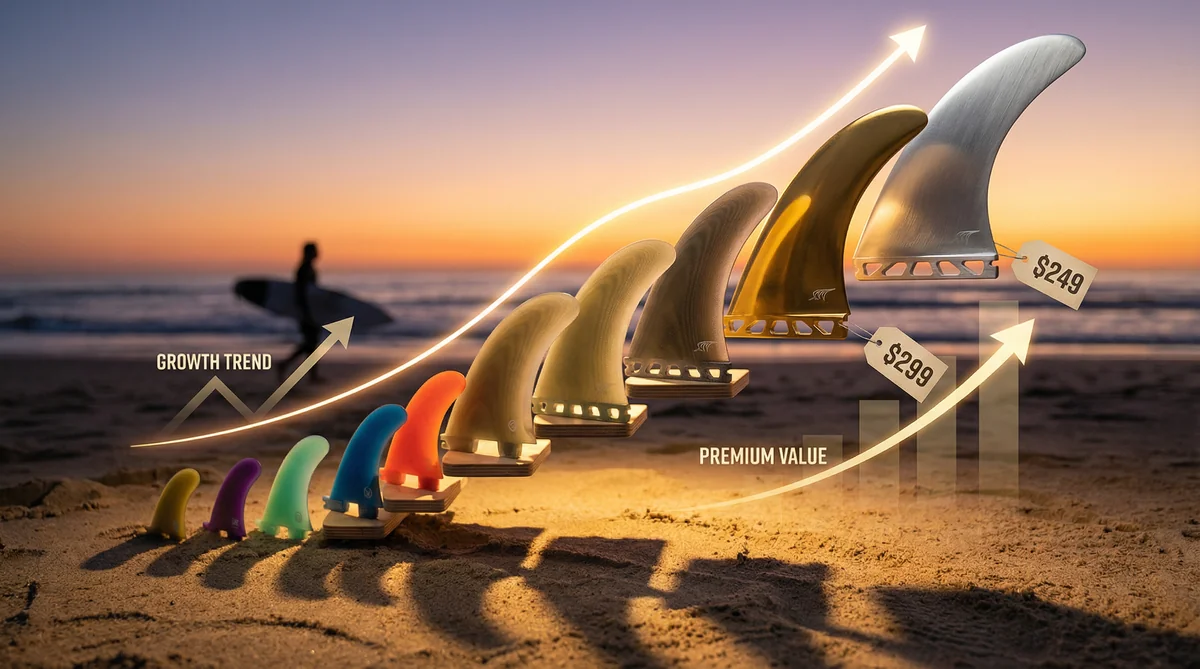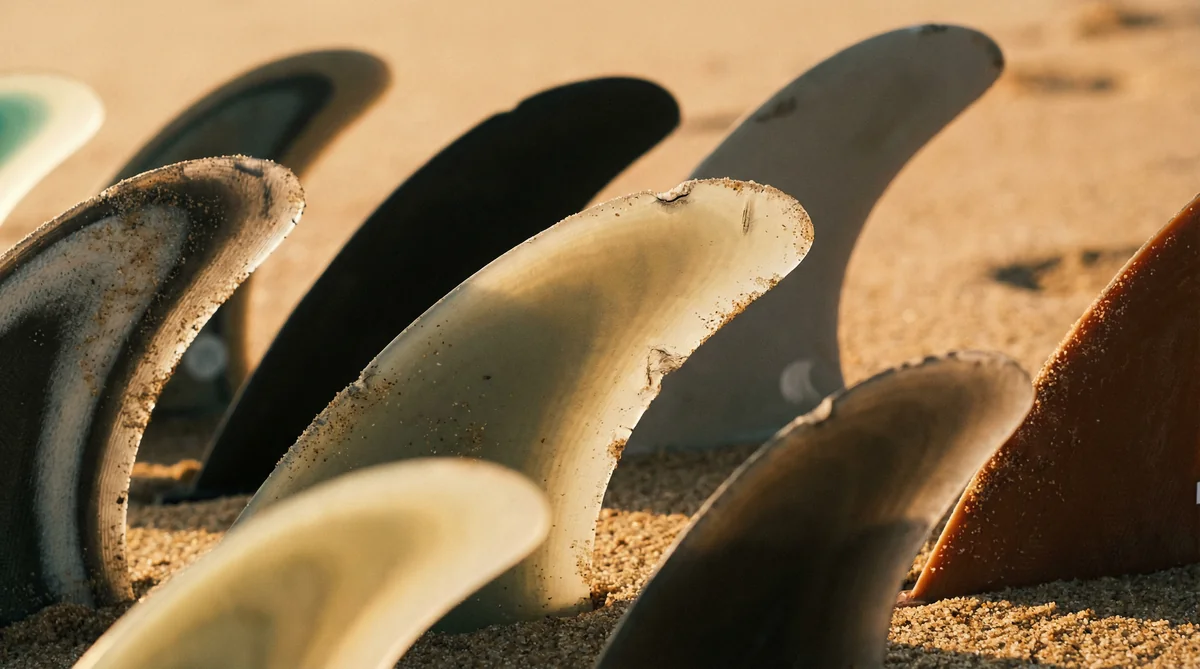
Walk into any surf shop on the West Coast that takes single fins seriously and look at the fin wall. The Greenough 4A is going to be there. Probably in three sizes. Probably more than one brand's version of it.
That's a fin a kneeboarder designed in the 1960s. It's still outselling templates that are younger than your shaper. That's not nostalgia. That's the design being right the first time.
Who Greenough Was, and Why a Kneeboarder Changed Everything
George Greenough was the strange genius nobody asked for and surfing didn't deserve. He rode on his knees. He filmed inside the barrel before anyone else thought to bring a camera in there. He built his own boards, called them Velo-Spoons, and used them to slot into pockets that stand-up surfers in 1965 weren't even looking at.
He was also obsessed with tuna. Specifically, the caudal fins of bluefin tuna. He noticed they were tall, narrow at the tip, full at the base, and built for two things at once: holding a tight line and snapping off it without losing speed. He copied the geometry, scaled it down, and put it on the back of a surfboard.
That's the whole origin story. A guy watched a fish, traced the shape, and accidentally invented the modern high-performance fin.
The Template: What the 4A Actually Is
The 4A is a high-aspect-ratio single fin. That means it's tall relative to how wide it is at the base. Most pre-Greenough single fins were short, fat, and built like rudders for boats. They held you straight. They didn't pivot. They sure didn't release off the top of a wave.
Pull a 4A out of the box and you're looking at three things working together. A full, planted base that locks into the bottom of every turn. A long sweeping rake that lets the board carry through the arc instead of stalling. A tapered, flexible tip that snaps clean when you go vertical.
Press the tip with your thumb. There's give. Not floppy give. Loaded-spring give, the kind of flex that returns energy at the end of a turn. That's the part most modern templates copy and most riders can't tell you why they like it.
Why It Started a Revolution
The shortboard revolution didn't happen because boards got shorter. It happened because the new fins let surfers ride a tighter line in the pocket without losing the wave. Greenough's film The Innermost Limits of Pure Fun in 1970 did the rest. Bob McTavish saw the footage. Nat Young saw it. Every shaper in Australia and California saw what was possible inside the curl when the fin would actually let you turn.
Within five years, 9'6 logs were getting cut down to 7'0s, then 6'4s. Same surfers. Different fins. The board length followed the fin, not the other way around.
If you ever wonder why a midlength feels modern and a 1965 noserider feels like driving a school bus, the answer is mostly under the back foot.
How a 4A Feels Underfoot
Drop in on a chest-high right with a 9.0 4A in a 9'4 log and the board doesn't fight the wave. It carves. You set a rail at the bottom and the fin grabs without that mushy lag traditional pivot fins give you. You come up the face and the tip releases the second you commit. The board slides for half a heartbeat, then bites again on the way back down.
Switch to an 8.0 in a 7'2 midlength and the whole personality changes. More drive. Faster from the take-off. Tighter arcs in the pocket. The same template, scaled, behaving like a different animal.
That's the trick of the 4A. It scales. A 6.5" version on a fish behaves nothing like a 10.5" on a glider, but both feel familiar because the geometry is honest about what it's doing.
The Sizes and What They're For
True Ames cuts the 4A from 6.5" all the way up to 10.5". The size you want comes down to two things: board length and how loose you want the tail.
6.5" to 7.5"
For fishes, eggs, mini-Simmons builds, and 2+1 setups where the center fin needs to play with side bites. Skatey. Loose. Will let the tail break in waist-high mush.
8.0" to 8.5"
The midlength sweet spot. Throw it in a 7'2 to 8'0 single-fin egg and the board will trim, pivot, and carry through cutbacks with no drama. Most underrated size in the catalog.
9.0" to 9.5"
Performance log territory. Long enough to hold a long noseride, flexible enough to drive off the bottom and not feel locked. If you've got one log fin, make it this.
10.0" to 10.5"
Heavy noseriders, traditional logs, gliders. More hold, more stability, less release. You're not throwing buckets on a 10.5. You're planting the nose and trimming.
Where the 4A Falls Short
Real talk. The 4A is not the right fin for everything. If you ride a heavy traditional noserider and you only ever want to walk the nose, a wider-base pivot fin like a Takayama or a Hatchet is going to lock you in better. You won't miss the snap because you're not trying to snap.
If you surf a high-performance shortboard, the 4A doesn't apply. You're in thruster or quad land. Different conversation. Read the fin setups breakdown if you want to map that out.
And if you ride waves over double overhead on a single fin gun, the 4A's flexible tip can feel a little nervous. Stiffer, more raked templates exist for a reason at Mavericks and Sunset.
How It Compares to Newer Templates
Every "performance" single fin made in the last 40 years has borrowed something from the 4A. The flex tip. The high aspect ratio. The full base into a sweeping rake.
Some templates went further. The Greenough 4-C is essentially a 4A with the tip cut shorter for more drive. The Skip Frye flex fins push the tail flex even further. The True Ames Stage 6 brings the rake down for tighter pocket surfing on midlengths.
Point is, when you compare a 4A against any of those, you're comparing variations on the same idea. The original is still the standard against which the others are measured. That doesn't happen by accident.
Why It's Still On Every Shop Wall
The 4A has been in production for over 40 years. It's outlasted three fin-box systems, two shortboard movements, and the entire SUP era. Shapers still spec it. Pros still ride it on their personal logs. Andy Nieblas, the CJ Nelson camp, the Joel Tudor crowd. Look at their fins. The 4A keeps showing up.
Versatility is part of it. So is the fact that it just works. But there's also something about a design that nailed it on the first try. You can refine a 4A. You can't really replace it.
Key Takeaways
- George Greenough designed the 4A in the 1960s by copying the caudal fin shape of bluefin tuna. Tall, full base, flexible tip, high aspect ratio.
- The 4A is the most popular single fin template ever made. It's been in production at True Ames for over 40 years and still outsells most modern designs.
- Sizing matters: 6.5" to 7.5" for fishes and 2+1s, 8.0" to 8.5" for midlengths, 9.0" to 9.5" for performance logs, 10.0"+ for heavy noseriders.
- It's not the right fin for traditional noseriding (too loose) or high-performance shortboards (wrong setup entirely).
- Modern performance single fin templates are mostly variations on the 4A. The original is still the benchmark.
If you're staring at the fin wall trying to pick a single fin for a board you just bought and the names are blurring together, throw your specs into our fin recommender and let it sort the size out. For a deeper background on how fin templates affect different boards, the longboard fins guide covers what's worth knowing without the marketing fog.
Helpful Resources
Ready to Find Your Perfect Fins?
Use our expert fin recommender tool to get personalized suggestions based on your needs.
Try Fin Recommender