You're standing in a shaping bay, watching a guy run his hand along a blank that doesn't look like much yet. No glass, no fins, no paint. Just foam and potential.
You ask him when he thinks about the fins. He looks at you like you just asked when he thinks about breathing.
"Before the outline," he says. "Sometimes before anything."
That answer surprises most surfers. We treat fins like an afterthought, something you grab off the rack, click into the boxes, and forget about.
But the people who actually shape surfboards? They're thinking about fins before the first cut.
The Fin Comes First (For Some Shapers, Literally)
Tom Wegener, the legendary Australian shaper behind some of the most radical wooden boards on the planet, starts every design with the fin and fin placement. The rest of the board gets built around that decision. Not the other way around.
Think about what that means. The rocker, the concaves, the rail shape, the outline. All of it flows from a choice about what's happening at the tail.
Most surfers pick their board first and then figure out fins. Wegener says that's backwards.
He's not alone. Matt Biolos, the guy behind Lost Surfboards, has spent decades obsessing over how fin templates interact with his bottom contours. His Mayhem 3.0 template features more base length, a narrower tip, and added rake compared to earlier designs.
When Biolos describes it, he doesn't talk about numbers. He talks about feel.
"It's got the drive, it can turn, and it's thin enough to have a nice soft flex."
Why Shapers Care About Cluster Spacing More Than You Do
Here's something you've probably never thought about: the distance between your fins matters as much as the fins themselves.
Shapers call it the fin cluster, the spacing and positioning of all your fins relative to the tail. Tighter clusters create shorter turning arcs. Wider clusters stretch the arc out into sweeping, drawn-out turns.
A rear fin sitting 6 to 7 inches from the tail edge and side fins at 11 to 12 inches is a common starting point. But every shaper tweaks those numbers based on the board's personality.
A compacted cluster on a shortboard makes sense. You want to whip it around in the pocket at Trestles. But spread that cluster out on a step-up for Sunset Beach, and suddenly you've got the hold and drive to draw big lines on an open face.
Same board concept, totally different fin placement. The shaper decided that before you ever saw the board in a shop.
If you want to understand how different fin configurations change your surfing, start paying attention to where the fins sit, not just what brand they are.
Biolos: Build the Fin Around the Board's Tail
Biolos designs boards for everyone from WSL pros to weekend warriors in Huntington Beach. His approach to fins is specific and opinionated: the tail shape dictates the fin setup, not the other way around.
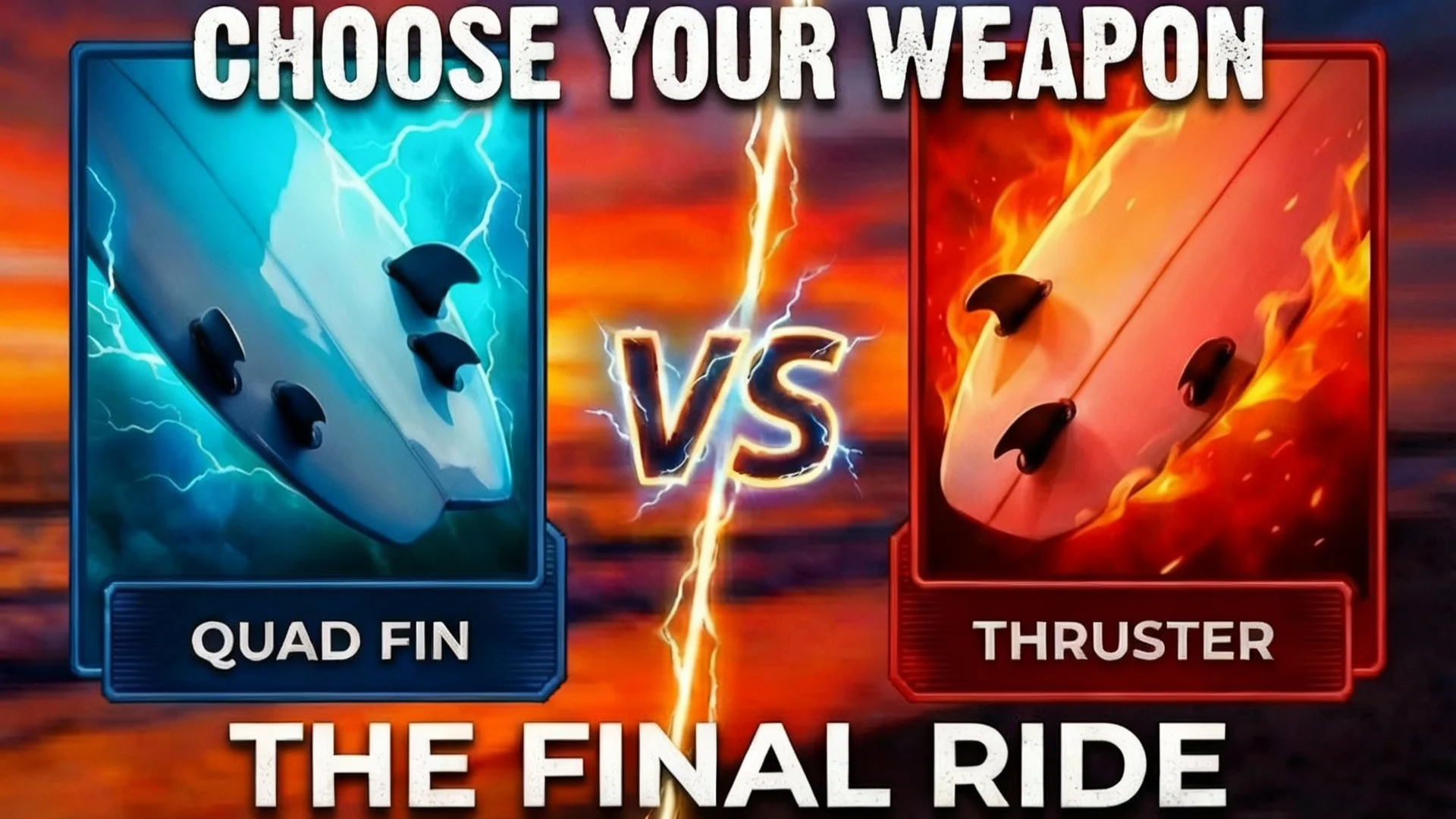
Wide tails with relaxed rocker and vee in the bottom? Quads. Almost always. The extra side fins generate speed without a center fin creating drag.
You drop into a waist-high wave on a Lost Puddle Jumper and the board just goes. No pumping, no fighting. You point it down the line and it shoots like someone kicked you from behind.
Narrower tails with more rocker? Thrusters. The center fin gives you that pivot point for vertical surfing.
Biolos pulls the tail in with his signature hip, a subtle bump in the outline that narrows the tail and gives the water a clean release point. The fins work with that hip. Rip the hip out, and his fin template wouldn't feel the same.
His FCS II Shaper Series fin is designed specifically to complement Lost's bottom contours. That's not marketing. That's a shaper who understands that the board and the fin are one system, not two separate purchases.
Tomo: Hydrodynamics Over Tradition
Daniel Thomson, better known as Tomo, approaches fin design from a completely different angle. Where Biolos starts from the tail and works outward, Tomo starts from physics and works inward.
Growing up around George Greenough, the godfather of modern fin design, Tomo learned to think about water flow before aesthetics. His boards for Firewire feature parallel outlines and sophisticated multi-concave bottoms that reduce drag and increase planing speed. The fins on a Tomo board aren't fighting the water. They're redirecting it.
Ride a Tomo twin fin in clean, head-high surf and it feels like the drag coefficient got turned off. You're gliding where you'd normally be pumping. The tail stays loose but controlled, like the board is saying "I know where we're going, just lean into it."
That feeling doesn't happen by accident. Thomson designed the fin cant, toe-in, and placement to work with those specific concaves.
Understanding concepts like fin cant and toe-in helps you appreciate why these design choices matter so much.
Merrick: Refine Everything, Change Nothing Rashly
Al Merrick took a different path. Where Tomo innovates radically and Biolos experiments constantly, Merrick refined.
The Channel Islands approach to fins has always been evolutionary. Small tweaks. Tested obsessively. Validated by the best surfers on earth.
Merrick's double-concave tri-plane hull design became the template that most modern thrusters are built on. When Simon Anderson invented the thruster in 1981, it was Merrick who spent years fine-tuning how three fins work together.
The cant angles. The toe-in. The foil thickness. Every variable got dialed until Kelly Slater was winning titles on Channel Islands boards with CI fin templates.
That's not flashy. Nobody writes breathless articles about incremental refinement. But the result is a fin-and-board system so reliable that it became the default for professional surfing for over two decades.
You set your rail on a bottom turn riding a CI board and the fins grab with quiet authority. Not aggressive, not dramatic. Just confident. Like a handshake from someone who's done this a thousand times.
What This Means for Your Next Fin Purchase
Most surfers buy fins in isolation. They read a spec sheet, pick a size based on their weight, and hope for the best. Shapers don't think that way. They think about fins as part of a system: tail shape, rocker, concaves, rail volume, and fin template all working together.
You don't need to become a shaper to benefit from this thinking. But you should at least ask the question: what was this board designed to do, and do my fins support that?
A few practical moves that help:
- Check if your board's shaper has a signature fin template. Biolos, Tomo, Hayden Cox, and others all have Shaper Series fins designed specifically for their boards.
- Pay attention to your fin cluster. If your board feels stiff in turns, your fins might be too spread out. If it feels squirrelly, they might be too tight. Use our fin sizing guide to get the baseline right.
- Match your fin stiffness to your board's flex pattern. A stiff fin in a flexy board creates a weird disconnect. A flexible fin in a stiff board feels dead.
- Talk to your shaper. Most of them love talking about fins. It's the one topic that gets them fired up faster than rocker templates.
Key Takeaways
- Top shapers like Wegener, Biolos, and Thomson think about fins before or alongside the board's outline, not after.
- Fin cluster spacing (how far apart your fins sit) affects your turning radius as much as the fin template itself.
- Biolos matches fin templates to tail shapes: quads for wide tails, thrusters for narrow tails with more rocker.
- Tomo designs fins and board bottoms as a unified hydrodynamic system, not separate components.
- Buying your shaper's signature fin template is the closest thing to a shortcut in surfing.
If you're riding a board and the fins feel like they're working against it, they probably are. Plug your board and wave details into FinFinder's recommender and it'll point you toward fin templates that match your setup. Takes about a minute.
Helpful Resources
Ready to Find Your Perfect Fins?
Use our expert fin recommender tool to get personalized suggestions based on your needs.
Try Fin Recommender