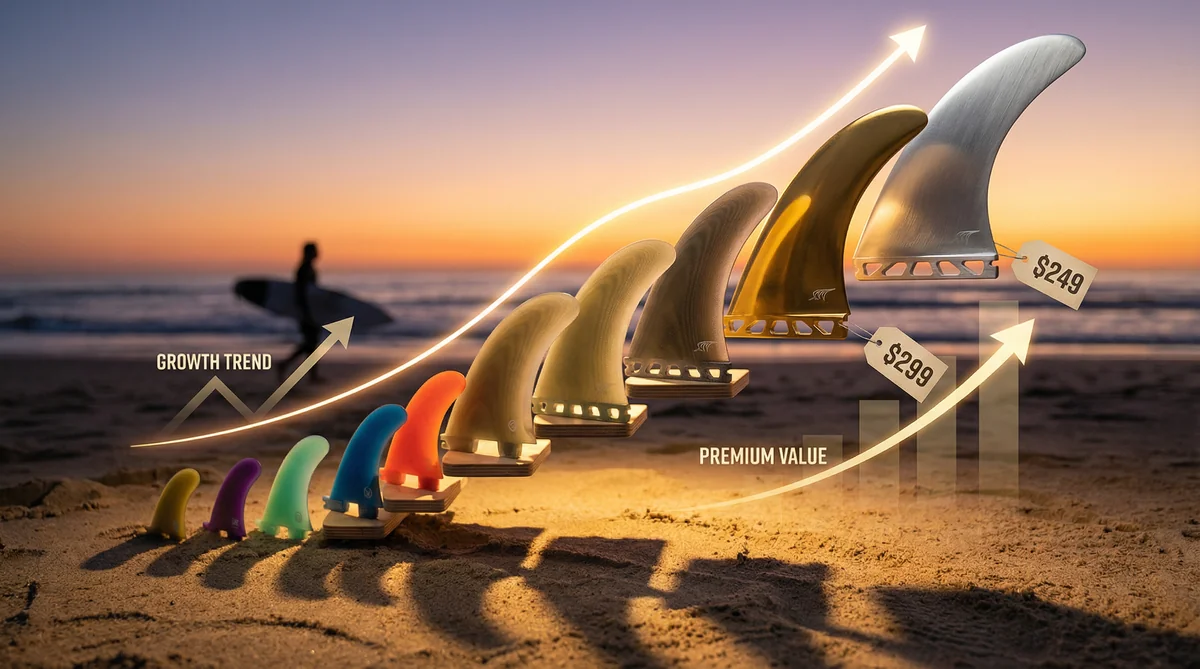
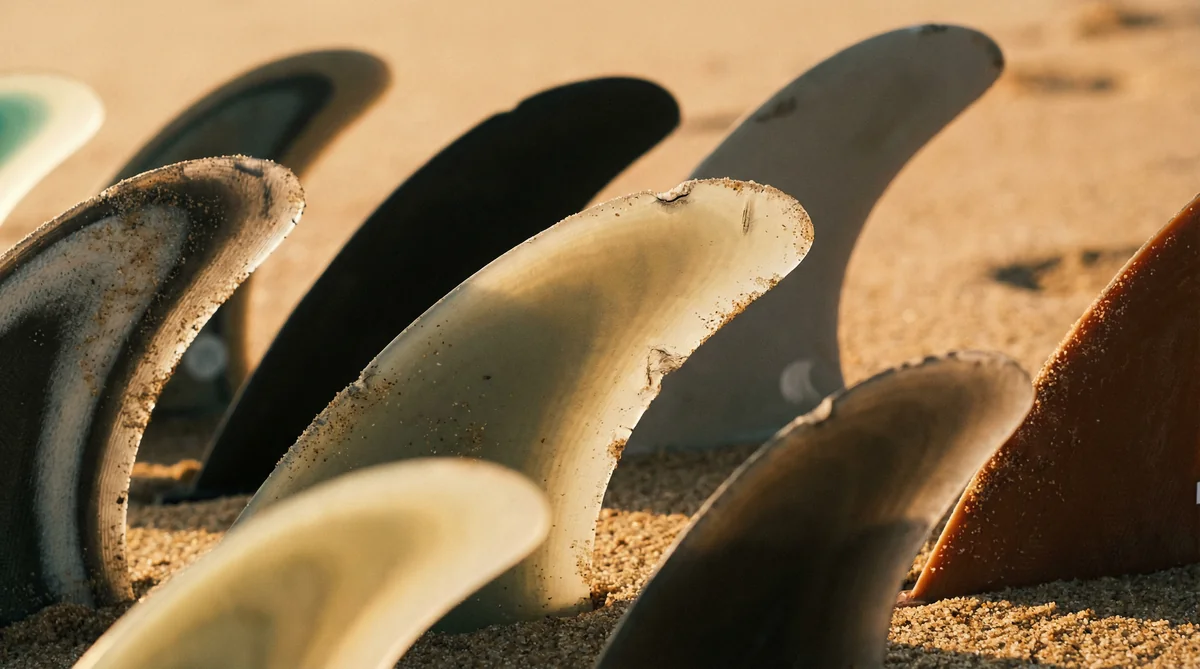
Flip your side fins over and look at the face that points at the stringer. The flat one. Except on half the fins sold today, it isn't flat at all. Run your thumb across it and you'll feel a slight scoop, a dish carved into the inside, like someone pressed a spoon into the foam.
That scoop has a name. It's called inside foil, and it quietly decides whether your board feels glued to the face or skates loose through a turn. Most surfers never notice it. Then they wonder why two thruster sets that look identical from the side feel like completely different boards.
What Inside Foil Actually Means
Every fin has two faces. The outside (the one pointing away from the board) is curved, or convex. The inside is the one that matters here.
On a center fin, both faces are usually symmetrical, called a 50/50 foil. Water flows evenly on both sides, which keeps the board tracking straight. Side fins are different. Because they sit at an angle and only ever work one side of the wave at a time, shapers foil them asymmetrically to generate lift, the same way an airplane wing does. If you want the deeper version of that, we broke it down in our piece on how fins actually create lift.
The inside face comes in three flavors. Flat, where the inner face is genuinely flat. 80/20, a gentle curve that blends side and center fin behavior. And concave inside foil, where that scoop gets carved in deliberately to pull more water across the surface.
Flat Foil: The Honda of Side Fins
Flat foil is the default. It's what comes in most stock fin sets, and there's a reason it refuses to die.
A flat inside face gives you an even mix of drive, pivot, and hold. Nothing spikes, nothing drops out. You set your rail on a bottom turn and the fin grips with this steady, no-drama confidence whether the wave is waist-high or double overhead. Predictable is underrated.
The flat face also handles speed better than people expect. When the wave gets fast and you're projecting across a long wall, a flat foil holds its line where a scooped one starts to drag. That's the trade nobody mentions on the packaging.
Concave Inside Foil: Speed You Didn't Earn
Now the fun one. Carve a concave into the inside face and you've built a tiny low-pressure pocket that sucks water onto the fin. More water attached means more lift, and more lift in slow conditions means free speed.
Drop into a gutless two-foot dribbler on concave-foiled fins and the board does something almost rude. It generates speed out of nothing. You pump once and you're already three sections down the line, gliding past the spot where your flat fins would've bogged into the flats. In small, mushy beachbreak, that scoop is borderline cheating.
Here's the catch, and it's a big one. That extra lift comes with extra drag as speed climbs. Inside foils make more lift at slow speeds, but as the wave gets faster they generate more drag than a flat foil and start to lose their bite. A concave set that felt magic at chest-high Cardiff can wash out and feel skatey when you take it to overhead Blacks.
So the honest verdict: concave inside foil is the better small-wave weapon, and the worse one when the ocean has actual power. Pick your conditions, not the marketing.
The Vector Foil and Why Everyone Copied It
You've probably seen the word "Vector" stamped on a Futures box. The Vector Foil is Futures' name for a concave running down the inside face of the front fins, from base to tip, paired with a slight twist in the upper section. FCS does its own version. The marketing language calls these "speed generating" fins, and for once the marketing isn't lying.
Take the Futures Alpha Vector. The concave plus the upper twist gives it this grippy, projecty sensation that feels alive under your back foot in small surf, then holds enough connection to work when it gets bigger. It's a genuinely clever bit of geometry. It's also why so many groveler-friendly fin sets now use some flavor of inside foil instead of going flat.
None of this is new, by the way. Surfers were hand-foiling concaves into glass-on fins decades before anyone trademarked the idea. Tom Curren was riding wild foiled fins on his fish at Backdoor while the rest of the world was still arguing about thrusters. The factories just caught up and put a name on it.
So Which One Goes in Your Board?
Real talk: most surfers should own both and swap with the forecast. But if you're committing to one, match it to where you actually surf.
Go concave inside foil if:
You spend most of your year in waist-to-head-high surf, you ride a groveler or a fish, or your home break is a soft beachbreak that needs help with speed. The scoop earns its keep when the wave won't give you anything.
Stick with flat foil if:
You surf punchy, powerful waves, you're often in overhead conditions, or you just want one set that behaves the same everywhere. A flat side fin won't dazzle you in the mush, but it'll never betray you when the wave stands up and tries to throw you over the falls.
If you're building a quiver around this, it's worth thinking about foil alongside the rest of your setup. We covered how the pieces fit together in the fin setups guide, and the broader theory lives in all about fins.
Still not sure whether your home break wants a scoop or a flat face? Tell the FinFinder recommender what you ride and where you surf, and it'll point you at a foil that suits your conditions instead of someone else's.
How to Tell What Foil You're Already Riding
You don't need a workshop to figure this out. Pull a side fin out of the box and hold it inner-face up under a light.
If that face looks dead flat and reflects light evenly, you're on a flat foil. If you see a soft shadow pooling in the middle of the face, like light catching the inside of a shallow bowl, that's a concave inside foil. Tilt it and the highlight will slide around the dish. A faint single curve with no real scoop usually means an 80/20.
Check the box your fins came in too. Words like "speed generating," "Vector," or "inside foil" all point to a concave. "Neutral," "all-around," or no foil callout at all usually means flat. Knowing which one you've got explains a lot about why your board feels the way it does, and it's the first thing worth checking before you blame your fin size for a board that won't hold.
Key Takeaways
- The "flat" inside face of your side fins often isn't flat. Many modern fins carve a concave into it to generate lift.
- Flat foil gives steady drive, pivot, and hold across all conditions. It's the reliable all-rounder.
- Concave inside foil creates free speed in small, slow waves but adds drag and loses bite once the surf gets fast and powerful.
- Vector-style foils (Futures Vector, FCS equivalents) are concave inside foils marketed as speed generators. The label is accurate.
- Match foil to your conditions: scoop for mush, flat for power. If you can only own one set, flat is the safer default.
Helpful Resources
Ready to Find Your Perfect Fins?
Use our expert fin recommender tool to get personalized suggestions based on your needs.
Try Fin Recommender