Tokyo, 2021. Olympic gold medal final. Italo Ferreira drops into his first wave, throws his whole body at a closeout, and free-falls out of the lip with so much force the board snaps clean in half before the whitewater even lands.
Most surfers would unravel. Italo paddled in, grabbed a backup off the beach, and went on to win the first men's gold medal in the history of the sport.
That one wave tells you almost everything about how he builds his equipment. The boards are small. They're light.
They're meant to take a beating and keep firing. And the fins underneath are doing quiet, violent work the cameras never show.
So let's break down Italo Ferreira's fin setup, what's actually under his back foot, and which parts of it are worth stealing for your own quiver.
The Board Comes First, and It's Weirder Than You'd Think
You can't talk fins without talking about what they're bolted into. Italo rides the IF-15, his pro model from Timmy Patterson. It's a high-performance shortboard with a foiled outline that fills out into a wider, fuller nose.
That nose isn't for paddling. It's there so the board stays stable when he lands a rotation that has no business being landed.
Under the hood it runs a slight single concave and a medium rocker. Standard performance-shortboard stuff. But here's the part that surprises people.
The IF-15 carries more volume than most WCT shapes. A tour board for one of the most radical surfers alive, and it's floatier than the thing the weekend crowd is told to ride. The reason is pure Italo. He generates so much speed that he doesn't sink through his landings, so the extra foam turns into drive and control instead of drag.
He grew up on the styrofoam lid of his dad's cooler in Baia Formosa, learning to wring speed out of nothing. The foam never scared him.
The board comes in sizes from roughly 5'5 to 6'4, as a thruster or a tri-quad, in either Futures or FCS II boxes. Which brings us to the fins.
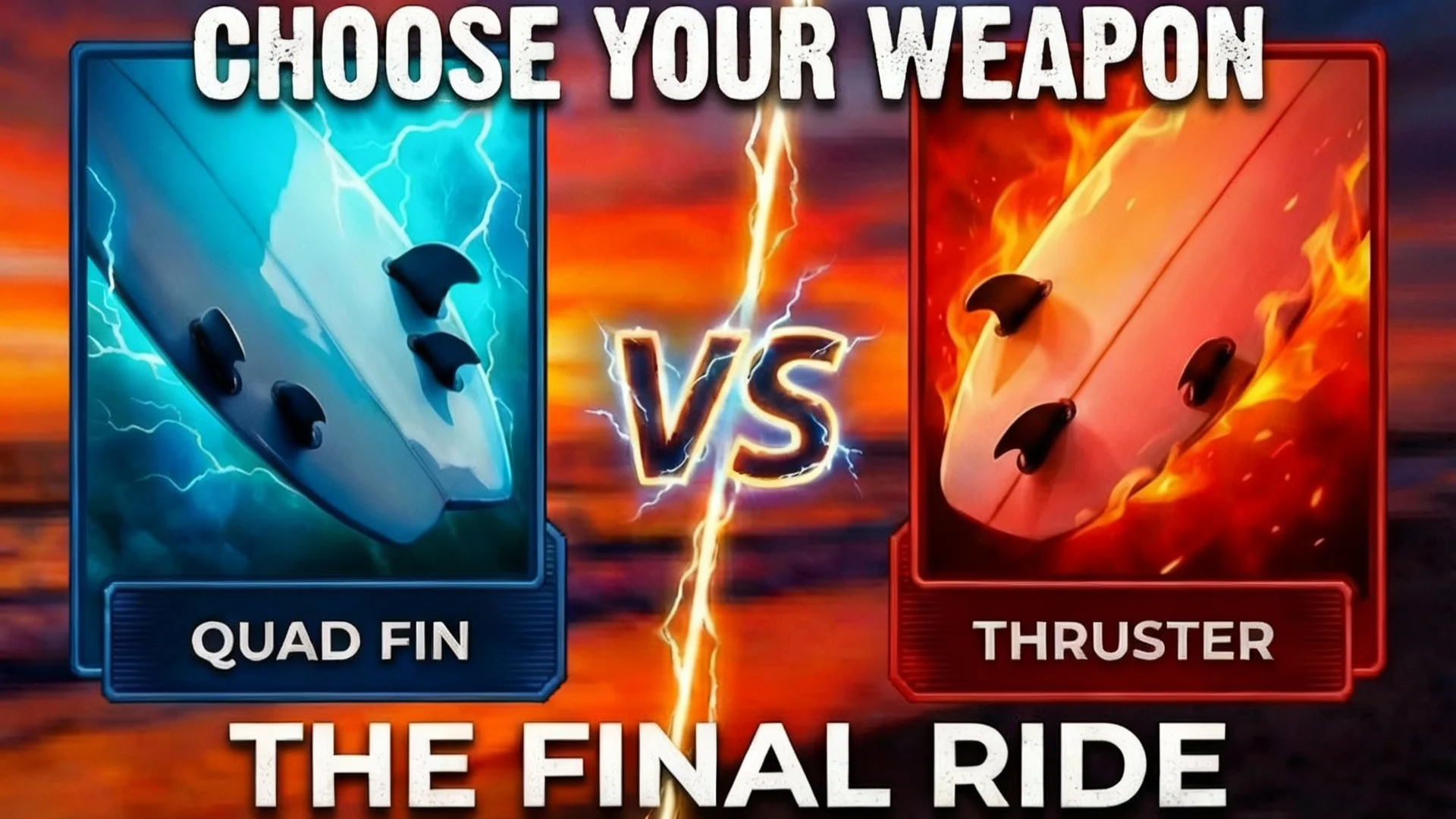
Why He Runs a Thruster, Not a Quad
Italo's surfing lives above the lip. Airs, rotations, tail-high gouges that look like he's trying to tear the fins out of the board. That style has a specific equipment requirement, and it isn't raw down-the-line speed. It's control of the release.
The thruster's center fin is the whole answer. It gives him a pivot point to rotate around, and it grabs the water again the instant he comes back down. A quad would feel looser and faster across the flats, but it would also let the tail wander when he needs it locked. For a guy whose entire game is launching and sticking, predictability beats slipperiness.
Here's how that feels in the water. You set your back foot, snap up off the lip, and the tail breaks free clean. No catch, no hesitation. Then you rotate, drop back into the pocket, and the center fin bites the face like it was waiting for you.
That handshake between release and re-engagement is the thruster doing its job. It's why the setup that built modern aerial surfing is still three fins, not four. For the full breakdown of how setups change the way a board feels, our fin setups guide walks through every configuration.
The Fins: Futures, and a Template Built for Drive Plus Release
Italo rides Futures. The system suits a power surfer who also flies, because the single-tab box and the foils Futures builds around drive sit well under a heavy back foot.
And a fin for his style has to pull off two opposite tricks. It needs enough drive to get the board to launch speed, then it has to let the tail release the second he asks. Those goals fight each other.
Too much hold and you can't break free for the air. Too loose and you can't generate the speed to get airborne in the first place.
The answer lives in the rake. A medium to larger rake template, where the fin sweeps back rather than standing straight up, stores energy through a bottom turn and pays it back as forward drive off the top. That's the engine behind a big punt. If you've never paid attention to sweep, our explainer on how fin rake changes your turns covers why this single number decides whether your surfing feels tight or sweeping.
Futures pairs the IF-15 with three fins worth knowing. The TP1 Honeycomb thruster is the balanced all-rounder, the one most people should start with on this board. The John John Florence Techflex leans into speed control for bigger, more powerful waves, with extra base and rake for drive. The F6 Blackstix is the speed generator for small, gutless days when you need the fin to do the pumping for you.
Notice the pattern. None of those are stiff, lifeless slabs. They're flex-tuned, light, and built to spring.
When you drop into a wave on a fin like that, the board doesn't just hold. It loads up under your back foot through the bottom turn, then releases everything forward as you stand up tall and aim for the lip. That stored-and-released energy is the difference between a turn that fizzles and one that throws buckets.
What You Can Actually Steal From His Setup
Real talk: you're not Italo. Nobody reading this is. Bolting his exact fins to a 5'5 with too little foam will just leave you paddling into sets two beats too late.
But the thinking behind the setup travels just fine. If you surf small to punchy beach breaks and you want to put more air under your turns, the recipe is a board with a touch more volume than your ego wants to admit, plus a thruster running a drivey medium rake template with some flex in it.
Speed first. Release second. That's the order Italo's whole program is built on.
What you shouldn't copy is the size. Italo rides tiny boards because he is a world champion with a lifetime of cooler-lid speed control and reflexes the rest of us will never have. Match his volume-to-weight ratio, not his length, and you'll get a board that actually works for the waves you surf. If you're weighing a fin-system jump to get on the Futures templates he rides, our guide on switching from FCS to Futures covers what changes and what doesn't.
Want a shortcut to the part that matters, the template and size that fit your weight, your board, and your local waves? Tell our fin recommender what you ride and it'll do the matching for you. Takes about a minute, and it won't try to sell you a 5'5.
Key Takeaways
- Italo Ferreira rides the Timmy Patterson IF-15, a high-performance shortboard that carries more volume than a typical tour board because he never sinks through his landings.
- He runs a thruster, not a quad, because his aerial game needs the center fin's pivot and clean re-engagement, not the loose feel of four fins.
- His fins are Futures, built around a medium-to-larger rake template that generates drive into a turn and releases the tail on command for airs.
- Futures pairs the IF-15 with the balanced TP1 Honeycomb, the drivey JJF Techflex for power, and the F6 Blackstix for small waves.
- Steal the logic, not the dimensions. Match his volume-to-weight ratio and his drive-plus-release fin thinking, but ride a board sized for you, not for a world champion.
Helpful Resources
Ready to Find Your Perfect Fins?
Use our expert fin recommender tool to get personalized suggestions based on your needs.
Try Fin Recommender