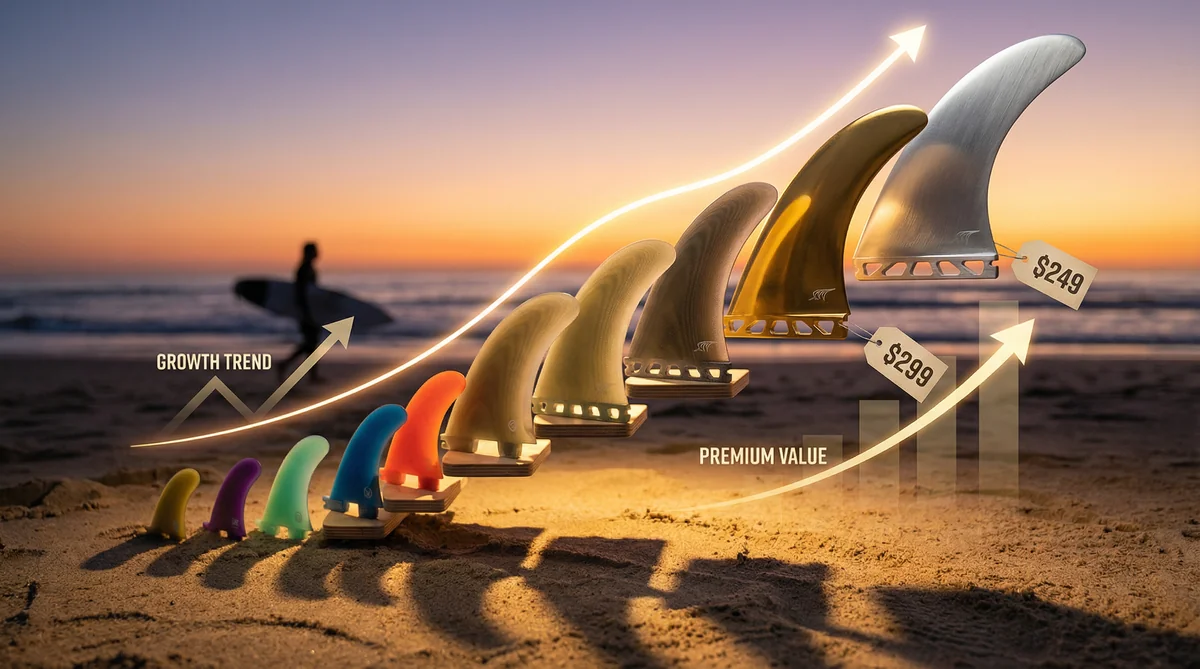
You're at the fin wall in your local shop and there's a matte black five-fin set staring back at you. KS1. A hundred and thirty bucks, designed by the guy with eleven world titles.
You pick it up and it's weirdly light, like it might lift off the rack in a gust. That's not a marketing trick. That's Kelly Slater's entire fin setup philosophy sitting in your palm.
Slater has ridden more fins than anyone alive. He spent two decades as the face of FCS, then walked away and built his own fin brand from scratch. If you want a shortcut to understanding what actually matters in a fin, tracing his path is about as good as it gets.
What Fins Does Kelly Slater Ride?
Kelly rides Endorfins, the company he launched at the tail end of 2021 under his Slater Designs banner. His workhorse template is the KS1, an upright, pivot-style fin he runs on Dan Mann shapes like the I-Bolic FRK. He'll flip between thruster, quad, and twin depending on what the ocean's doing that morning.
That's the short version. The longer version is that from two-foot Trestles to ten-foot Teahupoo, every fin Kelly has ridden for the last fifteen years traces back to two templates he obsessed over: the K2.1 and the K3. The KS1 is those two ideas welded into one.
From FCS Star to His Own Brand
For most of his career, Kelly's name was stamped on FCS fins. First the KFin, then the K2.1, then the K3. When he left FCS after title number eleven, the company kept the molds and rebranded them.
The K2.1 became the Reactor. The K-series carried on as the V2.
So if you've ever ridden an FCS Reactor and loved how it felt, congratulations. You've been riding a Kelly Slater fin the whole time, just under a different sticker. Same factory, same outline, different name.
Kelly said at the time he'd keep using the FCS box system, just not as a paid partner. Then he did the obvious thing for a man who owns a board brand, a wetsuit brand, and a wave pool. He started making the fins too.
Breaking Down the K2.1 and the K3
You can't understand the KS1 without understanding its two parents, because they solve opposite problems.
The K2.1: pivot and snap
The K2.1 is an upright template built to pivot. Bigger, more upright side fins with plenty of flex, paired with a smaller, stiffer center fin for control. It's fast off the top and it turns on a dime.
Here's how a pivot fin feels in the water. You come off the bottom, plant your back foot, and the board rotates around a point right under your rear pad instead of drawing a long line. The tail swings, the spray goes vertical, and you're already looking for the next section.
It's twitchy in the best way. Kelly built it for hollow pockets and vertical faces where you need the tail to come around now, not in half a second.
The K3: drive and arc
The K3 is the opposite personality. Slightly deeper, less base, a more raked tip. Where the K2.1 pivots, the K3 draws. It's the fin for powering off the bottom and holding a long, committed carve on an open wall.
Think J-Bay. Think a running Jeffreys Bay right where the wave keeps peeling and you want to lean into one enormous roundhouse instead of a dozen quick snaps. You set your rail, the extra rake grabs, and the board tracks through the turn with this locked-in confidence that makes you commit harder than you should. That's the K3.
Kelly rode both. K2.1 when the wave was small or hollow, K3 when it was big and open. Two fins, two moods, one surfer who couldn't decide.
Inside the KS1 Template
The KS1 is Kelly's answer to owning two fins. He merged the K2.1 and the K3 into a single all-rounder, keeping his favorite upright pivot outline on the side fins and pairing it with a smaller, more hooked rear.
The numbers back up the pivot bias. In the large size, the front fins run a 116mm base and 119mm height. Taller than they are wide, which is the signature of an upright, snappy template. The center fin sits at 111.5mm base by 115mm height, and the quad rears come in at 98mm base by 106mm height.
Notice those quad rears. At 98mm base they're bigger than most quad trailers on the market, and that's on purpose. Kelly likes his fins clustered tight together, closer to the stringer and closer to each other than a typical setup.
Why Kelly Runs a Tight Cluster
A tight cluster changes how a board turns. Move the fins closer together and closer to the tail's center line, and you free up the rail. The board pivots quicker, feels looser underfoot, and lets you throw the tail with less resistance.
The tradeoff is drive. Spread fins out wide and you get more hold and more down-the-line drive, but you sacrifice that snappy, skatey release. Kelly, being Kelly, wants the release.
He's spent forty years making tight radius turns look effortless, and his fin placement is built to serve that. It's a setup that rewards a surfer who lives in the pocket.
If you want to understand how fin position and cluster width shape a board's feel before you commit, our guide to fin setups walks through the thruster, quad, and twin logic in plain language.
Thruster, Quad, or Twin: How He Switches
The KS1 comes as a five-fin set, which means one purchase covers three completely different boards.
Run it as a thruster for control and predictability in punchy, powerful surf. Pull the center fin and drop in the two rears for a quad, and the board frees up and generates its own speed through flat sections, which is why quads shine when the wave goes soft. Or run it as a twin plus a small trailer for that loose, drifty retro feel.
Kelly bounces between all three. He's been spotted on quads in weaker waves for the extra glide and on thrusters when he needs the tail to hold in something serious. That flexibility is the actual argument for a five-fin set over a locked three-fin. You're buying options, not just fins.
The Part Nobody Talks About: They Float
Here's the genuinely clever bit. Endorfins are built to float. The core is recycled PET that's mostly trapped air with zero water absorption, wrapped in carbon twill and a non-woven carbon veil that tunes the flex.
Drop a normal fin in the lineup and it's gone, sinking to the reef to sit there for a few hundred years. Drop an Endorfin and it bobs. It's a small thing, but it's the kind of detail that tells you Kelly actually surfs and actually loses fins like the rest of us.
Should You Ride Kelly Slater's Fins?
Honest take. For most surfers, the KS1 is a sharper tool than their surfing currently needs. The upright pivot template rewards precise back-foot surfing, and if your turns are still rounding out, a mellower all-rounder will flatter you more.
But that's not a reason to skip it. The KS1 is one of the more forgiving pivot fins out there because Kelly baked the K3's drive into it. And if you already surf off your back foot and want a board that snaps the second you ask, this is a legitimately great set. The floating eco angle is a real bonus, not the reason to buy.
The wrong move is buying the KS1 because Kelly's name is on it and then riding it on a board and in waves it was never meant for. A pro's fin only works on a pro's terms.
Key Takeaways
- Kelly Slater rides his own Endorfins KS1 template, an upright pivot fin that fuses his old FCS K2.1 and K3 designs into one all-rounder.
- The K2.1 was built for pivot and snap in hollow waves. The K3 was built for drive and long carves at open walls like J-Bay. The KS1 splits the difference.
- His FCS templates still exist. The K2.1 lives on as the FCS Reactor and the K-series as the V2, so you can ride his outline without the KS1 badge.
- Kelly runs a tight fin cluster with slightly larger quad rears, which frees the tail for quicker, looser pivots at the cost of some drive.
- The five-fin set converts between thruster, quad, and twin, and the fins float thanks to a recycled air-filled core.
Copying Kelly Slater's fin setup only works if you surf like Kelly Slater, which none of us do. The smarter play is matching a template to your board, your weight, and the waves you actually ride. Tell our fin recommender what's under your feet and it'll point you at the right set in about a minute. Then you can argue about whether the GOAT's fins would even suit you.
Helpful Resources
Ready to Find Your Perfect Fins?
Use our expert fin recommender tool to get personalized suggestions based on your needs.
Try Fin Recommender