You're watching the Pipe Masters replay for the third time. Barron Mamiya drops into a Backdoor bomb, sets his rail, and comes out clean with a 9.80. You're not looking at his board. You're not looking at his stance. You're staring at his fins, wondering what the hell he's running that lets him hold a line on a wave that would snap most surfers in half.
Turns out, he was riding borrowed fins. Prototype fiberglass sets that FCS sent to his shaper, not to him. And he won the whole contest on them. Twice.
Pipeline doesn't care about your brand loyalty or your favorite flex pattern. It cares about physics. And the fins you ride there are the difference between threading a barrel and getting bounced off the reef like a tennis ball.
Why Pipeline Breaks Your Normal Setup
Most waves let you get away with mediocre fins. Pipeline doesn't. The wave jacks up from deep water to a shallow reef shelf in seconds, producing one of the steepest, most hollow takeoffs in surfing. You're dropping down an almost vertical face, setting a rail, and trying to maintain speed through a tube that's collapsing around you.
Your beach break fins, the ones that feel loose and fun at waist-high Trestles, will betray you here. The force of the water overwhelms soft flex. The steep face demands more hold than a shallow-raked fin can provide. And if your fins let go on a bottom turn at Pipe, you're not just falling off your board. You're hitting reef.
Pipeline fins need three things: stiffness to handle the power, depth to grip steep faces, and an upright template for tight adjustments inside the barrel. Everything else is negotiable.
What the Pipe Specialists Actually Ride
Barron Mamiya: The Fiberglass Convert
Mamiya won the 2024 and 2025 Pipe Pro on FCS fiberglass prototype fins that weren't even meant for him. His shaper Britt Merrick had them lying around. Mamiya tried them, felt the difference immediately, and never switched back.
His words: "They felt super good. Lots of drive, tons of hold." He said the fiberglass let him "float over foamballs" and that the back of his board "just felt sturdy." On a wave where sturdy means the difference between a barrel and the hospital, that matters.
He pairs them with a Channel Islands Goldie, Merrick's purpose-built barrel board with thin down rails and deep double concave through the tail. It's a board designed to hold a line on the steepest wave in the world. The fiberglass fins complete the package.
John John Florence: Futures Techflex, No Exceptions
JJF rides Futures JJF Techflex fins in his Pyzel boards at Pipeline. The Pro size, slightly smaller than Large, in 6'1" to 6'2" Pyzel Ghosts and Bastards. The Techflex construction is stiff and ultra-responsive. Stable at speed, springy when things slow down.
The specs tell part of the story: 4.45" base, 4.56" height, 14.98 square inches of area with flat foil sides and a 50/50 center fin. But specs don't explain how it feels when you drop into a triple-overhead right and the board locks in with a quiet authority that says, "We're fine. Keep going."
Florence doesn't change much between waves. Same fins, same boards, same approach. Three world titles suggest the approach works.
Kelly Slater: The Mad Scientist
Slater designed his own fins. Of course he did. His Endorfins line includes the KS1, an upright pivot template built specifically for hollow waves. The construction is wild: a P.E.T core that's 90% air (the fins literally float on water), wrapped in carbon twill with an ultralight carbon veil that tapers to the tip for controlled flex.
But here's the interesting part. Slater prefers quads for barrels and thrusters for the face. At Pipeline, where you might need both in the same heat, that means strategic board selection. Quad for pure barrel-hunting. Thruster when Backdoor is offering workable sections.
And then there's the whale thing. In 2016, Slater rode fins with whale bump tubercles at Pipe. Ridged leading edges inspired by humpback whale flippers that create lift and maintain grip at sharper angles. It's the kind of move that sounds insane until you remember it's Kelly Slater and he's probably right.
Jack Robinson: Big Fins, Big Waves, Simple Approach
Robinson won the 2023 Pipe Pro with a 9.17 on Futures Large Techflex thrusters. Always Large. Always thruster. Quads only on tow boards.
His signature Futures template sits in the rake category, meaning more sweep for hold and drive on powerful faces. He pairs them with Eric Arakawa boards when conditions get serious. Not his everyday Sharp Eye shapes. Arakawa. That's the board he trusts when the wave is trying to kill him.
Robinson's approach is the anti-Slater: find what works, don't overthink it, ride it with conviction. At Pipe, conviction is half the battle.
The Fiberglass Comeback Nobody Expected
Mamiya's back-to-back wins on fiberglass prototypes kicked off something bigger. For years, the industry pushed carbon, honeycomb, and every space-age material they could think of. Lighter, stiffer, faster. That was the pitch.
But in heavy, fast-moving water, carbon can feel dead. Like surfing on a piece of furniture. Fiberglass has a natural flex pattern that gives you feedback. You can feel the wave through the fin, feel the board loading and releasing. At Pipeline, where you're making micro-adjustments at 25 miles per hour inside a tube, that feedback loop is everything.
Stab called it a fiberglass renaissance. It's more like a correction. The best material for powerful surf was never the newest one. It was the one surfers have been riding for decades.
The Quad vs. Thruster Debate at Pipe
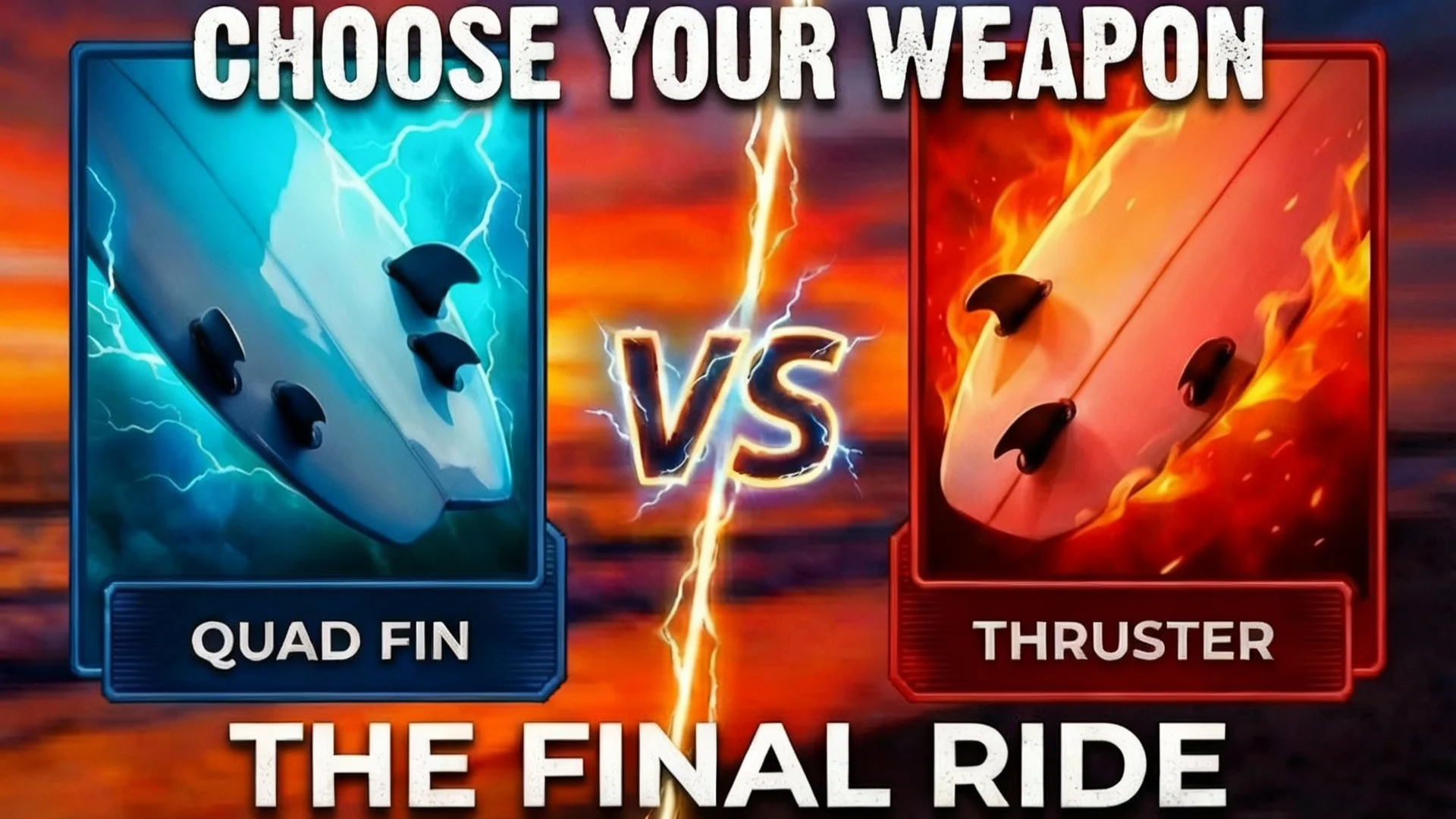
This one's simple. Quads are faster in the barrel. No center fin means no drag when you're running down the line. Two fins per rail instead of one gives you more grip on steep faces. If all you're doing is pulling into tubes, quads win.
But Pipeline isn't just tubes. Backdoor offers workable shoulders. Sets come through with sections you can hit. And when you need to stall, adjust, or pump back into the pocket, a thruster's center fin gives you control a quad can't match.
Most CT surfers default to thrusters at Pipe. Slater rides quads for pure barrel heats. The smart play is having both in your board bag and reading the conditions. If it's maxing Pipe with long, draining lefts, go quad. If Backdoor is firing and there are turns to be had, go thruster. If you're not sure, thruster. It's the safer bet when the wave can punish bad decisions.
What This Means for Your Heavy-Wave Fins
You're probably not surfing Pipeline. But you might be surfing your local heavy reef, or planning a trip to Indo, or paddling out at a break that gets serious a few times a year. The same principles apply.
Size up. Your medium fins are fine for chest-high beach breaks. When the wave gets powerful and hollow, step up to medium-large or large. The extra depth and base length give you the hold you need on steep faces.
Go stiffer. Flex is fun in small surf. In overhead hollow waves, flex gets overwhelmed. A stiffer fin holds its shape under load and gives you predictable performance when everything else is chaos.
Consider your template. More upright, less rake. You need tight pivots inside the barrel, not sweeping carves. An upright template lets you make quick adjustments without losing your line.
And if fiberglass is an option, try it. The pros are coming back to it for a reason. There's a warmth and responsiveness in fiberglass construction that carbon and plastic can't replicate when the wave is pushing serious water.
Key Takeaways
- Pipeline pros favor stiffer, deeper, more upright fins than what you'd ride at your average break. Hold and drive trump looseness.
- Fiberglass fins are making a serious comeback in heavy surf after Mamiya's back-to-back Pipe wins on prototype sets.
- Thrusters are the safer all-around choice at Pipe; quads are faster in pure barrel situations. Most pros carry both.
- Size up your fins for powerful waves. Undersized fins lose hold on steep faces, and at spots like Pipeline, that's a safety issue.
- The best Pipe riders don't chase trends. They find a setup, trust it, and ride it with total commitment.
If you're looking at a heavy swell forecast and wondering whether your current fins can handle it, the FinFinder recommender can match you with setups built for power. Quicker than calling your shaper, and it won't judge you for asking.
Helpful Resources
Ready to Find Your Perfect Fins?
Use our expert fin recommender tool to get personalized suggestions based on your needs.
Try Fin Recommender