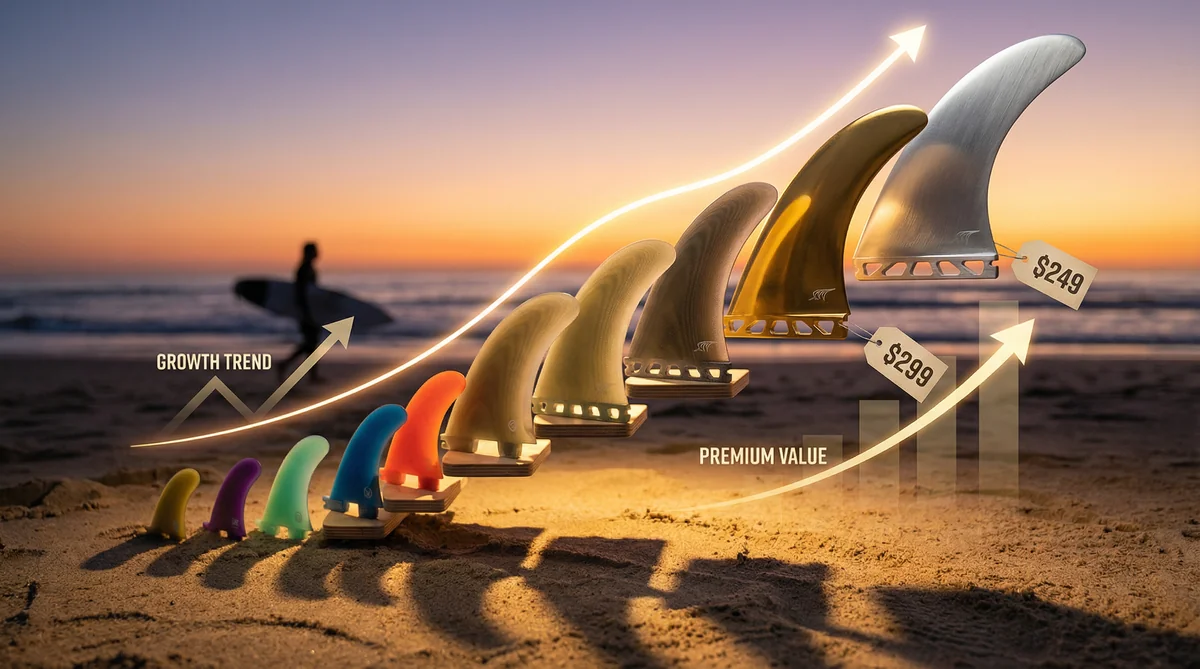
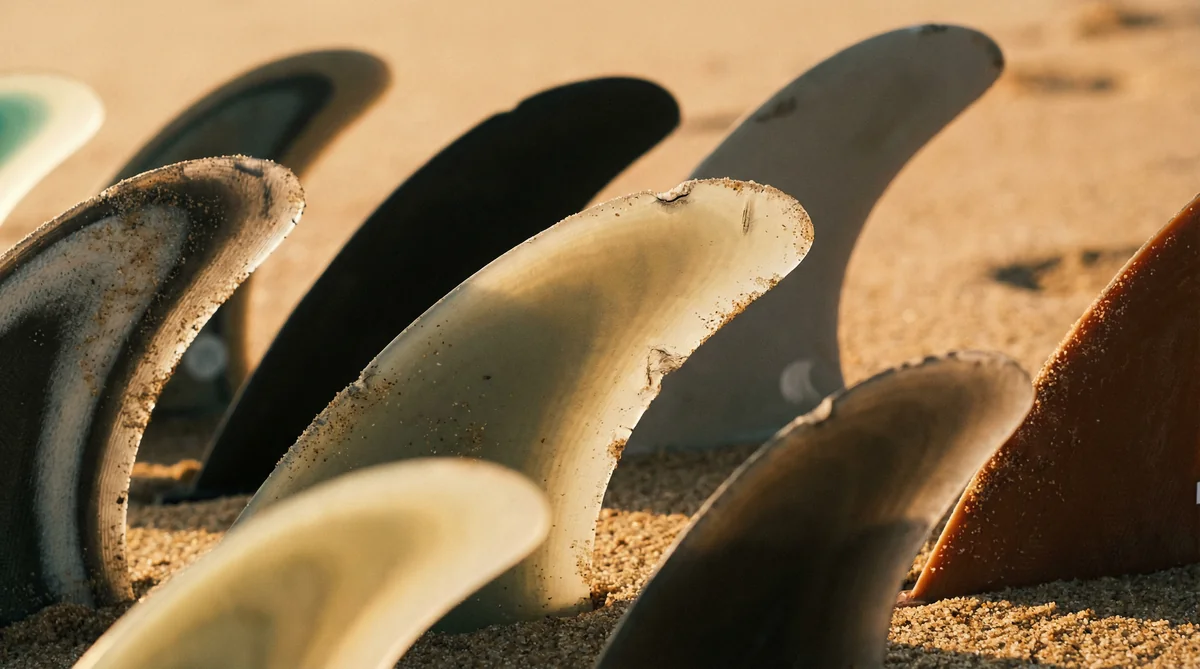
You're at the shop, standing in front of a pegboard of longboard fins, and every single one of them is nine inches of glassed plastic that looks basically identical. The kid behind the counter asks what you ride. You say "a log." He points you at the most expensive one. You buy it.
You just bought the wrong fin, and you won't figure out why for six months. Here's the thing the shop never explains: the pivot vs flex longboard fins question has almost nothing to do with your board. It's about how you actually surf.
A 9-inch single fin isn't a 9-inch single fin. There are three families, they do completely different jobs, and most surfers ride the wrong one their whole life because nobody told them the families exist.
The Three Fin Families That Actually Matter
Forget brand names for a second. Every longboard single fin lives in one of three camps: pivot, flex, or cutaway. The shape of the outline tells you which.
Pivot fins are tall and upright with a wide base and almost no rake. They look like a shark's dorsal fin that went to the gym. Flex fins have a wide base that thins dramatically toward a whippy tip, with noticeable rake sweeping backward. Cutaway fins scoop a chunk out of the trailing edge near the base, narrowing the foot of the fin while keeping length up top.
Three outlines. Three feelings underfoot. Your board doesn't choose between them. Your style does.
Pivot Fins: Built to Park You on the Nose
A pivot fin is an anchor. That's not an insult, that's the entire design brief.
Drop your weight onto the nose of a log and the tail wants to slide out and spin. The pivot fin's job is to refuse. All that vertical surface area bites the water and holds the back of the board planted while you walk to the tip. You're hanging five over the whitewater at San Onofre and the board just sits there, glued, like the wave signed a contract with your front foot.
That hold is the whole point. The Velzy Noserider and the Captain Fin Joel Tudor 9.5 are pivot templates, and Tudor didn't build his career on responsiveness. He built it on standing on the nose at Malibu longer than physics should allow.
The trade-off is real though. Pivot fins turn like a school bus. You bury a rail and the board comes around eventually, in a wide arcing sweep, on its own schedule.
If you want to snap off the top, this is the wrong fin and it always will be. It's slow, it's stable, and for traditional logging it's perfect. For anything else it feels like dragging a barn door.
You also feel the drag on the paddle and the trim. The board pushes a little more water and accelerates a little slower than a raked fin would. On a clean point wave that drag is invisible because you're trimming, not sprinting. On a gutless beach break it's the difference between making the section and watching it close out in front of you.
Flex Fins: Drive, Whip, and the Performance Log
Flex fins are the opposite philosophy. Less surface area for the length, a thin loaded tip, and rake that stores energy through a turn.
Here's how it feels. You set a hard bottom turn on a 9'4 at Cardiff, lean in, and the tip of the fin bends and loads like a diving board. Then it snaps back and fires you up the face with speed you didn't pump for.
It's the closest a longboard gets to feeling like a shortboard off the bottom. The board comes alive under your back foot instead of sitting there politely.
That whip costs you nose time. A thin-tipped flex fin doesn't hold the tail down the way a fat-based pivot does. You can still noseride a flex fin, but you're working for it, picking your moment, and you won't get the long parked tip-time a pivot hands you for free.
Performance longboarders ride flex for a reason. If your idea of a good wave is cutbacks, rail work, and the occasional tail slide on a high-performance log, flex is your family. The Greenough-lineage templates that True Ames builds live here, and they reward surfers who actually drive the board instead of just trimming it.
Cutaway Fins: The Middle Ground Nobody Explains Well
The cutaway is what you ride when you refuse to pick a side. Narrow base, less drive than a pivot, but it puts the working part of the fin down in cleaner, less turbulent water.
The result is a fin that holds decently on the nose and still lets you turn off the tail without a written invitation. It's loose where a pivot is locked and stable where a flex is twitchy. Devon Howard's Harmonic 67 is the famous one, raked enough for drive off the bottom but with enough hold to walk forward and hang on.
Real talk: a lot of all-around loggers should be on a cutaway and don't know it. If you're surfing San O on a Sunday, doing a little of everything, a cutaway does 85 percent of what a pivot does and 70 percent of what a flex does, which for most people on most waves is the better deal.
So Which One Do You Actually Need?
No fence-sitting. Here's the call.
If you bought a traditional log to noseride, ride a pivot. Period. A 9 to 10-inch pivot with a fat base, slid toward the back of the box. Don't let anyone sell you a flex fin for a noserider, you'll spend a year wondering why your hang-fives wash out.
If you ride a performance longboard and your best waves involve real turns, ride a flex. The drive and snap are the entire reason you bought a thinner, lighter board. A pivot on a performance log wastes the board.
If you're somewhere in the middle, which is honestly most longboarders, ride a cutaway and stop agonizing. You can always buy a dedicated pivot later when your noseriding gets good enough to deserve one.
Box position is the free tuning knob nobody uses. Slide any fin back in the box and it gets more stable and harder to turn, basically more pivot-like. Slide it forward and it loosens up and turns easier, basically more flex-like.
Noseriders go back, performance setups come forward, and you can shift it between sessions with a screwdriver. That one adjustment changes the board more than people expect.
Size matters too, but less than the family. Bigger fin equals more hold and stability, smaller equals looser and faster. Get the family right first. If you want the full breakdown of length, box position, and how it stacks against side-bite setups, our longboard fin guide goes deeper, and the fin sizing guide has the numbers.
Key Takeaways
- The pivot vs flex decision is about how you surf, not what board you own. Match the fin family to your style first.
- Pivot fins are noseriding anchors. Wide base, upright, no rake. They hold the tail and turn slowly. Best for traditional logging.
- Flex fins drive and whip off the bottom. Thin loaded tip, real rake. Best for performance longboards and surfers who turn.
- Cutaway fins split the difference and quietly suit most all-around loggers better than either extreme.
- Get the family right before you obsess over the half-inch of length. A perfect-size wrong-family fin still feels wrong.
Still not sure which camp your surfing falls into? Tell FinFinder what you log and how you actually ride it, and it'll point you at the right family before you drop sixty bucks on a fin that fights you every wave. The honest answer is usually less expensive than the one the shop hands you.
Helpful Resources
Ready to Find Your Perfect Fins?
Use our expert fin recommender tool to get personalized suggestions based on your needs.
Try Fin Recommender