You're sitting on the rocks at Snapper, watching a set wrap around the point. A goofy-foot throws an air reverse off the end section and the whole beach hoots. Then Steph Gilmore drops in behind him, does almost nothing, and somehow looks better.
That's the Gilmore trick. Eight world titles built on making hard surfing look like she's barely bothering. And a big, quiet chunk of that glide lives in Stephanie Gilmore's fin setup.
What Stephanie Gilmore actually rides
Gilmore rides DHD, shaped by Darren Handley on the Gold Coast. Her signature board is the SG No.8, named for the record eighth title she locked up at the 2022 Rip Curl WSL Finals at Lower Trestles. Narrow round tail, reduced tail rocker, a single-to-double concave built to hold speed.
Under that board sits a standard three-fin FCS thruster in a medium. Nothing exotic. No secret half-fin, no asymmetric wizardry, no quad experiment mid-heat. The interesting part isn't the hardware. It's the template she leans on, and why it fits her better than the pivot-happy setups the air generation loves.
Rake over pivot: the fin that matches the style
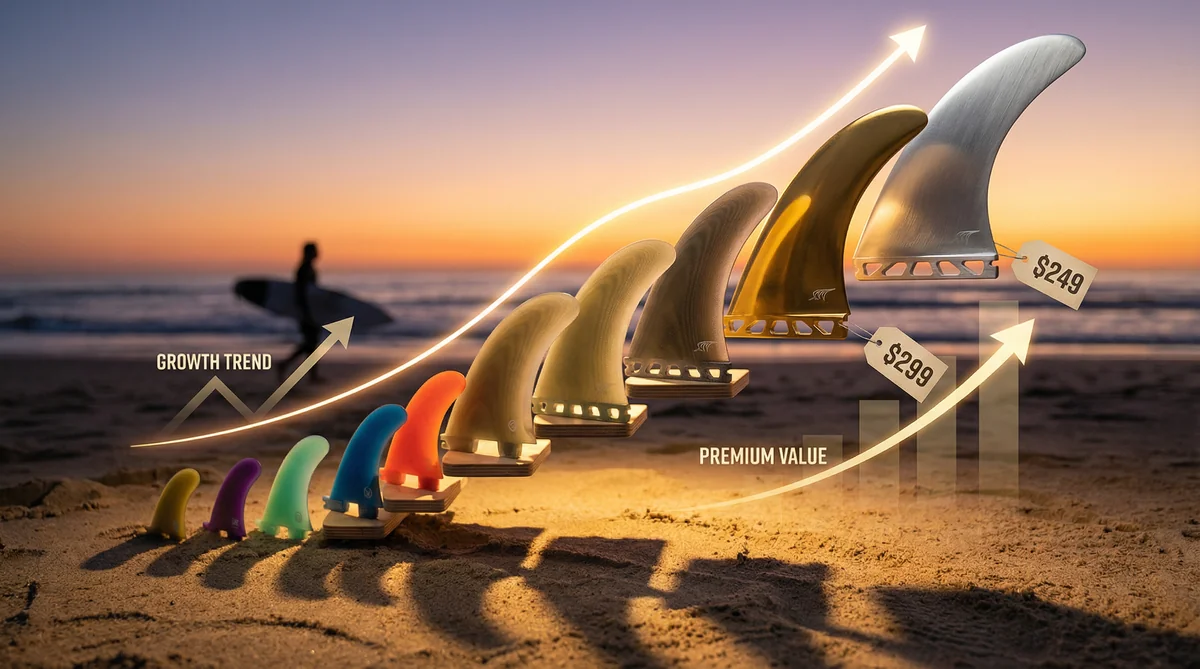
Fins live on a spectrum. On one end, upright templates with a straight leading edge that pivot tight and turn on a dime. On the other, raked templates that sweep back and draw longer, rounder arcs. That single design choice, how far the fin sweeps back, shapes how a turn feels more than almost anything else.
Gilmore lives on the raked end. Her whole game is the long turn. The carve that starts up near the lip and finishes way down the line with speed still on tap. An upright pivot fin fights that instinct. A raked fin feeds it.
Set your rail on a running wall with a raked medium thruster and the board stops hunting for the pocket. It just leans in and goes. The fins hold the arc and keep pumping speed back into your front foot, so the turn exits faster than it entered. That leftover speed is where style comes from. You can't look relaxed if you're scrambling to make the section.
Why medium fins, not small
Gilmore is tall for the tour at around 5'10", and she surfs with real power off the bottom. A small fin set would let go under that load. Medium fins give her the base area to hold a rail through a committed bottom turn without the tail greasing out from under her.
Snapper on a proper south swell is a racetrack. You're doing 20 down a sand-bottom wall trying not to outrun the section in front of you. Medium raked fins let her stand on the gas and trust the tail to stay planted, so she can drive to the lip and still make the next bowl. Undersized fins in that spot feel like ice skates on a freeway.
This is the sizing logic most surfers skip. They buy the fin their favorite pro rides and ignore that the pro weighs 40 pounds more or less than they do. Fin size tracks your weight and your speed, not your idol. Our fin sizing guide lays out the weight brackets if you're not sure where you land.
The DHD connection
DHD and FCS work hand in glove, and there's an FCS II DHD template built around exactly the kind of drive-and-hold surfing Handley's boards want. Whether Steph runs that DHD template or a drawn-out Carver-style fin, the DNA is the same. Elongated outline, higher sweep, long committed turns, deep rail engagement.
It's worth understanding the pairing. A high-performance board with a fast tail wants a fin that can put all that speed to work through a rail. Bolt a twitchy pivot fin onto a drivey DHD and you've fought the board's whole design. The fin and the board have to agree on what kind of turn they want to make.
She's not a one-setup surfer
Gilmore's contest weapon is the medium thruster, but she's played the whole field. She's ripped on a DHD twin and even a Mark Richards x Mayhem California Twin when the waves go small and skatey. Loose, fast, zero back-foot resistance.
That range tells you something. A surfer this stylish knows a fin setup isn't a personality. It's a tool you match to the day. Thruster for the drawn-out power surfing that wins titles. Twin for the fun stuff when nobody's judging.
Style is a setup decision, not just talent
People watch Gilmore and file it under natural talent, like her flow fell out of the sky. That undersells the gear. Style is what happens when a surfer, a board, and a fin all want the same kind of turn, and nobody in the chain is fighting the others.
Think about what kills style for the rest of us. The board that bogs mid-carve. The fin that breaks free right when you commit. The tail that skips out and turns a smooth arc into a save. Every one of those is a mismatch between how you surf and what's bolted under your feet.
Gilmore removes those variables. The DHD is tuned for speed, the medium fins hold the load, and the rake lets the turn breathe. Once the equipment stops arguing with itself, the surfer is free to just draw the line. That freedom reads as effortless because, for her, it kind of is.
You won't buy her backhand. But you can buy the part where your fins and board stop working against you, and that's a bigger jump for most surfers than any amount of practice on the wrong gear.
The honest takeaway for your own boards
Here's the part worth stealing. If you're a rail surfer who cares more about how a turn looks and feels than how many times you can hack the lip, copy the logic, not the exact fin. A medium, raked thruster on a clean high-performance board is one of the most slept-on setups in surfing.
Most intermediates buy upright pivot fins because the guys doing airs ride them. But most of us aren't doing airs. We're trying to draw a clean line and hold speed through it. For that, Gilmore's approach wins going away.
One caveat, because we're honest here. Rake costs you tightness. If you surf small, gutless beach breaks and you need to force the board around in a soft pocket, a more upright fin will feel livelier and quicker. Match the fin to the wave you actually surf, not the surfer you wish you were.
Key Takeaways
- Gilmore rides a DHD, usually the SG No.8, with a plain medium FCS thruster. The magic is the template, not any gimmick.
- She favors a raked fin because her style is built on long, drawn-out carves, not tight pivots.
- Medium fins give her the hold to stand on the gas at fast points like Snapper without spinning out.
- The lesson for you: choose rake for flow and drive, upright for tight pivot in weak surf.
- Copy her logic, not her exact fin. Your weight and your waves decide the size, every time.
Want to know where you land on the upright-versus-raked scale? Feed your board, weight, and home break into the FinFinder recommender and it'll point you at a template that suits how you actually surf, not how the tour surfs. Takes about a minute, and it won't try to sell you Steph's fins just because her name's on them.
Helpful Resources
Ready to Find Your Perfect Fins?
Use our expert fin recommender tool to get personalized suggestions based on your needs.
Try Fin Recommender