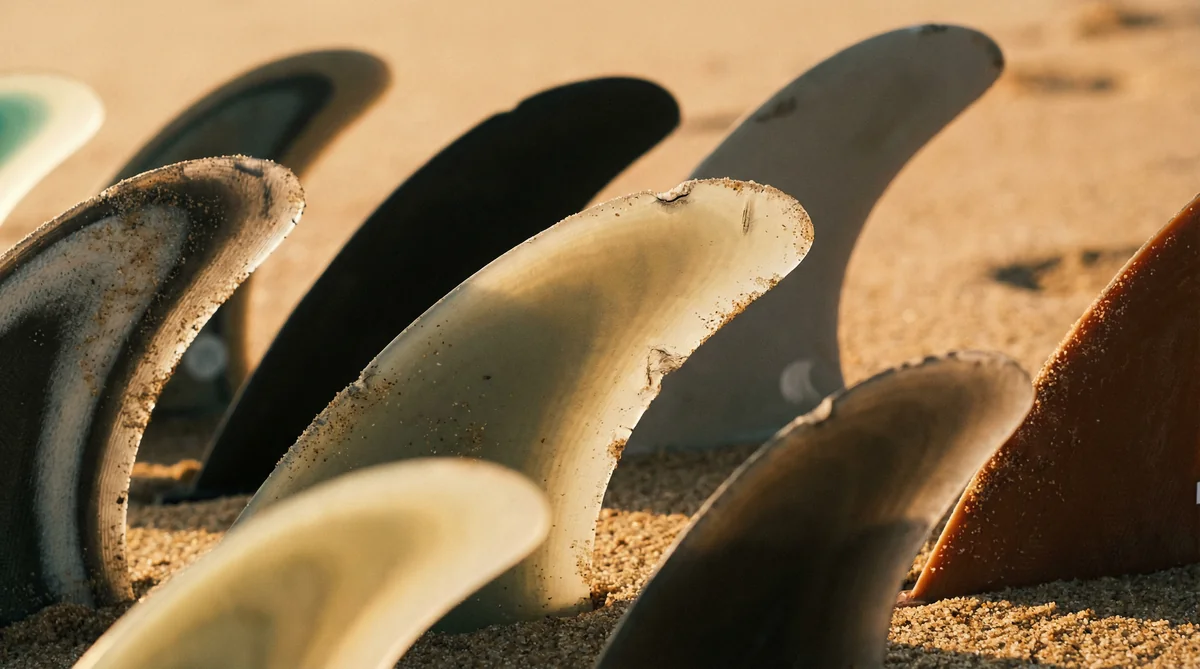
You're at the top of a clean head-high wall, you load up your back foot, and you go to snap off the lip. The board's there, the wave's there, your timing's right. Then the tail just lets go. It slides out sideways, the fins lose their bite, and you're either flailing for the recovery or eating the inside section. Same wave, same board, same surfer who made that turn ten times last week.
That's spin-out. And almost everything you've heard about why surfboard fins spin out is half wrong.
Surfers blame "cavitation" because it sounds technical and it's the word the windsurf crowd has been throwing around for decades. But true cavitation, where water actually boils into vapor against the fin, basically doesn't happen at surfing speeds. You'd need to be moving way faster than even a Nazare bomb lets you go. What's really happening is one of two things, and knowing the difference tells you exactly how to fix it.
What's Really Happening When You Spin Out
A fin doesn't push you through a turn by brute force. It works like a wing turned sideways. As water flows past it at an angle, pressure drops on the outer face and builds on the inner face. That pressure difference is lift, and lift is the grip that holds your rail in the wave.
Spin-out is the moment that lift collapses. The fin stops generating its sideways force and the tail breaks free. Two separate things cause it, and people constantly mix them up.
Stall: Too Much Angle, Too Fast
This is the common one. When you stomp your back foot and crank the board hard, you're forcing the fin to a steeper and steeper angle against the water. Every fin has a limit. Past a certain angle of attack, the smooth flow on the low-pressure side detaches from the surface and goes turbulent. The lift dies almost instantly. That's a stall, and it's the same physics that drops an airplane wing out of the sky.
You feel it as a sudden, violent release. One second you're locked in, the next the tail's gone. It usually happens on the hardest, most vertical part of a turn, exactly when you're asking the most of your fins.
Ventilation: The Fin Sucks Air
This one's sneakier. When your fin gets close to the surface, that low-pressure outer face can suck air straight down from above. Air instead of water means almost no lift, because air is roughly 800 times less dense. The fin's basically running on nothing.
Ventilation loves the top of the wave, off-the-lip moments, and any time the tail kicks high in the pocket. It's why your snaps feel solid down low and sketchy up high. Bob Simmons wanted fins close to the rail for tighter turns back in the 1940s. George Greenough later figured out that longer, deeper fins kept the working surface buried in solid water where it couldn't gulp air. That tension between the two ideas still shapes every template you can buy.
Why It Happens to You Specifically
Spin-out isn't random. If your fins keep letting go, one of these is usually the culprit.
Your fins are too small. A smaller fin has less surface area generating lift, so it reaches its stall angle sooner. Undersized fins feel loose and fun in mushy waves, then betray you the second the wave has real push. If you're a heavier surfer riding fins sized for a grom, you're going to spin out. Our fin sizing guide breaks down the weight ranges, and most surfers err too small.
Your fins are too shallow. Depth is your insurance against ventilation. A shorter fin sits in the zone where air can reach it more easily. This is exactly why noseriders and big-wave guns run tall fins, and why fin depth changes hold more than most people realize.
Your foil is trashed. A fin grips because of its precise cross-section, the subtle curve that organizes the water flow. Ding the leading edge on a rock, sand it down, or buy a warped knockoff, and you've wrecked the one thing that keeps flow attached. Worn or damaged fins spin out at angles a clean fin would hold all day.
You're a back-foot masher. Sometimes it's not the gear. If you bury your weight on the tail and yank turns from your back leg, you're driving the fin past its stall angle on purpose. The fix here costs nothing.
How to Make Your Fins Hold
Start with the free fix. Move your weight forward and drive turns more from your front foot and your rail, less from a back-foot stomp. A rail-driven turn keeps the fin at a sane angle and the board carves instead of pivots. Plenty of spin-out problems vanish the moment a surfer stops surfing off their heel.
If technique isn't it, go bigger or deeper. Sizing up your fins, or moving to a taller template, buys you a higher stall angle and more grip in the part of the wave where you're losing it. You'll trade away a little looseness, but a board that holds is a board you can trust.
Look at your template too. Upright fins with more area down low hold better and resist sliding out, which is why pumpy, drivey surfers gravitate to them. More raked, swept-back fins release earlier, which feels playful but spins out sooner when you push hard. If you want the feeling of grip through a vertical snap, an upright template in solid surf is the move. The difference between tight and sweeping turns lives almost entirely in rake.
And inspect your fins. Run a finger down the leading edge. If it's chipped, gouged, or sanded flat, that fin's costing you grip whether you've noticed or not. A fresh set sometimes fixes a "spin-out problem" that was really just a beat-up old set of plastics.
When Spinning Out Is a Good Thing
Now for the part most fin guides skip. Controlled release is a skill, not a flaw. Watch any air section or a tail-high reverse and the surfer is deliberately breaking the fins free, sliding the tail, then re-engaging. The whole point of a looser, more raked setup is to let go on command.
The problem isn't release. The problem is release you didn't ask for. A good setup spins out when you tell it to and holds when you need it to. Dialing that balance is the entire game, and it depends on your weight, your waves, and how you actually surf. If you'd rather not guess your way through three sets of fins, our fin recommender will narrow it down in about a minute, and the all-about-fins guide covers the rest of the picture.
Key Takeaways
- True cavitation almost never happens at surfing speeds. What you're feeling is a stall (too much angle) or ventilation (the fin sucking air near the surface).
- Stall hits when you force the fin past its angle of attack, usually from too much back-foot pressure on a vertical turn.
- Ventilation strikes near the surface, which is why snaps feel loose up high and solid down low. Deeper fins fix it.
- The free fix is technique: drive from your front foot and your rail, not a back-foot stomp.
- If gear's the issue, size up, go deeper, or pick a more upright template, and never ride fins with a damaged foil.
Helpful Resources
Ready to Find Your Perfect Fins?
Use our expert fin recommender tool to get personalized suggestions based on your needs.
Try Fin Recommender