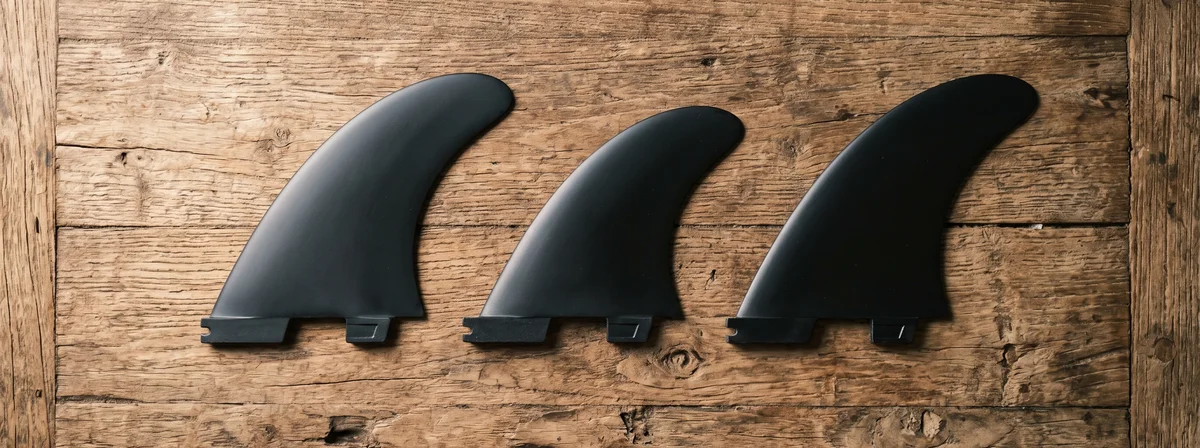
You're at the shop pulling a new thruster set out of the box. Three fins. You lay them on the counter and something's off.
Two of them match. The third is smaller. You flip the box over, double-check the model number, and yeah. That's how it came.
That smaller one is your center fin. And no, it's not a manufacturing accident.
Most thruster sets ship with a center fin noticeably shorter than the two side fins, with a smaller base too. FCS does it. Futures does it. Even the cheap soft-top sets do it.
Every serious fin company prints a shrunk third fin, and most surfers can't tell you why.
The Drag Problem Nobody Talks About
Your center fin is the only fin pointed perfectly straight. The two side fins angle inward, that's toe-in, and tilt outward, that's cant. When the board is trimming, those side fins are working at angles that bleed off some lift and reduce direct drag. The center fin is pure parallel, the one fin acting like a brake every time you go down the line.
If the center matched the sides for area, you'd basically have an oversized rudder dragging behind you between turns. Speed dies. Glide dies. The board plows.
Shapers and fin engineers shrink it for that reason. Smaller surface area, smaller base, often less rake. Just enough fin back there to do its job without acting like a parachute when you're pumping for the inside section.
What the Smaller Fin Actually Does
The center fin has two jobs. First, it pivots the board. When you push your back foot to bury a turn, the center fin redirects the tail. Without it, the sides do all the work and the board feels squirrelly, like driving a car with bad alignment.
Second, it adds hold in the back third of the rail line. On a vertical lip hit, the side fins release at different times depending on how you weight the board. The center fin keeps the tail anchored long enough that you can finish the rotation before everything lets go.
Pivot and a little extra hold. Both can be done with a smaller fin. Both are ruined by a fin that's too big.
What Happens When You Match the Sizes
Some surfers swap the center for one that matches the sides. Sometimes by accident. Sometimes on purpose, after seeing a clip of Kelly riding equal-sized thrusters at Trestles in 2016 and figuring what's good for Kelly is good for them.
It's not.
Match the areas and the board's character flips. Turns get heavier. The board feels stiff through the bottom turn, reluctant to release off the top. You get more grip on steep faces, which is why some guys at Pipe and Cloudbreak run it that way.
You also lose the snappy quickness that makes a thruster feel like a thruster in the first place.
I rode a friend's board with an equal-area back fin at Blacks last summer, thinking it'd help on the bigger sets. Felt like the board was wearing ankle weights. Every turn was a negotiation with the tail. Wrong call for the day.
The Feel of a Too-Big Back Fin
You drop in, set your bottom turn, and the board carves but doesn't accelerate. You expect that quiet whoosh of the rail releasing into trim. Instead the tail digs in and you're pushing through molasses to get speed back.
Off the top, the snap turns into a heavy push. The board wants to draw long arcs, not throw spray. Picture a full-rail bottom turn at chest-high Lowers. With the right back fin, the board fires out of the turn like a slingshot. With one too big, you're still working when you should be drifting up to the lip.
That's the difference a quarter-inch of base length makes back there.
The Feel of a Too-Small Back Fin
Opposite problem. You pump down the line and the board feels electric, alive, almost too willing to slide. Then you commit to a real turn and the tail breaks loose half a second too early.
Your weight is still on the inside rail and the board is already sideways. Recovery is possible. Confidence is not.
This is what happens when surfers pull the center fin out of a thruster and ride two-plus-nothing. Loose, fast, and totally unreliable on any wave with vertical sections. Great for ankle-slappers. Terrible for anything you'd actually want to surf hard.
How Much Smaller Should It Be
The standard ratio is around 5 to 10 percent smaller in surface area than the sides. FCS templates like the Performer and Reactor follow this. Futures Alpha and AM templates do too. The difference looks subtle on the table and feels obvious in the water.
Some templates push the ratio further. Speed-oriented sets like the FCS II Carver run an even smaller back fin to maximize down-the-line glide. Hold-oriented sets like the H4 keep the back fin closer to the sides for control in heavier surf.
The right ratio depends on the wave. Smaller back fin for small, weak waves where speed is everything. Closer-to-equal back fin for steep, hollow surf where hold matters more.
The Pipe Exception
Watch any deep-Pipeline footage and pause on the fins. Many of the regulars run a back fin almost equal to the sides. John John has played with it. Florence Marine X ships boards with a Pipeline configuration that includes a beefier center fin.
The reason is simple. At Pipe, you don't need speed. The wave gives it to you for free.
What you need is hold. A bigger center fin keeps the tail planted when the lip is folding over your head and physics is asking serious questions. The drag penalty doesn't matter when the wave is doing 25 miles an hour and you're just trying not to die.
For everywhere else, stick with the smaller back fin. You're not at Pipe.
How to Tell If Yours Is Wrong
If your thruster feels heavy through turns and bogs in soft sections, your back fin is probably too big for the conditions. Try a smaller center, or move to a quad and see what shifts.
If your tail breaks loose unpredictably and the board feels twitchy on critical hits, your back fin is probably too small. Try a slightly larger center, or step into a template with more area like the H4 or AM2.
Most surfers never touch the back fin and just run whatever shipped in the box. That's fine for 80 percent of conditions. The other 20 percent is where small adjustments to the center fin make boards feel like new equipment.
Key Takeaways
- Your center fin is smaller because it sits parallel to the stringer and creates pure drag when trimming, unlike the angled side fins.
- Its main jobs are pivot and back-end hold, both achievable with less surface area.
- Matching the center fin to the sides creates more hold but costs speed and looseness.
- The standard ratio is roughly 5 to 10 percent smaller than the sides, varying by template and intended use.
- Heavy-wave surfers sometimes upsize the back fin. For everyday conditions, the standard ratio wins.
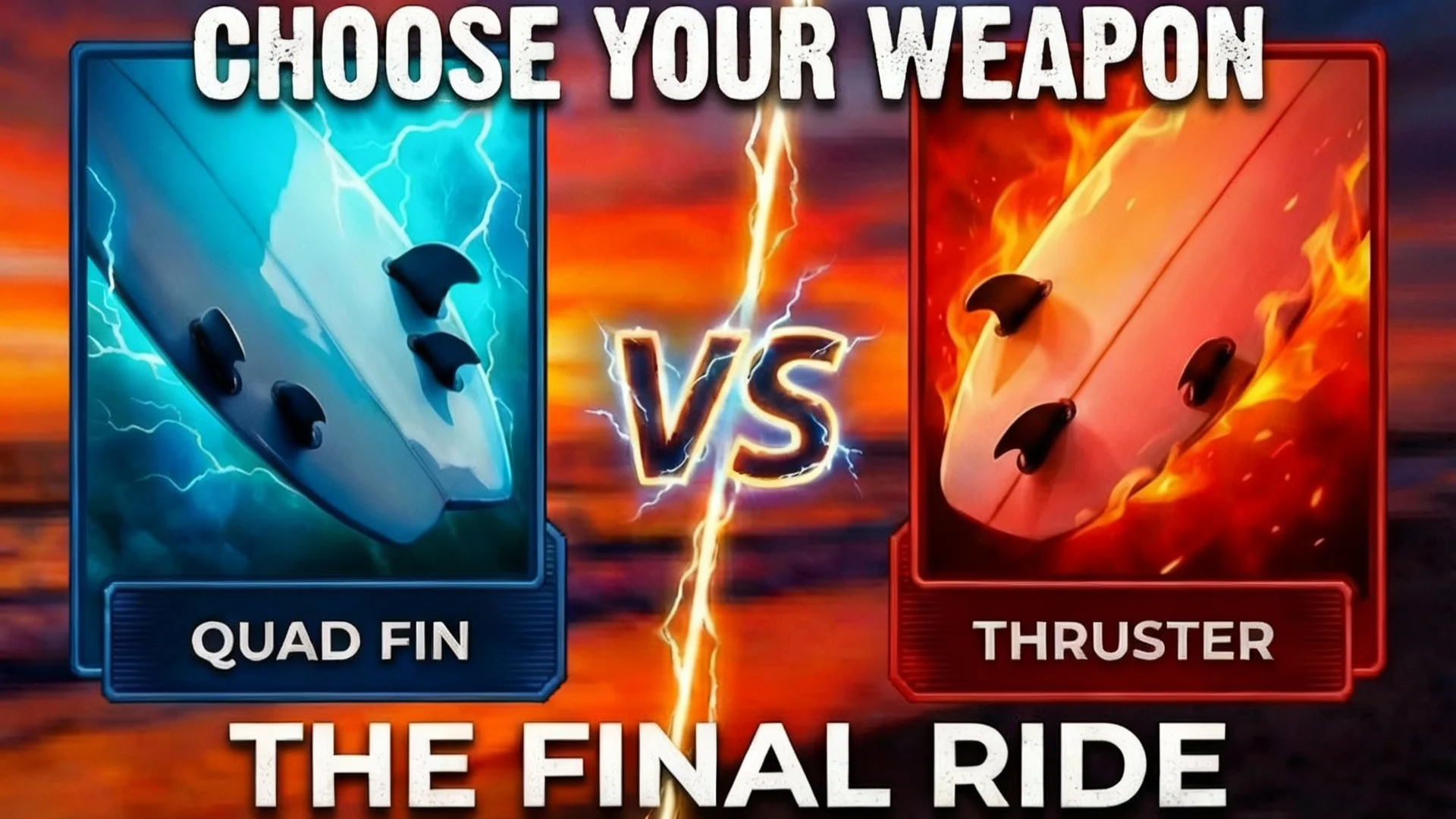
If you're not sure whether your back fin matches your wave, the FinFinder recommender sorts the math in about a minute. Tell it your board, your weight, and where you usually surf, and it tells you what center fin fits. Or read up on how thruster, quad, and twin setups stack up if you're rethinking the whole quiver.
Helpful Resources
Ready to Find Your Perfect Fins?
Use our expert fin recommender tool to get personalized suggestions based on your needs.
Try Fin Recommender