Sebastian Steudtner gets towed into a six-story Nazaré bomb on a 6'6" weighted gun with foot straps and a fin setup most shapers would call wrong for any other wave on earth. Tiny bases. Stiff foils. Cant angles you'd never run on a shortboard. That's not an accident. That's the whole point of tow surfing.
The thing is, when you're hitting 40 mph on the face before you even let go of the rope, the rules of fin design flip on their head.
Tow boards are nothing like the guns under Greg Long at Mavericks
Paddle big wave boards are built for getting into the wave. Long planshape, long fins, every gram of lift dedicated to catching a moving mountain under arm power. Those are the 10' pintails you see Greg Long and Grant Baker swing around at Cortes Bank and Mavs.
Tow boards solve the opposite problem. The ski catches you the wave. Your job is staying on the board through chop, bumps, and the kind of speed your spine wasn't built for.
So tow boards are short. Most sit between 5'8" and 6'8". They're heavy, often with brass weights or extra glass in the deck so they punch through chop instead of skipping off it. And they have foot straps, because at 50 mph a slip is a coffin.
The fins follow that same heavy-and-stable logic.
Speed kills drag, not just surfers
At paddle-in speeds, a wide-based fin gives you drive. It pushes water, and that translates into forward motion. Useful. Necessary.
At tow speeds, that same wide base is a parachute. Speed comes from the wave, not from your fins. Anything generating extra drag is robbing you of control on the face.
That's why tow fins almost universally have:
- Smaller bases for less drag at sustained speed
- Stiffer materials so you don't get flex chatter at 40+ mph
- More rake for smoother, longer arcs through high-G turns
- Thicker foil profiles that favor stability over snap
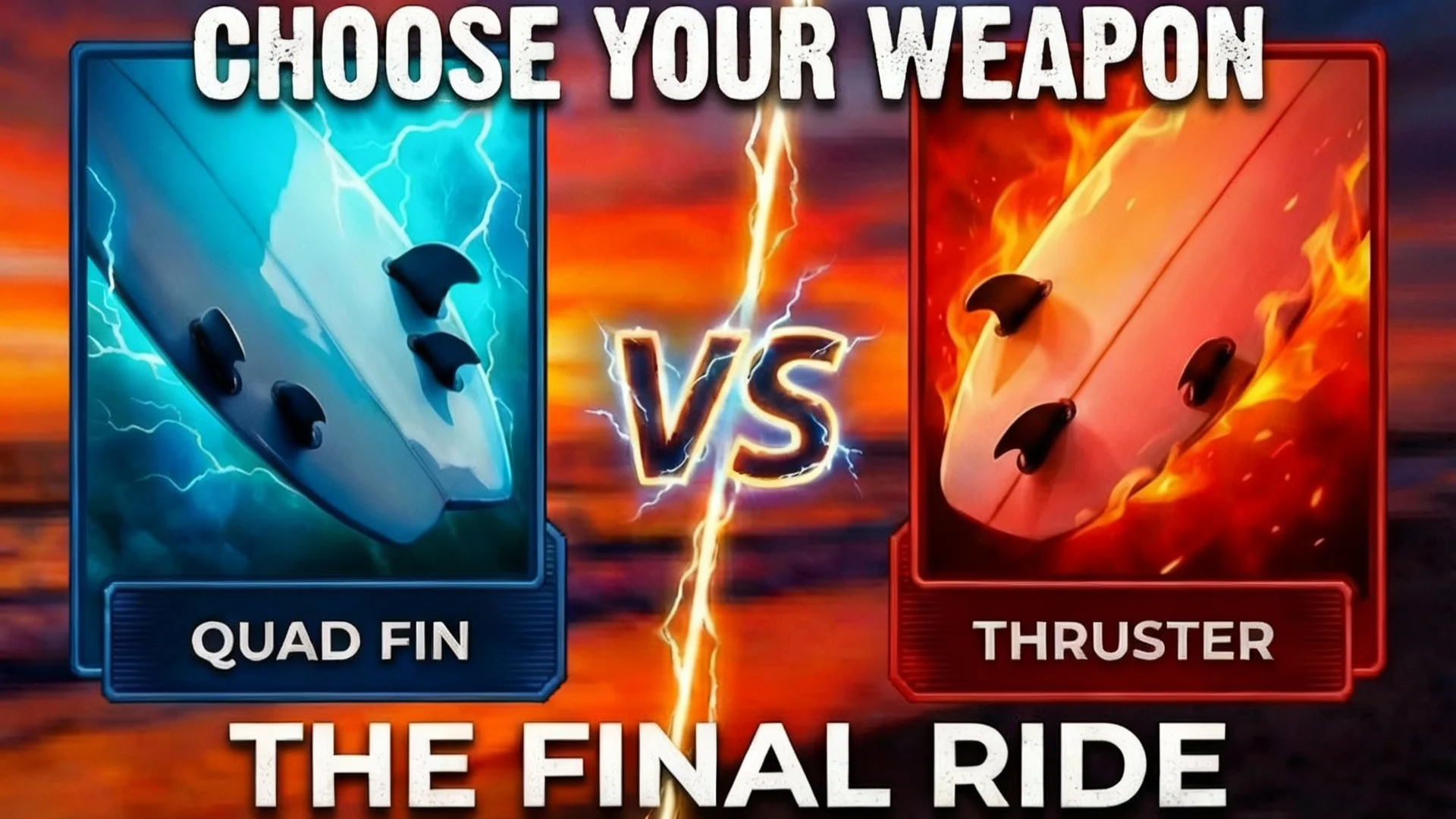
You'll still see thruster setups, quads, and the occasional wild bonzer or twin keel experiment at giant Jaws sessions. But the templates inside those clusters look nothing like what's on your daily driver. If you want a refresher on how the different fin setups compare in normal surf, that page covers it.
The strap factor changes everything
Foot straps do something weird to fin physics. When you can't shift your feet, you can't unweight the tail the way you'd flick out of a turn on a paddle board. Every input has to go through your knees and hips.
That means the fins have to be more forgiving on inputs you can't take back. Riding strapped is closer to snowboarding than to surfing in a lot of ways. The board has to want to track. The fins have to hold without you asking them to.
Which is why most tow templates lean toward stiffer flex patterns and slightly forward cant. You want a board that locks in and stays locked. Loose isn't a feature here.
What pros actually run on tow days
Tow fin setups vary by athlete and wave, but a few patterns repeat.
Quads for Nazaré-style speed runs
Lucas "Chumbo" Chianca and a lot of the Nazaré crew lean quad. Two sets of side fins, no center fin to bog through high-speed transitions. Speed and release. Quads in this configuration are usually shorter than what you'd run on a 5'10" fish, closer to H-series templates from FCS or smaller AM-style inserts from Futures.
Thrusters with a tiny center fin
Kai Lenny has been spotted running thruster setups on tow boards at Jaws, but with a noticeably small center fin. The center fin is there for stability through chop, not for pivot. Think of it like training wheels for high-speed straight running. The trailing fin is also typically softer in flex than the side fins so it absorbs micro-corrections instead of fighting them.
Glass-on for the absolute biggest days
Some of the heaviest tow guns, the 6'10" weighted weapons for 60-foot-plus days, still run glass-on fins. Old school. Locked in. You're not swapping fins on a board you might snap in the first 30 seconds anyway, so why bother with a removable system that adds two tabs of failure point.
It's not just smaller, it's calibrated different
A common misread: tow fins are just shrunken versions of your normal fins. Wrong.
A tow-specific template like the Futures Tow Quad or FCS H-series Tow has a foil profile designed for sustained high-speed water flow. Normal fins assume bursts of acceleration and deceleration. Tow fins assume the whole ride is one long screaming bottom turn followed by a few hopeful arcs at the top of the wave.
Different physics, different shape, different feel.
Should you care if you're never towing into Pe'ahi?
Probably not. The vast majority of surfers will never need a tow setup. If you're reading this from your couch in San Diego, your daily driver fins are doing a fine job and don't need tow-specific anything.
But there's a sneaky takeaway here for everyone else. The tow crew has been running smaller-base, higher-rake fins for stability at speed long before that combo became popular in normal performance shortboard templates. Watch what big wave guys ride, and the trends quietly flow back down to your local lineup three years later.
If you've ever wondered why your H4s feel locked in but loose at the same time, this is part of the answer. The DNA is partially borrowed from a 6'4" tow board ridden into a Cortes Bank bomb a decade ago. Same with the rake-heavy templates in the all about fins breakdown.
Board weight changes how the fins respond
Here's something most non-tow surfers miss. A typical performance shortboard weighs around 6 pounds. A weighted tow board can hit 12 or 14 pounds with brass plugs and extra glass schedules built into the deck.
That extra weight changes the relationship between the fins and the water. Heavier boards plow through chop instead of bouncing on it, which means the fins are in clean water more of the time. Counterintuitively, that lets you run smaller fins than the wave size would suggest, because you don't need extra surface area to fight ventilation in turbulent water.
It also means rail pressure transfers differently. A 6-pound shortboard responds instantly to your back foot. A 13-pound tow gun has inertia. The fins have to bite immediately and hold, because by the time you feel the board doing something wrong at 45 mph, you've already passed the point where you can correct it.
This is also why most tow surfers obsess over fin cant. Slightly outward cant gives more bite when you load a rail, but too much creates twitchiness at speed. Two degrees of difference between templates can be the gap between a clean line and a yard sale.
Why this matters beyond the WSL Big Wave events
Tow surfing got partially banned from the World Tour big wave events years ago, which made some people think the discipline was dying. It isn't. Cross-step ski-driven sessions at Cortes Bank, Pe'ahi, Nazare, and remote outer reef bombies are still where the absolute biggest waves get ridden every winter.
And the fin tech keeps evolving quietly. Carbon-honeycomb foils tuned specifically for sustained 40+ mph flow. Asymmetric tow templates with different left and right side fin geometry for surfers who only ride one direction at certain breaks. These aren't experiments anymore. They're production fins available from both major fin box systems if you know what you're looking for.
Key Takeaways
- Tow boards solve a different problem than paddle big wave guns: control at speed, not catching the wave.
- Tow fins lean smaller, stiffer, and higher-rake because drag becomes the enemy when the wave is doing the work.
- Foot straps change the input game, so most tow templates favor hold over snap and stability over release.
- Quads dominate at Nazaré, thrusters with small centers show up at Jaws, and glass-on setups still ride the absolute heaviest days.
- Fin trends pioneered for tow surfing eventually show up in normal performance templates years later, so what looks niche today might be on your shortboard in 2028.
We built a tool that walks you through fin selection for your actual board and the actual waves you surf, not the 80-foot bomb you'll never see. The Fin Finder handles the boring math so you can skip the guesswork.
Helpful Resources
Ready to Find Your Perfect Fins?
Use our expert fin recommender tool to get personalized suggestions based on your needs.
Try Fin Recommender