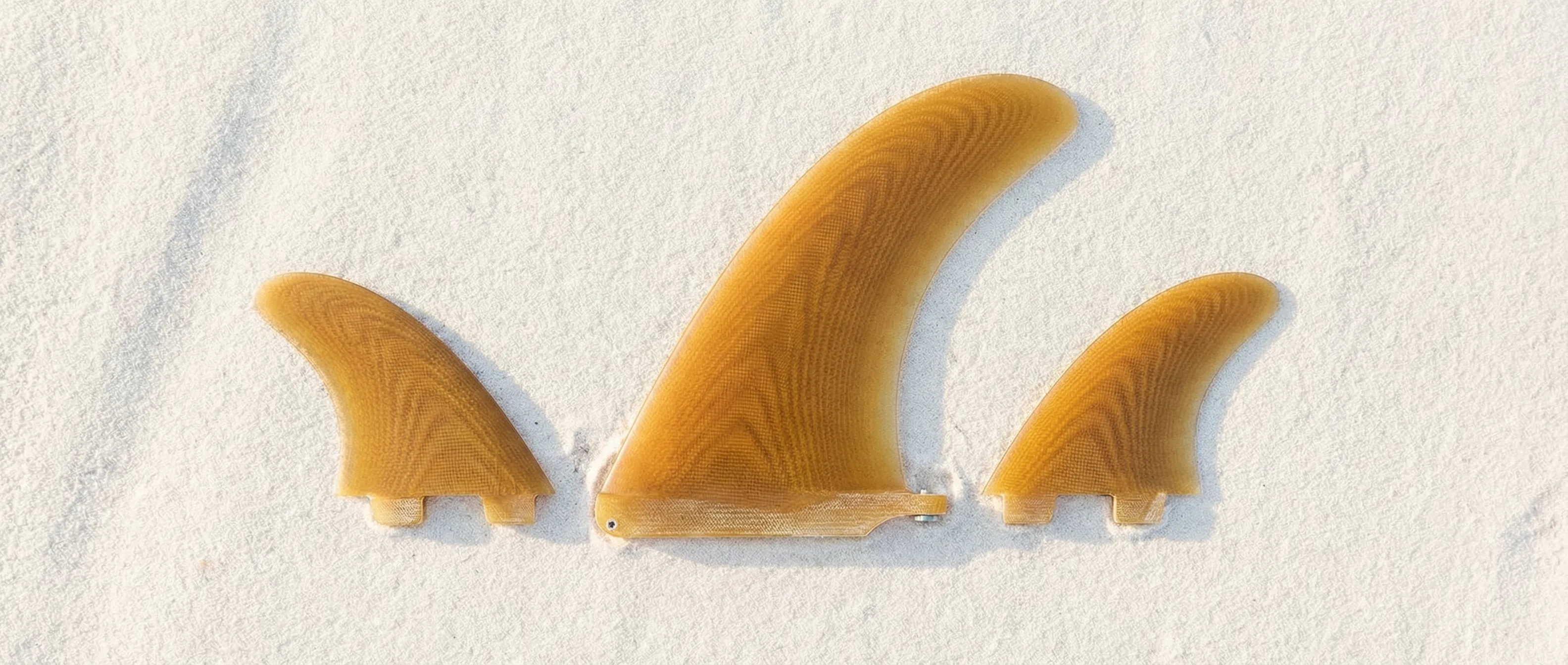
You're standing in the shop staring at a 7'2" egg, and the shaper drops three fins on the counter. One big center fin, two little guys he calls "side bites." You think: is this a single fin? A thruster? Some weird hybrid compromise that doesn't commit to either?
Welcome to the 2+1. And no, it's not a compromise. It's the setup that turned midlengths from clunky transition boards into the most fun thing you can paddle out on in average surf.
What a 2+1 Fin Setup Actually Does
A 2+1 is exactly what it sounds like. One large center fin in a standard US box, flanked by two smaller side fins (side bites) in FCS or Futures plugs. The center fin does the heavy lifting. The side bites are support crew.
But that support crew changes everything.
A pure single fin gives you that long, arcing glide that feels like drawing lines with a calligraphy pen. Smooth, deliberate, soulful. The problem? When you want to go vertical or the wave gets steep, a single fin runs out of hold. The tail slides. You lose confidence in your rail.
Add side bites and suddenly the board grabs when you commit to a turn. You set your rail on a bottom turn and instead of that sketchy moment where you're hoping the fin holds, the side bites lock in and the board says "go harder." It's like the difference between driving on dry pavement versus gravel. Same car, completely different grip.
Who Should Ride a 2+1 (And Who Shouldn't)
The 2+1 belongs on midlengths, eggs, mini-longboards, and funshapes between 6'6" and 9'0". It's the default setup for boards in that awkward-but-amazing range where you want single fin flow without single fin limitations.
Devon Howard, who co-designed the Channel Islands Mid, rides a 2+1 in everything from ankle-high Malibu rollers to overhead point surf. The CI Mid with a 6.5" center and 4" side bites is basically the poster child for this setup. There's a reason it's been one of the best-selling midlengths for years.
You should NOT ride a 2+1 on a high-performance shortboard. That's thruster territory. And if you're on a proper longboard (9'0"+) and want to noseride, a single fin with no side bites gives you the pivot and tail release you need for walking the board. Side bites on a noserider add hold that fights your footwork.
The Center Fin Is the Boss
Here's where most people get confused. In a 2+1, the center fin determines 80% of how the board rides. The side bites are seasoning, not the main course.
A bigger center fin (7"+) gives you more drive and stability. It tracks straight, holds in bigger surf, and feels more like a traditional single fin. Great for heavier surfers or meatier waves.
A smaller center fin (6-6.5") loosens the board up. Less tracking, more pivot, quicker rail-to-rail transitions. This is where the 2+1 starts feeling like a completely different animal. The side bites pick up the slack on hold, so you can run a shorter center fin without the tail washing out.
Think of it like a volume knob. Turn the center fin up (bigger) for stability and drive. Turn it down (smaller) for looseness and play. The side bites are there to make sure you don't spin out when you crank it.
Dialing In Your Side Bites
Side bites typically run between 3.25" and 4.0". True Ames recommends their 3.7" side bites as the sweet spot for most 2+1 setups, and honestly, that tracks with what works on the water.
The Sizing Formula
As your center fin gets bigger, your side bites can get smaller. And vice versa. A 7" center with 3.25" sides gives you a drive-heavy setup that feels close to a pure single fin. A 6" center with 4" sides pushes toward thruster territory with more bite and response.
The most popular combo? A 6.5" center with 3.5-3.7" side bites. It's the sweet spot that gives you single fin soul with enough hold to push through critical sections.
A Trick Nobody Talks About
You can run your side bites loose in their plugs. Not falling-out loose, but with a quarter turn less torque on the grub screw. This lets them flex slightly during turns, giving you a softer, more organic feel. It's subtle, but if you're chasing that buttery mid-turn flow, try it.
How It Feels in the Water
You take off on a chest-high right at your local point break. The first thing you notice is the glide. That center fin gives you this effortless forward momentum, like the board is on rails going down the line. No pumping, no fighting. Just speed from the wave itself.
Then you see a section building ahead. On a single fin, this is where you'd start planning your exit strategy. But with the side bites engaged, you drop your back foot, lean into a bottom turn, and the board holds. Not in a stiff, thruster way where it feels mechanical. More like a gentle correction. The fins say "we got you" and you come off the bottom with speed you didn't have to manufacture.
That's the magic of a 2+1. It surfs bigger than the wave deserves.
2+1 vs Single Fin vs Thruster: The Honest Breakdown
Let's not dance around it.
Single fin gives you the purest glide and the most soulful surfing experience. But it's limited. Steep drops, fast sections, and anything overhead starts exposing the lack of hold. If you want to surf like it's 1972, go single fin and don't look back.
Thruster gives you maximum control and vertical surfing capability. Three equal-sized fins, all working together. It's the competitive standard for a reason. But on a midlength, a thruster can feel overfinned and stiff. Too much grip, not enough glide.
2+1 splits the difference, and I'd argue it does it better than either extreme. You keep that single fin draw and flow while adding just enough stability to push your surfing into sections you'd otherwise bail on. For midlengths and eggs, it's the right call 90% of the time.
Not sure which fin setup matches your board? That's a question worth getting right.
Common 2+1 Mistakes
Running a Center Fin That's Too Big
If your center fin is 8"+ with big side bites, you're creating so much drag that the board feels sluggish. The whole point of a 2+1 is balance. More total fin area doesn't mean better performance. Match your center fin to your board length: roughly 1" of fin per foot of board is a starting point, then adjust from there.
Ignoring the Side Bite Position
The closer your side bites sit to the center fin, the tighter and more responsive the board turns. Further apart gives you a wider, more stable platform. Most boards come with fixed plug positions, but if you're getting a custom, talk to your shaper about cluster spacing. It matters more than people think.
Using Thruster Side Fins as Side Bites
Don't jam your leftover thruster fins into the side plugs and call it a 2+1. Thruster fins are too big, too upright, and have the wrong foil for a side bite role. Purpose-built side bites are smaller, flatter-foiled, and designed to complement a center fin, not compete with it.
Best 2+1 Fin Combos Worth Trying
- True Ames CI Mid 2+1 Set: The gold standard. 6.5" center with matched 4" sides for FCS. Devon Howard approved, and it shows. Ideal for 7'0"-8'0" midlengths.
- True Ames California Classic + 3.7" Side Bites: A more traditional single fin shape with side bite support. Great all-around feel for eggs and funshapes.
- Futures F6 + Side Bites: If you're in the Futures ecosystem, the F6 center fin with matching side bites gives you a clean, neutral setup. Good baseline to start experimenting.
- Captain Fin Tyler Warren 2+1: A rakier center fin for drawn-out turns. Works beautifully on wider-tailed midlengths where you want speed and flow over snap.
For help matching fins to your weight and board size, getting the numbers right makes a real difference with 2+1 setups.
Key Takeaways
- The 2+1 setup combines single fin glide with side bite hold, making it the ideal setup for midlengths, eggs, and funshapes.
- Your center fin controls 80% of the ride. Bigger center fin equals more drive and tracking; smaller equals more looseness and pivot.
- The sweet spot for most riders: 6.5" center fin with 3.5-3.7" side bites.
- Don't use leftover thruster fins as side bites. Purpose-built side bites have a different size, foil, and function.
- For midlengths in the 6'6" to 9'0" range, a 2+1 beats both single fin and thruster setups in versatility.
If you're trying to figure out which center fin and side bite combo fits your board and your surfing, FinFinder's recommender can match the setup to your dimensions and wave conditions in about a minute.
Helpful Resources
Ready to Find Your Perfect Fins?
Use our expert fin recommender tool to get personalized suggestions based on your needs.
Try Fin Recommender