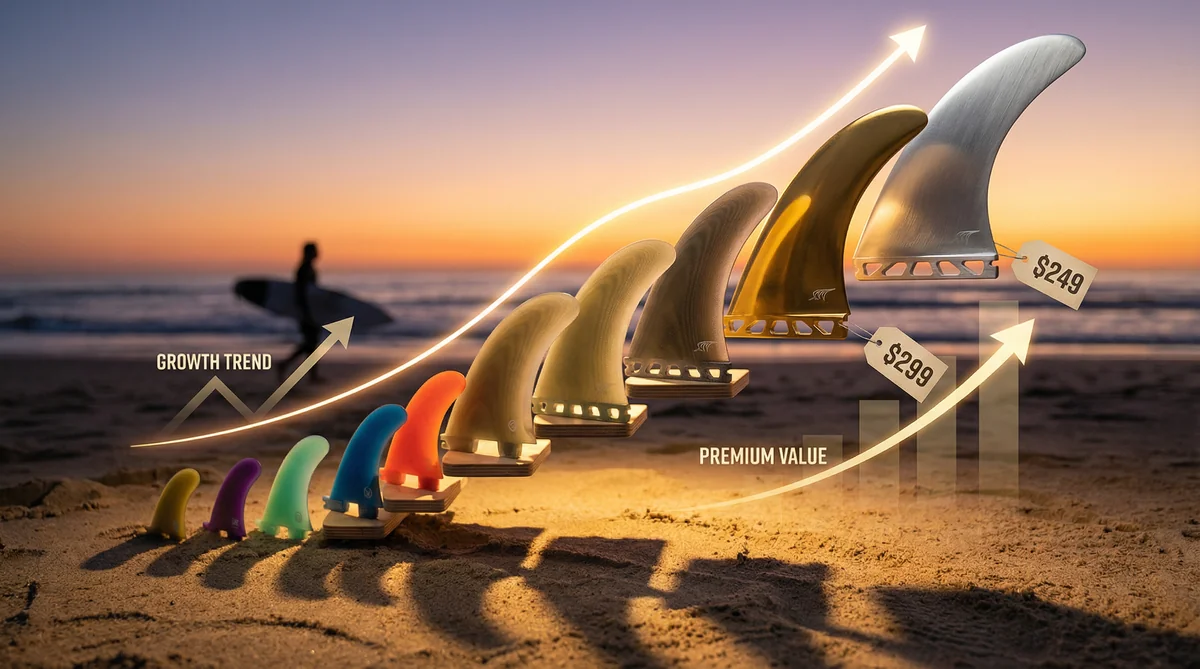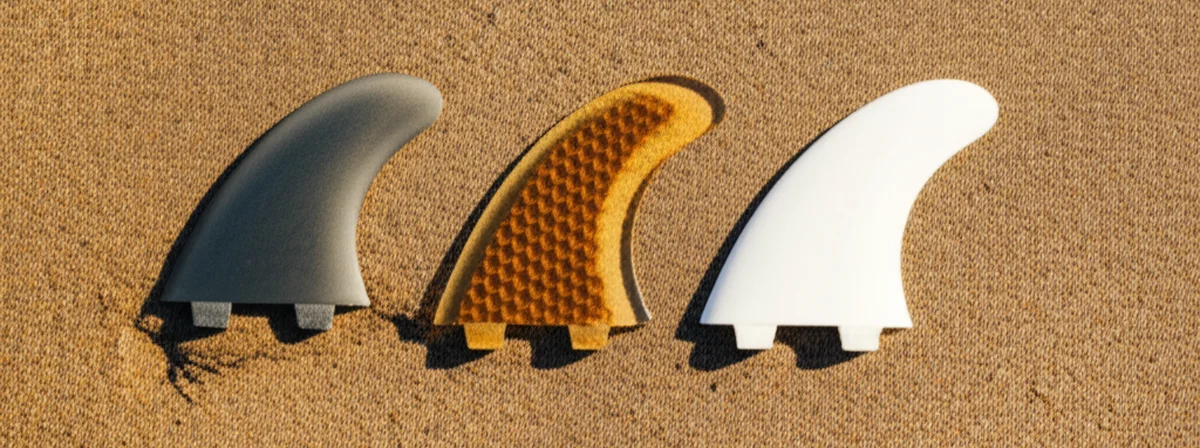
You're at the surf shop staring at three sets of thruster fins. Same template. Same size. Same brand. One costs $35, one costs $90, one costs $150. The guy behind the counter says the expensive ones are "more responsive." Cool. What does that even mean?
It means everything. Fin material is the single most underrated variable in your setup. Surfers obsess over template and size, which matter, but the stuff your fin is made of controls how it flexes, how it rebounds, how fast it responds when you shift your weight. Two identical templates in different materials feel like completely different fins.
Here's what's actually going on inside those three price tiers.
Plastic Fins: The Ones That Came With Your Board
Let's start with the fins you're probably riding right now. If your board came with fins included, they're almost certainly injection-molded plastic, sometimes labeled "composite" or "nylon" to sound fancier. They're not.
Plastic fins flex. A lot. And the problem isn't the flex itself. It's that they flex and don't snap back.
You push into a bottom turn, the fin bends, and instead of springing back with energy, it just sags. Like a wet noodle trying to hold a line. There's no rebound, no drive, no life. You're losing energy with every turn.
That's not an opinion. It's material science. Plastic has poor "flex memory," meaning it deforms under load and returns slowly.
Fiberglass and carbon snap back almost instantly. That difference is the gap between a fin that works with you and one that absorbs your energy like a sponge.
When Plastic Is Fine
Plastic fins aren't evil. If you're learning to surf, they're perfect. They're cheap ($25-35 for a set), nearly indestructible, and they don't punish mistakes the way stiff fins do.
Hit a rock? Scrape the bottom? Your plastic fins will survive. Your $150 carbon set might not.
They're also fine for your beater board. The soft-top you take out when it's junky and you don't care. Nobody needs premium fins on a Wavestorm.
When Plastic Holds You Back
The moment you're trying to generate speed through turns, maintain drive through flat sections, or feel any kind of feedback from the wave face, plastic is working against you. If you've been surfing for more than a year and you're still on stock fins, upgrading your material will feel like getting a new board. Seriously.
Fiberglass Fins: The Sweet Spot Most Surfers Should Be Riding
Fiberglass fins are the workhorse of surfboard fins. They've been the standard in high-performance surfing for decades, and for good reason. The flex pattern is controlled, responsive, and predictable.
Here's how they feel: you set your rail on a bottom turn and the fin loads up. You can feel it bending, storing energy. Then as you redirect up the face, it releases that energy back into the board.
It's like the difference between jumping on concrete versus jumping on a trampoline. The fin works WITH your movement instead of just bending out of the way.
FCS calls their version "Performance Glass" (PG). Futures uses layered fiberglass with honeycomb cores. The construction varies, but the principle is the same: stiff base for drive, controlled tip flex for release. That combination gives you stability through powerful turns and forgiveness when you're not perfectly positioned.
The G10 Standard
You'll hear "G10" thrown around. It's a grade of fiberglass laminate, layers of woven glass cloth bonded with epoxy resin, that's become the benchmark for quality fins. G10 fins are hand-foiled (shaped by machine or hand after molding), which means each fin has a true hydrofoil profile. Plastic fins are just popped out of a mold.
That foiling matters. A properly foiled fiberglass fin cuts through water cleanly, creating lift and reducing drag. A molded plastic fin pushes water around. One slices. The other plows.
What You'll Pay
A quality fiberglass thruster set runs $70-110. That's the FCS II Performer PG, Futures F6 Honeycomb, or similar mid-range options.
For most surfers, this is the best dollar-per-performance upgrade you can make. Forget that new leash or traction pad. Upgrade your fin material first.
Carbon Fins: The Premium Tier That's Not Always Worth It
Carbon fiber fins sit at the top of the food chain. They're the lightest, stiffest, most responsive fins you can buy. And they cost accordingly: $120-180 for a thruster set.
The feel is immediate and precise. You shift your weight and the board responds NOW. There's zero lag between input and output.
Drop into a steep section at somewhere like Blacks in La Jolla, set your rail hard, and carbon fins grip the face with this locked-in confidence that fiberglass can't quite match. Every micro-adjustment you make translates directly to the board.
That precision comes from carbon fiber's insane stiffness-to-weight ratio. Carbon fins can be 20-30% lighter than equivalent fiberglass fins while being stiffer at the base. Less weight in the fins means less rotational inertia, which means faster rail-to-rail transitions and quicker pivot.
Who Actually Benefits From Carbon
Here's where we get honest. Carbon fins are amazing. They're also overkill for 80% of surfers.
You'll feel the difference if you're an advanced surfer generating serious speed, surfing powerful waves, and making quick, aggressive direction changes. The precision of carbon rewards surfers who are already putting significant force through their fins. Guys like Kolohe Andino and Mick Fanning ride Performance Core (carbon) constructions because they're putting forces through their fins that would overwhelm softer materials.
If you're surfing waist-high mush three days a week and doing mellow cutbacks, the gap between fiberglass and carbon won't justify the price. You'll notice the difference in weight when you pick them up, but in the water? Marginal at best.
The Durability Trade-Off
Carbon fins are lighter and stiffer, but they're also more brittle. Fiberglass absorbs impact and bounces back. Carbon can chip, crack, or snap if you hit something hard. That $150 set meeting a shallow reef is an expensive lesson.
Futures' Blackstix line tries to split the difference with a carbon-fiberglass matrix that's lighter and more responsive than pure fiberglass but more durable than pure carbon. It's a solid middle ground if you want carbon-esque performance with better survival odds.
How Material Changes Flex (And Why That Matters More Than You Think)
Same template, different material, completely different flex pattern. This is the part most surfers miss.
A plastic fin with a medium template flexes everywhere. Base, mid, tip, the whole thing bends. That uniform flex means the fin can't hold energy. It's mushy.
A fiberglass fin with that same template flexes primarily in the tip while the base stays stiff. That's "controlled flex."
The stiff base gives you drive and hold. The flexible tip gives you release and forgiveness. You get both stability and maneuverability from one fin.
A carbon fin with that same template barely flexes at all. The base is rock-solid, and even the tip has minimal give.
That translates to maximum responsiveness but zero forgiveness. Every input matters. Every mistake shows.
For a deeper look at how flex patterns affect your surfing, check out our flex guide.
The Honest Verdict: What Should You Buy?
Here's the stance nobody in the fin industry wants to take: most surfers should be riding fiberglass fins and nothing else.
Plastic is for beginners, beaters, and boards you don't care about. Carbon is for advanced surfers in powerful waves who can feel and use the difference. Fiberglass is the right answer for everyone in between, which is about 80% of the surfing population.
If you're riding stock plastic fins right now, jumping to fiberglass will transform how your board feels. That's not marketing.
I rode the same Futures AM2 template in Thermotech (plastic) and then Honeycomb (fiberglass core), and the difference was night and day. The Thermotech felt dead. The Honeycomb felt alive. Same exact template. Different universe.
If you're already on fiberglass and wondering about carbon, ask yourself: am I surfing hard enough to feel the difference? If you're throwing buckets and driving through critical sections at speed, carbon will reward you. If your sessions are mostly about flow and fun in everyday waves, save the money for a trip. Different setups might change your surfing more than a material upgrade at that point.
Quick Material Comparison
| Material | Flex | Weight | Durability | Price Range | Best For |
|---|---|---|---|---|---|
| Plastic/Nylon | Uncontrolled, mushy | Heavy | Very high | $25-40 | Beginners, beater boards |
| Fiberglass/G10 | Controlled, responsive | Medium | High | $70-110 | Most surfers, all conditions |
| Carbon Fiber | Stiff, precise | Light | Moderate | $120-180 | Advanced surfers, powerful waves |
Key Takeaways
- Fin material controls flex pattern and response more than template or size for the same design.
- Plastic fins lack flex memory, meaning they absorb your energy instead of returning it. Upgrade to fiberglass if you've been surfing more than a year.
- Fiberglass (G10, Performance Glass, Honeycomb) is the sweet spot for 80% of surfers: controlled flex, durability, and reasonable pricing at $70-110 a set.
- Carbon fins deliver maximum precision and minimum weight, but the performance gap over fiberglass only shows up for advanced surfers pushing hard in powerful waves.
- Same template in different materials feels completely different. Material isn't just a price tier. It's a performance variable.
Not sure which material matches your surfing? Plug your details into the recommender and it'll sort out material, template, and size in about a minute.
Helpful Resources
Ready to Find Your Perfect Fins?
Use our expert fin recommender tool to get personalized suggestions based on your needs.
Try Fin Recommender