You're sitting at First Point Malibu on a waist-high summer dribbler, watching a guy walk to the nose on a nine-foot log. Five toes over. Then ten. He holds it through the whole inside section, casual as a Sunday. Then, right where you expect him to step back and straighten out, he drops to the tail and snaps a turn off the foam that has no business happening on a board that long.
That turn isn't just footwork. A big part of it is the fin. Odds are he's riding a cutaway longboard fin, the template with a literal notch chewed out of its trailing edge, and it's the single piece of gear that lets a log behave like two completely different boards in one wave.
What a Cutaway Fin Is
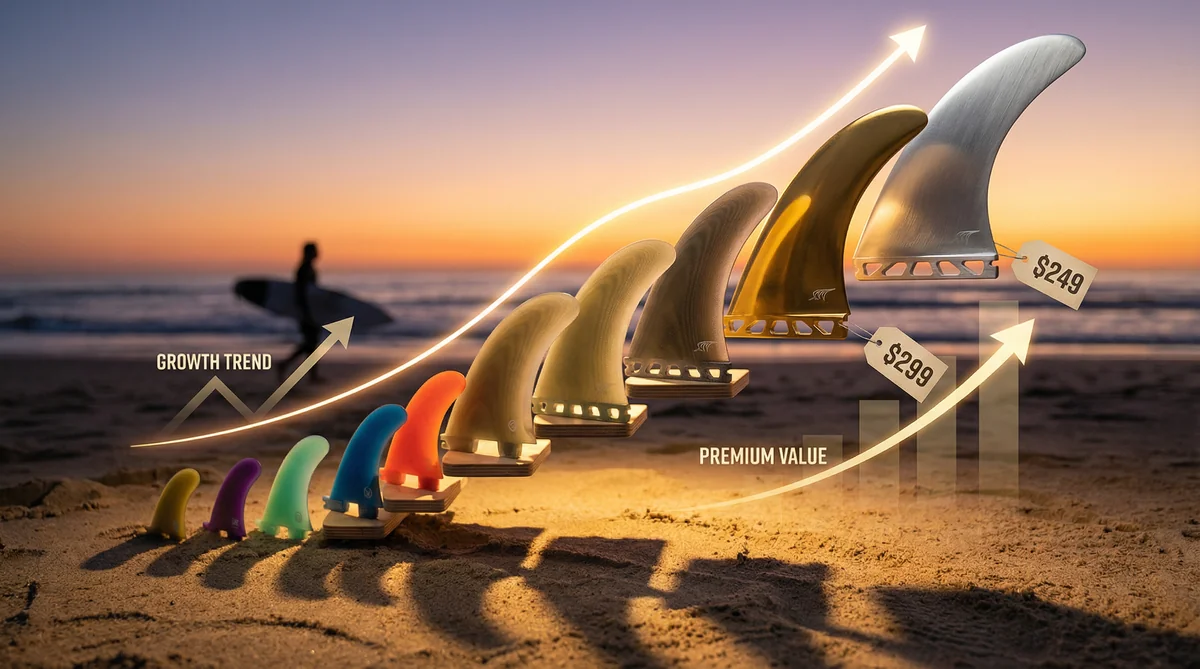
Pull a cutaway out of the box and the shape gives it away. The base, the part that bolts into your fin box, is short. Then the trailing edge swoops up and forward in a clean concave scoop before the fin sweeps back out to a tall tip.
That scoop is the cutaway. Shapers literally cut material away from the back of the base. What you're left with is a tall fin sitting on a narrow foot, with a big chunk of negative space carved out underneath the upper half.
Compare it to a classic pivot fin and the difference is obvious. A pivot fin, the kind a dedicated noserider runs, is a long upright dagger with a wide base and almost no rake. It's built to plant. The cutaway keeps the height for stability but starves the base, and that's the whole trick.
Why the Notch Loosens Everything Up
Drive comes from base length. A long base grips the water and shoves the board forward out of a turn, which is exactly what you want when you're trimming for the nose and don't want the tail wandering.
Cut that base down and you cut the drive. The fin stops wanting to track in a straight line and starts wanting to pivot. Less material in the water also means less drag, so the board frees up and slides through direction changes instead of fighting them.
Here's how it feels. You bury the tail on a bottom turn and instead of the board railroading through a long arc, it spins off the back foot like the fin found a hinge. The nose swings, the rail re-engages, and you're pointing back up the face with this loose, skatey energy that a pivot fin would never give you. On a board that weighs as much as a small child, that responsiveness feels close to cheating.
The Trade Nobody Mentions at the Shop
That looseness costs you something, and it's worth being honest about it.
Ride a cutaway as a straight single fin and you'll notice the board doesn't hold the nose the way a pivot fin does. The narrow base means less drive and a little less of that locked-down stability when you walk forward. In gutless, slow waves, you'll feel the tail get loose right when you want it glued.
So a cutaway in a single-fin box is a compromise fin. It noserides okay and turns great, but it's a jack-of-both-trades. The pivot fin still owns the nose, and it isn't close. If hanging ten is your entire reason for living, a cutaway alone isn't your fin. We broke down that exact tension in our guide to pivot versus flex single fins, and the short version is that you're always trading hold for release.
Where the Cutaway Comes Alive: The 2+1
The cutaway was basically built for a 2+1 setup, and that's where it stops being a compromise and starts being a weapon.
Drop a cutaway center fin into the box, add a pair of side bites, and the math changes. The side fins hand back the drive and hold the cutaway gave up. Now you've got a board that walks to the nose with enough stability to be useful, then snaps off the bottom with real performance bite. True Ames describes this combo as snappy turns and quick cutbacks with a lively feel, and for once the marketing copy matches what your feet report.
That's why nearly every high-performance longboard you see under a competitive logger runs this exact arrangement. Watch Harley Ingleby or Taylor Jensen surf a contest heat and you're looking at a cutaway-style center fin doing the heavy lifting between their noserides and their tail snaps. The fin lets one board cover both halves of the scoresheet.
Sizing and Setting One Up
Cutaways run shorter than the pivot fins logs usually wear, because you don't need as much area when side bites are sharing the load.
For a 2+1 performance longboard:
Most cutaway center fins live in the 6 to 7.5 inch range. On a 9-foot board, a 6.5 to 7 inch cutaway with a set of side bites is the sweet spot. Smaller frees the board up more, larger adds hold and drive back in.
For a single-fin box:
You can run a cutaway solo, but size up toward the 8 to 9 inch range to claw back some of the drive and nose stability you're losing without side fins. Just go in knowing it'll feel looser and less planted than a true pivot fin.
Real-world options aren't hard to find. True Ames, Futures, and Rainbow Fin Company all make well-regarded cutaways, and most performance logs come pre-drilled for the side boxes you'll want. If you're fuzzy on how the center and side fins split the work, the fin setups guide walks through how a 2+1 actually balances out.
Who Should Ride One
Real talk: the cutaway isn't a noserider's fin and it isn't a beginner's fin. It's for the surfer who refuses to choose between trim and turns.
If you ride a high-performance or hybrid longboard, surf a mix of points and beachbreaks, and want one board that can cross-step to the nose and then actually carve, the cutaway in a 2+1 is the answer. It's the most versatile center fin you can bolt into a log.
If you ride a heavy traditional log and live for stalling under the lip with ten toes over, skip it. Run a proper pivot fin and don't look back. The cutaway will just make your nose feel nervous.
Key Takeaways
- A cutaway fin has a notch scooped out of its trailing-edge base, leaving a tall fin on a narrow foot. That short base trades drive and hold for looseness and pivot.
- As a single fin, a cutaway turns great but won't hold the nose like a dedicated pivot fin. It's a compromise in a single-fin box.
- The cutaway shines as a 2+1 center fin. Side bites restore the drive and hold it gives up, creating a log that noserides and snaps off the tail.
- Size a 2+1 cutaway center around 6.5 to 7 inches on a 9-foot board. Go bigger (8 to 9 inches) if you're running it solo in a single box.
- Built for performance and hybrid longboards, not heavy traditional noseriders. If hanging ten is the whole point, ride a pivot fin instead.
Not sure whether your board wants a cutaway, a pivot, or something in between? Tell the FinFinder recommender what you ride and how you actually surf, and it'll match you to a template instead of leaving you guessing in the fin aisle. The broader theory on longboard fins lives in our longboard fins guide if you want the full picture first.
Helpful Resources
Ready to Find Your Perfect Fins?
Use our expert fin recommender tool to get personalized suggestions based on your needs.
Try Fin Recommender