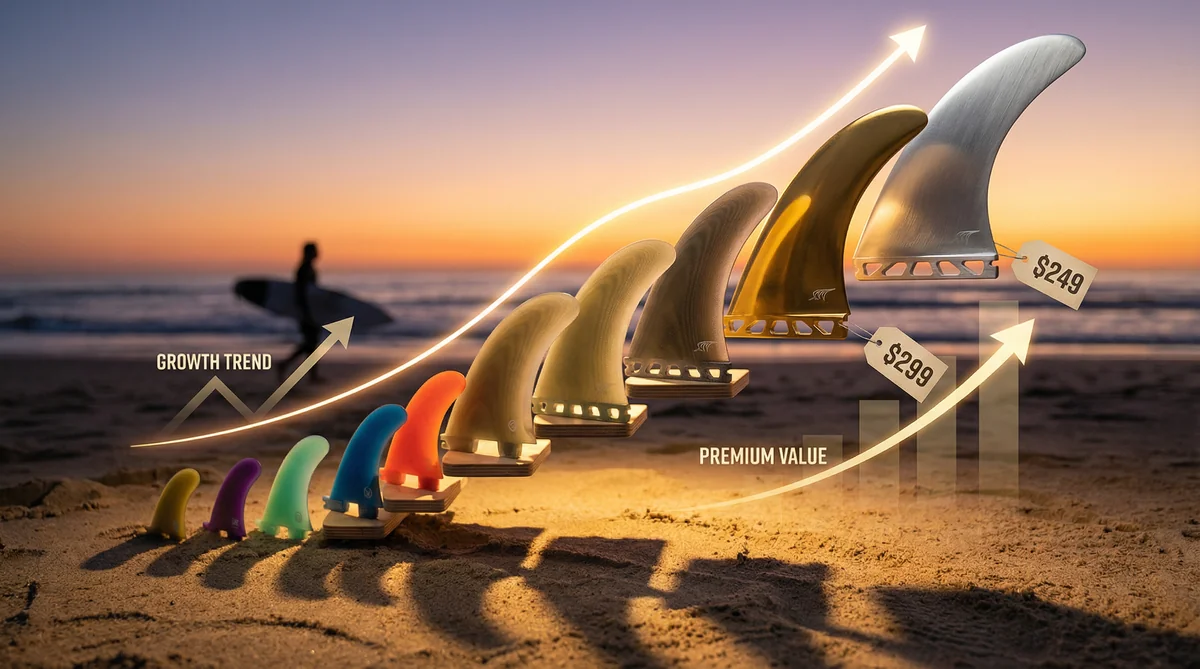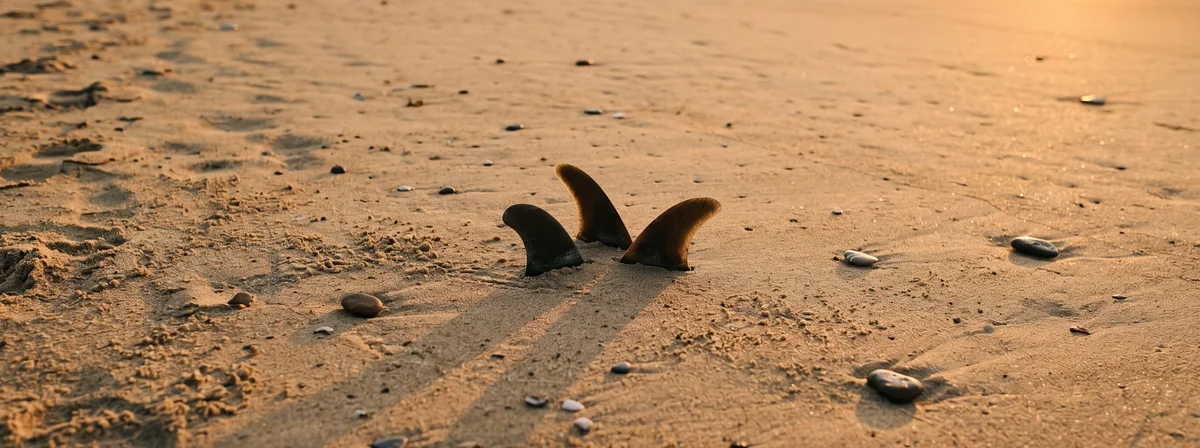
You order two custom shortboards from the same shaper. Same length, same width, same volume, same outline.
You ride the first one and it feels like a missile, drawing long arcs and refusing to spin out. The second one wants to pivot under your back foot before you've even committed to the turn. Same spec sheet, two completely different brains.
The shaper moved the side fins.
Not the fins themselves. The cluster. The geometry of where those boxes sit on the board, and how far apart they are. It's the spec almost nobody measures and the one that quietly decides how your board turns.
What Fin Cluster Spacing Actually Is
Cluster spacing is the relationship between the three (or four, or five) fin boxes a shaper glassed into your board. Three numbers do most of the work.
Distance from the tail block. Distance from the rail. And the toe-in angle pointing your side fins toward the nose.
For a standard high-performance shortboard, the side fins typically sit around 11 to 11.5 inches from the tail block, and the center fin lives around 3 to 3.5 inches up from the tail. Side fins ride about 1.25 inches off the rail, with somewhere between 1/8 and 3/16 of an inch of toe-in. Those numbers sound boring until you realize that shifting any one of them by a quarter inch changes how the board feels under your feet in a way no fin swap will ever match.
Tighter cluster, looser board. Wider cluster, draggier and drivier board. That's the whole game in one sentence.
The Tight Cluster: Skatey, Pivoty, A Little Nervous
A tight cluster pulls the side fins closer to the center fin, both forward and inward. The water column working across all three fins is shorter and tighter, which means the board breaks free of its track faster. You think about a turn and you're already in it. There's almost no delay between intention and rotation.
This is what most modern groveler shapers do on purpose. The Lost Puddle Jumper, the Slater Designs Houdini, anything labeled "high performance small wave," they all run on the tighter side. You drop in on a head-high mushburger, pump twice, and the board redirects off the top with this nervous, twitchy energy that feels like it weighs nothing.
The tradeoff shows up at speed. Push that same board into overhead surf and the cluster that felt magic at 2 feet starts to chatter. The fins want to release before you've finished your bottom turn. You spend the wave fighting the board's reflexes instead of using them.
The Spread Cluster: Drivey, Locked In, A Little Stubborn
A wider cluster does the opposite. The side fins sit farther forward and slightly farther from the rail. The water has more board to grip across, and the fins sweep through a longer arc when you set a rail.
Drive goes up. Hold goes up. The board feels like it has weight even when it doesn't.
This is what step-up shapers default to. The Channel Islands Twin Pin in step-up trim, the Pyzel Ghost, the JS Monsta, all of them. You feel it the second you paddle into something serious.
The board sets a rail and stays there. Your bottom turn draws this confident, drawn-out line that ends exactly where you wanted it to. The board says "I got this," and you believe it because you can feel ten inches of fin column gripping the wave face.
The price you pay is in mush. A spread cluster in 2-foot crumble feels like surfing through wet sand. The drive that saves your life at Sunset is the same drive that bogs you out at home.
How Different Shapers Set Their Clusters
Every shaper has a house geometry. Al Merrick's standard high-performance layout sits in the middle of the road, which is part of why Channel Islands boards have been the safe choice for decades.
Mayhem at Lost runs tighter clusters on his small-wave models and opens them up dramatically on his step-ups. Pyzel Ghosts and Phantoms are known for spread clusters that hold in big surf. JS goes wider on the Monsta line for drive in punchy beach breaks.
None of this is in the marketing copy. You won't find "11 3/8 inch front fin position" on the website. You'll find "drives off the bottom turn" and "loose under your back foot," which are just shaper-speak for the cluster they laid out.
If you really want to know what a board does before you buy it, lay a tape measure across the bottom and measure the boxes yourself. The board will tell you the truth before the website does.
Why Quads Are a Different Conversation
On a quad, the cluster question splits in two. You have a front cluster and a rear cluster, and the gap between them is the spec that matters most.
A short gap (rear fins close to front fins) makes the board feel like a thruster with no center. Loose, fast, but holds well. A long gap (rear fins pushed way back) gives you that classic locked-in fish drive where the board accelerates out of every section and refuses to skid.
Read more about how this plays out across different fin setups, because cluster geometry interacts with setup choice in ways most surfers never think about.
What This Means When You Buy Off the Rack
You can't change your cluster spacing once a board is glassed. The boxes are where they are. What you can change is the fin you slot into them, and that's where understanding your cluster becomes useful instead of academic.
If your board has a tight cluster and feels twitchy, you don't need a "looser" fin. You need a fin with more rake and a longer base to put some drive back into the equation. If your board has a spread cluster and feels stuck, you don't need a "drivey" fin. You need a more upright template to give you pivot the geometry doesn't.
This is also why the forward-or-back position within the box matters so much on boards that allow it. You're effectively tuning your cluster after the fact, in 1/8 inch increments, on the only axis the shaper left you.
The Sensory Test
Want to know what your board's cluster is doing without reading specs? Paddle out and try one thing. Set up for a long bottom turn and let the board do its work without forcing it.
If it draws a sweeping arc and finishes high in the pocket, your cluster is on the wider side. If you're already vertical halfway through the bottom turn and the tail wants to break free, your cluster is tight. Neither is wrong. They're just different tools, and they want different fins to balance them out.
Most surfers blame the fin when the board feels off. Half the time, the fin is fine. The cluster is the conversation nobody is having.
Key Takeaways
- Cluster spacing is the geometry of where your fin boxes sit on the board. It's set by the shaper and you can't change it after glassing.
- Tight clusters feel pivoty and loose. They shine in small to medium surf and chatter at speed.
- Spread clusters feel drivey and locked in. They love size and bog in mush.
- The same fin in a tight cluster behaves nothing like that fin in a spread cluster. The cluster is the bigger variable.
- If your board feels off, look at the fin template you're running against the cluster geometry before blaming either one.
Cluster spacing isn't a spec you can change after the fact, but the fin you slot into it is. Tell our recommender what board you're trying to wake up and it'll match a fin to the geometry your shaper already locked in. That's most of the work.
Helpful Resources
Ready to Find Your Perfect Fins?
Use our expert fin recommender tool to get personalized suggestions based on your needs.
Try Fin Recommender