You're at Lowers on a waist-high morning, pumping like your heart rate depends on it, and the board just won't run. The shoulder's soft, your timing is clean, and some kid on a fish still glides past you doing half the work.
That's not a fitness problem. That's drag. More specifically it's fin drag, and you've been quietly paying it on every wave you've ever ridden.
Here's the trade nobody mentions when you buy your first set of fins. The same surfaces that grip the face and let you turn are also plowing through the water the entire ride. Lift and drag come as a pair. You don't get to order one without the other.
Your Fins Are Braking Even When You're Going Straight
Trim down the line on a clean wall and it feels like the board is doing nothing but accelerating. It isn't. Your fins are still dragging the whole time, just quietly.
Two things are happening even in dead-straight trim. Water rubbing along the fin's surface creates friction. And the fin shoves water aside as it moves, leaving a small churning wake behind it. Both cost you speed, and they never switch off.
This is the baseline tax. You pay it on every wave whether you turn or not. The only question is how big the bill is, and that's where your setup decisions start to matter.
The Four Ways a Fin Steals Your Speed
Drag isn't one thing. It's a stack of separate penalties, and knowing which is which tells you what to change.
Skin friction
Water is sticky against a surface. The bigger the wetted area of your fins, the more friction you generate. This is the boring, constant drag that scales straight with fin size.
More fin, more area, more friction. It's why a set of big keels feels gluey compared to small grovel fins.
Form drag
This is the wake. As the fin pushes through, water can't close cleanly behind it, so it tumbles into turbulence and pulls backward on the fin. A thick, blunt foil makes a fat wake. A clean, tapered foil lets the water knit back together with less fuss.
Induced drag
This is the price of lift itself, and it's the sneaky one. The moment your fin makes a sideways force to hold a turn, it spins energy off its tip into a little vortex. That vortex is wasted speed.
The harder you lean, the more lift you make, and the more induced drag you eat. Drag climbs faster than lift does, which is exactly why a hard, committed bottom turn scrubs speed and a lazy one doesn't. We dug into that lift-versus-drag tradeoff in the post on how fins actually generate lift, and it's the engine behind everything here.
Surface drag
Run your fins near the surface, like when the board goes vertical off the top, and you start dragging on the boundary between water and air. Done wrong this tips over into ventilation, where the fin sucks air down and lets go entirely. That greasy, skating-on-ice feeling at the top of a wave is the extreme version of this.
The Center Fin Tax
Now the practical part. The single biggest chunk of drag you can choose to remove is your thruster's center fin.
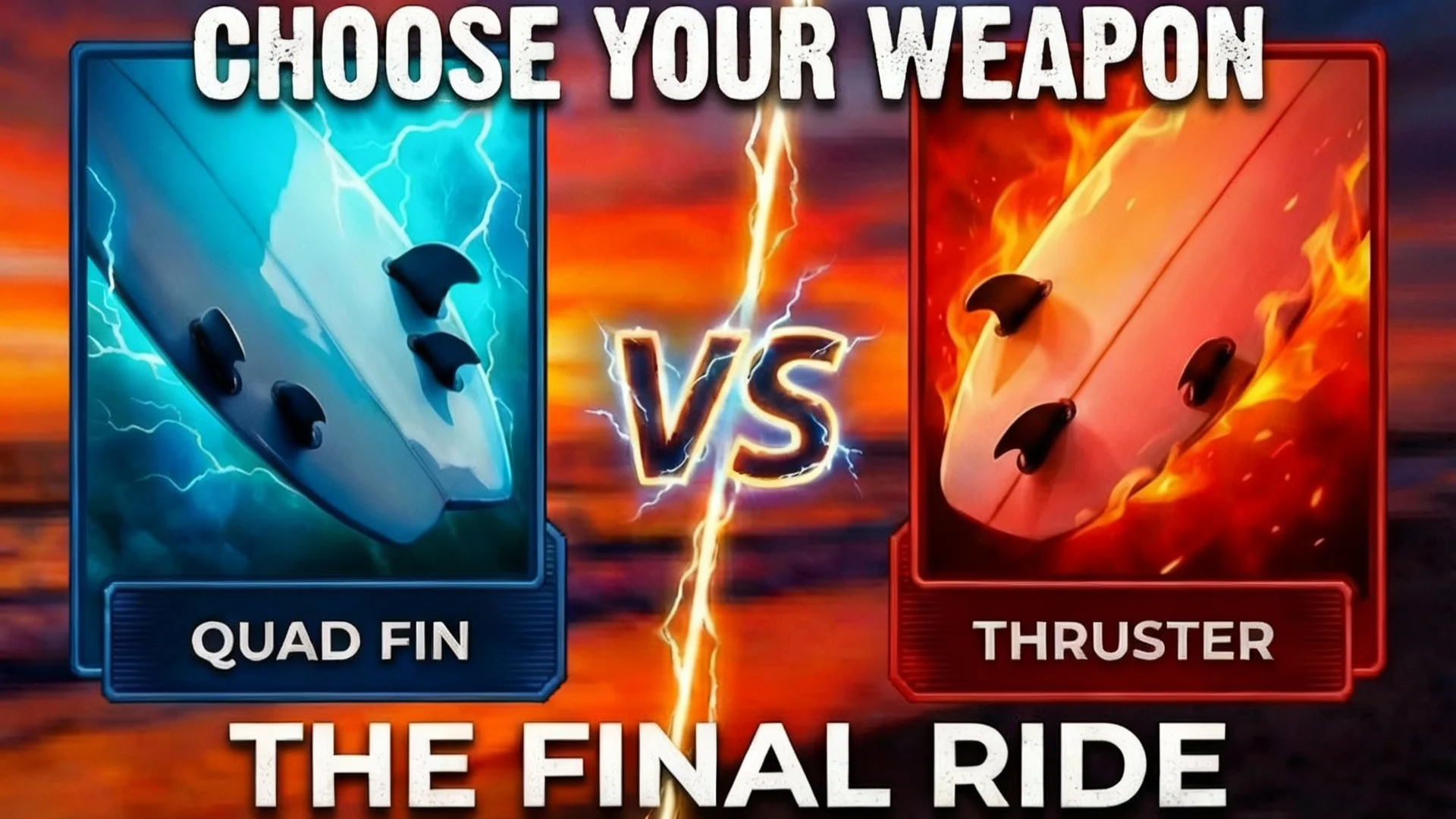
A trailing center fin sits dead in the water flow and does almost nothing for straight-line speed. It's pure friction and wake until you load it up in a turn. That's the whole reason quads feel faster in weak surf. Pull the center fin out and you delete its drag entirely.
You feel it instantly. Drop into a gutless two-foot section on a quad and the board picks up this free-rolling glide, like someone unclipped a parachute from your tail.
Mick Fanning didn't ride quads at J-Bay for fun. He rode them because down a long, fast wall, that center fin is a brake he didn't need. We broke the full comparison down in quads versus thrusters, but the speed difference is mostly a drag story.
The catch is that the center fin earns its keep the second the wave stands up. It anchors your tail and holds a line through powerful, vertical turns. So the tax is worth paying when the wave has juice, and a waste when it doesn't.
The Drag You Build In On Purpose
Some drag is baked into your setup before you ever paddle out. Toe-in is the big one.
Your side fins aren't pointed straight back. They angle in toward the nose, usually around 5 to 10 degrees. That angle means each fin is running at a permanent slight angle of attack even in straight trim, generating a little lift and a little drag at all times.
It's a deliberate trade. Toe-in makes the board feel responsive and lively off the bottom, and you pay for that liveliness with a touch of constant drag.
Crank in too much toe and the board gets twitchy and slow down the line. Back it off and the board runs faster but feels stiffer to engage. Cant works the same way, tilting the fins out to free up the rail at the cost of a bit of straight-line efficiency.
If you want the full breakdown, we covered cant and toe-in angles separately. The point here is that these aren't free. They're drag you signed up for on purpose.
How Good Fins Cheat the Tax
You can't escape drag, but a well-designed fin pays a smaller bill for the same grip. Three things do the heavy lifting.
Foil is first. A clean, smoothly tapered cross-section lets water flow attached for longer before it breaks into turbulence, which shrinks form drag. A lot of cheap molded fins skip this and you can feel the sluggishness.
Aspect ratio is second. A taller, narrower fin makes more lift for less induced drag than a short, wide one, the same reason glider wings are long and skinny. That's part of why upright templates feel quick and efficient, which we got into in the piece on fin aspect ratio.
The base fillet is third and most overlooked. That little smooth flare where the fin meets the board isn't styling. It cleans up the messy, draggy flow right at the root, and CFD testing has shown it measurably cuts drag. Small detail, real speed.
So How Much Speed Are You Really Losing?
Here's the honest take. Drag isn't your enemy. The wrong drag for your waves is.
Most everyday surfers in soft, gutless beach break are running too much fin. Big, stiff thruster sets built for power waves, dragging hard through sections that have no push to begin with. They're paying a fat drag tax for hold they never use, then wondering why the board feels slow.
If your home break is waist-to-chest mush most of the year, smaller fins or a quad will free up speed you didn't know you were missing. If you surf real power, keep the area and the center fin. Drag is the cost of grip, and when the wave's trying to throw you, grip is worth every bit of speed it eats.
Key Takeaways
- Fin drag never turns off. Even in straight trim, skin friction and wake are scrubbing speed the whole ride.
- Induced drag is the cost of lift itself, and it rises faster than the lift does. That's why every hard turn trades speed for hold.
- The thruster's center fin is the biggest chunk of drag you can choose to delete. Pulling it for a quad frees up real glide in weak surf.
- Toe-in and cant are drag you build in on purpose to gain responsiveness. More of either means more drag down the line.
- Clean foils, higher aspect ratios, and a proper base fillet all buy you the same grip for less drag. It's why good fins feel faster.
- The goal isn't zero drag. It's matching your fin area and setup to how much push your waves actually have.
Figuring out how much fin you can drop without losing the hold you need is mostly a math problem, and it's the exact math our fin recommender runs. Tell it what you ride and the waves you surf, and it'll sort the area and setup so you stop dragging more fin than your breaks deserve.
Helpful Resources
Ready to Find Your Perfect Fins?
Use our expert fin recommender tool to get personalized suggestions based on your needs.
Try Fin Recommender