You're surfing your quad at Blacks on a head-high south swell. The speed is unreal. You're flying down the line with zero pump needed, threading sections you'd never make on a thruster.
Then you set your rail for a bottom turn and the tail slides. Not a little. A full-on drift that sends your stomach into your throat.
You recover, but that confidence is gone.
This is the quad paradox. All that speed, all that freedom, and then the moment you need the board to hold, it squirrels out on you. Thousands of surfers have ditched their quads over exactly this feeling. Most of them didn't need a new fin setup. They needed one tiny addition.
The Nubster: Surfing's Best-Kept $25 Secret
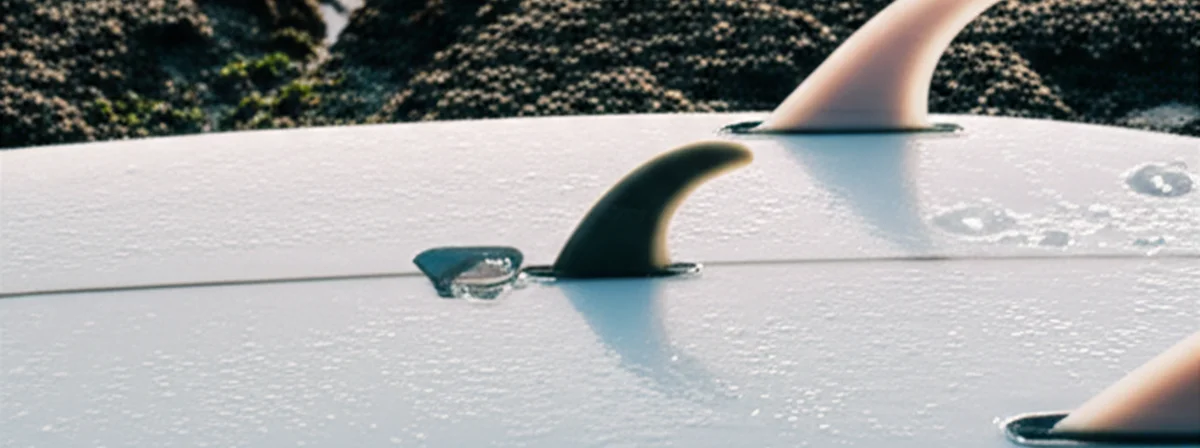
A trailer fin is a small center fin that sits in the fifth plug behind your quad fins. It's also called a nubster, a knubster, or (my favorite) a guitar pick. At roughly 1.7 inches tall with a 3.7-inch base, it's barely bigger than your thumb.
But it changes everything about how your quad holds through turns.
Sean Mattison, a former pro surfer and coach out of Oceanside, California, designed the original Nubster to solve the exact problem above. Quads generate ridiculous speed because there's no center fin creating drag. But that missing center fin also means less directional stability when you're loading your rail on a steep face.
The nubster splits the difference. It sits low enough that it doesn't create meaningful drag when you're flying straight. But when you engage your rail and the board tilts, that little fin catches water and gives you a subtle anchor point. Drive through the bottom turn. Release off the top.
How Kelly Slater Made the Guitar Pick Famous
The nubster went from shaping-bay curiosity to mainstream surfing gear in a single contest. Kelly Slater ran one in his quad setup at the 2011 Quiksilver Pro New York and made the finals. Martin Potter and Peter Mel called it the guitar pick on the broadcast. Mattison sold hundreds overnight on his Von Sol website.
Slater himself said the nubster made his quad "faster, smoother, and adds a little more control." Not exactly a ringing endorsement from a man known for understatement. But he kept riding it. He used it through his 11th world title campaign.
That's not a gimmick. That's an 11-time world champion choosing this fin when everything was on the line.
What a Trailer Fin Feels Like Under Your Feet
You won't notice it paddling out. You won't notice it duck diving. The first time you feel a trailer fin is on your first real bottom turn.
You drop in, angle toward the bottom, and set your rail. Where your quad used to slide, the board grips. Not like a thruster grip where you feel the center fin biting hard and steering you. More like a gentle hand on your shoulder.
A suggestion, not a command. The board says "I'm here if you need me" and then lets you decide how hard to push.
Off the top, you barely know it's there. At 1.7 inches tall, the nubster is so short it doesn't engage when the board is flat or when you're releasing the tail for a snap. All the quad looseness you love on the lip stays intact.
That's the trick. It only works when you need it and disappears when you don't.
When to Add a Trailer Fin to Your Quad
Your Quad Feels Too Loose in Bigger Surf
Quads thrive in small-to-medium waves where speed generation matters most. But when the waves get overhead and hollow, that missing center fin can make the tail feel unpredictable. A trailer fin adds just enough hold to surf your quad with confidence when the waves have push. If you've ever wished your quad felt more planted in solid surf without switching back to a thruster, this is the move.
You're Transitioning From Thrusters
Going from a thruster to a pure quad can be jarring. The looseness freaks people out. Adding a nubster for your first few sessions on a quad setup gives you training wheels you can remove later.
Some surfers remove it after a month. Others never take it out.
You Surf Hollow Reef Breaks
This is where trailer fins shine brightest. Fast, hollow waves where you want quad speed but can't afford to have the tail slide on a critical bottom turn. Think Pipeline, Uluwatu, or your local slab. The nubster gives you that extra half-second of hold that can be the difference between making the barrel and going over the falls.
When to Skip the Trailer Fin
Not every quad needs a nubster. If your quad already feels dialed and you love the loose, skatey feel in small surf, don't mess with it. Adding a trailer fin tightens the turning radius slightly. In 2-foot mushburger conditions where you want maximum tail freedom, that extra stability works against you.
Also skip it if you're riding a wide-tailed fish with keel fins. Keels already provide tons of drive and stability from their massive surface area. A nubster on a fish feels redundant. It's like putting a seatbelt on a seatbelt.
Which Trailer Fin to Buy
You don't need to overthink this. Three solid options:
- FCS II VS Fin: The FCS version of the nubster. Pops right into any FCS II center box. About $25. Clean, simple, works.
- Futures TMF (The Middle Finger): Futures' take on the trailer fin. Same concept, same rough dimensions, fits Futures boxes. Around $30.
- Ho Stevie Nubster: Budget option that performs surprisingly well. $15-20 and compatible with most center plugs.
The performance differences between these are minimal. Fin material, foil, and flex barely matter at this size. Just match the fin to your fin box system and you're good.
The 4+1 Setup vs Pure Quad vs Thruster
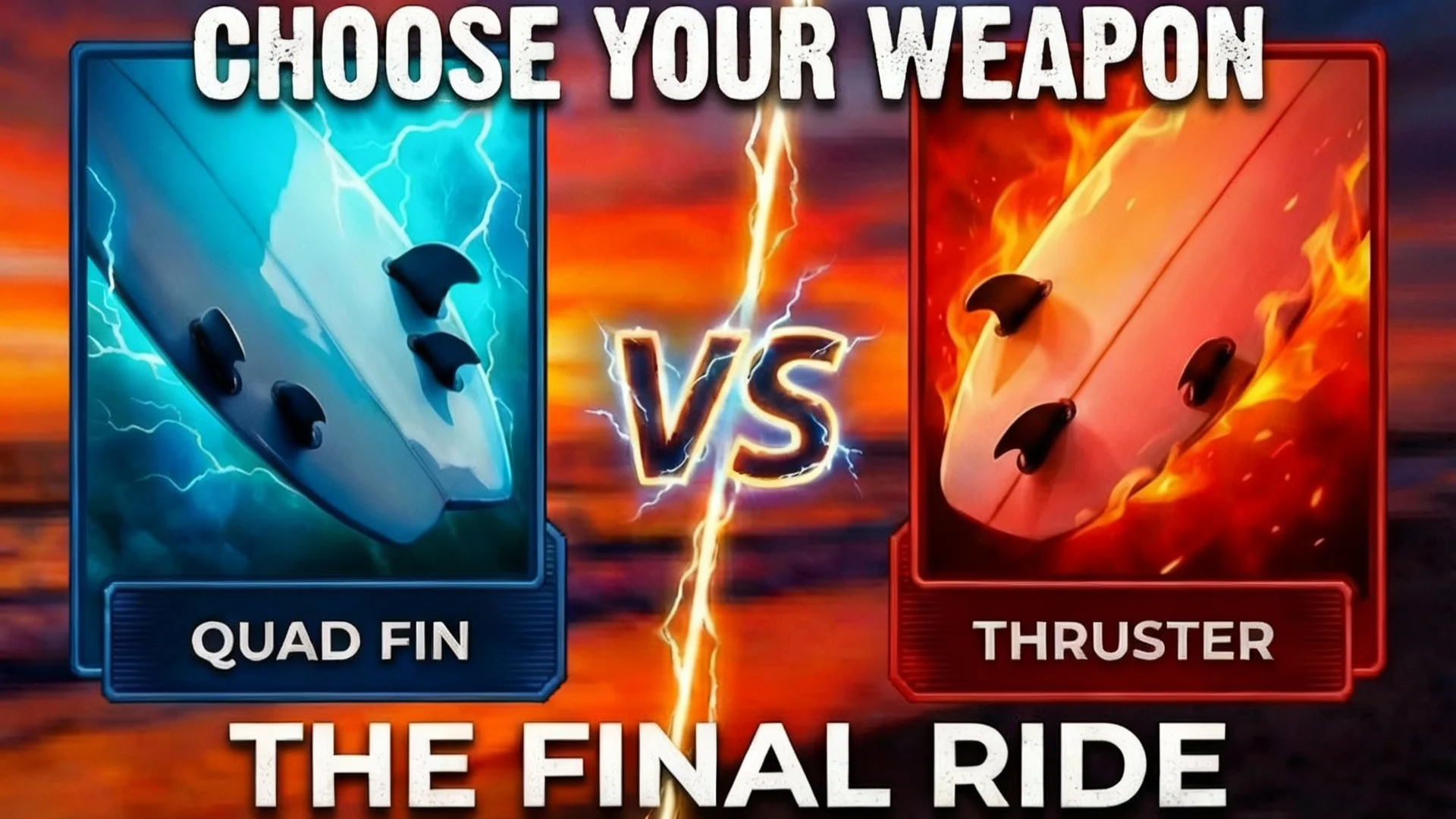
The 4+1 (quad plus trailer) sits right between a pure quad and a thruster on the control-to-speed spectrum. Here's the honest breakdown:
- Pure quad: Maximum speed, maximum looseness. Best in small-to-medium waves. Least hold in critical turns.
- 4+1 with nubster: 90-95% of quad speed with significantly more hold through bottom turns. Best for surfers who want quad performance with a safety net. Sweet spot for hollow, powerful waves.
- Thruster: Maximum control and pivot. Most drag. Best in powerful surf where precision matters more than raw speed.
If you own a five-fin box board, you already have all three options. That center plug isn't just for switching between thruster and quad. It's also for the 4+1 configuration that most surfers never try.
Dialing In Your Trailer Fin
Some five-fin boards let you adjust the center box position slightly forward or back. If yours does, experiment.
A trailer fin pushed further back gives more hold and stability. It'll feel closer to a thruster, which is useful in bigger, more powerful waves. Pushed forward, it loosens up a bit and maintains more of that pure quad feel.
Most surfers set it dead center and forget about it. That's fine. The difference between positions is subtle. But if you're the type who geeks out on fin performance details, it's worth a few sessions of testing.
Key Takeaways
- A trailer fin (nubster) is a tiny center fin that adds hold to a quad setup without creating meaningful drag. It's roughly 1.7 inches tall and costs $15-30.
- Kelly Slater popularized the nubster at the 2011 Quiksilver Pro New York and used it through his 11th world title campaign.
- The 4+1 setup gives you 90-95% of quad speed with significantly more stability through bottom turns. It's the sweet spot for hollow, powerful conditions.
- Skip the trailer fin in small, mushy surf where you want maximum tail freedom, or on fish boards with keel fins that already provide plenty of drive.
- Match the fin to your box system (FCS II VS, Futures TMF, or budget nubsters) and start with center placement before adjusting.
Not sure whether your quad needs a trailer fin or a completely different setup? Plug your board specs into the FinFinder recommender and find out in 60 seconds.
Helpful Resources
Ready to Find Your Perfect Fins?
Use our expert fin recommender tool to get personalized suggestions based on your needs.
Try Fin Recommender