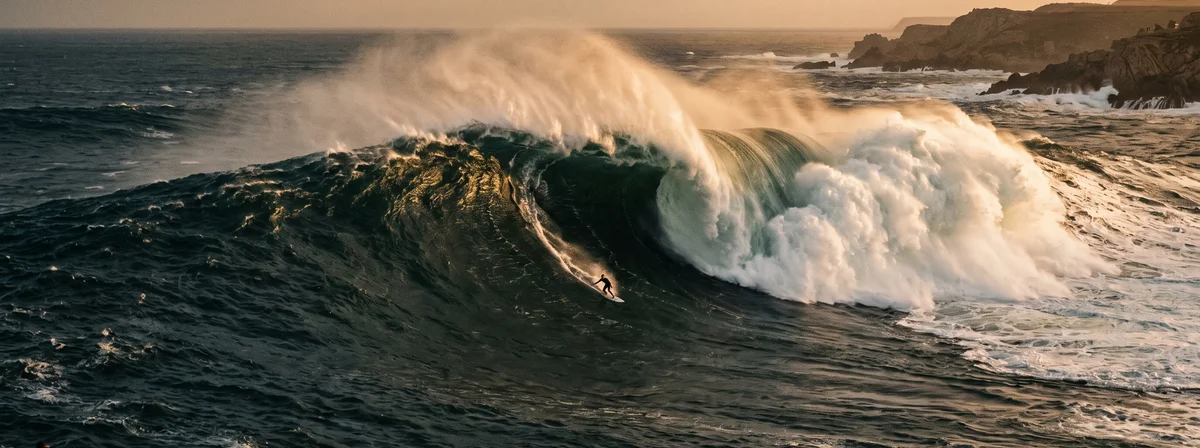
The horn sounds and someone on the cliff yells "OUTSIDE" loud enough to carry over the wind. You can hear the wave before you see it. This is Mavericks on a 30-foot day, and the guy paddling for the bomb has fins on his 10'2 gun that look nothing like the ones on your shortboard.
Taller. Raked further back. Glassed into the board because at 40 miles an hour you don't want a screw popping loose.
Big wave fin setups play by different rules.
Why Big Wave Fins Look So Strange
Every fin spec that matters in normal surfing matters double when the wave is trying to kill you. Speed multiplies the load. A 6-foot face puts maybe 40 pounds of pressure on a fin during a hard turn.
A 40-foot face at Mavericks generates closer to 400. The fin has to hold against forces that would snap a normal performance template.
That's why you see three things on big wave guns. Bigger surface area for grip on a face that's moving faster than the board. More rake to keep the line drawn out through bottom turns that can take three full seconds. And stiffer construction, usually fiberglass or honeycomb core, never the soft flex patterns you'd want on a small wave fish.
Foil thickness matters too. Big wave fins run thicker bases because a thin foil flutters under heavy load. Flutter at 8 feet is annoying. Flutter at 50 feet is the moment your edge releases and you go over the falls in front of a wave carrying a Volkswagen worth of water in the lip.
The Paddle Gun Setup: Bigger Everything
Most paddle-in big wave guns run a thruster. The reasoning is simple. Three fins distribute the load across more surface area, which matters when you're loading up a single bottom turn for what feels like half a minute. Quads work for some riders but most of the Mavericks crew sticks with three.
The templates of choice are big. Greg Long, Jamie Mitchell, and Grant "Twiggy" Baker have all ridden variants of the True Ames Greenough 4A or similar tall, raked single-foil templates. Futures makes a dedicated BW (Big Wave) line and FCS offers oversized templates in the same spirit.
All of them push past 5 inches of depth, where most performance thrusters sit closer to 4.5.
Glass-on fins still show up on guns more than on any other category of board. There's a reason. A removable fin box has plastic and screws and tabs that can fail under heavy enough load. Glass-on means the fin is laminated into the board itself.
Stronger. Heavier. Permanent. If you're going to die because a fin failed, you'd rather it not be the screws.
The feel matches the geometry. You drop in late on a Mavericks bomb, set your rail at the bottom, and the fins lock with an almost glacial confidence. They're not snappy or skatey.
They draw a long arc that doesn't end until you're back near the lip. The whole turn feels like steering a car instead of a bicycle.
Tow Boards Run Different Rules
Tow surfing changed the equation. When a jet ski whips you into the wave at 30 mph, you don't need a long paddle gun anymore. Tow boards are 6 to 7 feet, weighted with lead or thicker glass, and have foot straps screwed into the deck. The fins on those boards look almost normal at first glance, until you notice the configuration.
Most tow boards run quads. The reason is straight-line speed. Without a center fin acting as a brake, the board accelerates faster down the face. That matters at Nazare or Jaws where the wave is moving as fast as the surfer needs to be moving to make the section.
Kai Lenny, who has probably tow surfed and foiled and paddled into more big waves than anyone alive, runs quad setups on his Jaws boards. Sebastian Steudtner, who holds the official world record at 86 feet at Nazare, has run everything from quads to twin keels on his tow boards over the years.
The smaller fins don't need to grip a long bottom turn. They need to track straight at speed and let the surfer link sections without scrubbing momentum.
Mavericks vs Nazare: Same Theory, Different Problems
Mavericks is a cold, deep-water reef break in Half Moon Bay where the wave can be almost perfectly shaped on the right swell direction. Nazare is a chaotic Atlantic monster that breaks over a deep-water canyon and never quite does the same thing twice. The fin demands look similar on paper but feel different in practice.
At Mavericks, you can paddle in. Most of the lineup still does on smaller days. The fins need to hold a long, drawn-out bottom turn through a wave that wants to drag you across the inside boneyard. That's why glass-on thrusters with big templates dominate the paddle quiver.
At Nazare, almost nobody paddles. The wave is too fast, too deep, too unpredictable.
Lucas Chianca, Maya Gabeira, and the regular tow crew use their jet ski runs to position into the bowl and then ride for survival. Quad tow setups rule that lineup. The fins are smaller, the boards are heavier, and the goal is making the section, not stylish carving.
Garrett McNamara, who put Nazare on the map with his 78-foot ride in 2011, was running a custom tow setup designed for that specific board. Everything bespoke. The big wave world doesn't really shop off the rack.
Why Material Matters More Out Here
Performance surfers argue about carbon versus fiberglass like it's a religion. Big wave guys mostly don't bother. Almost everyone goes fiberglass or honeycomb core for one reason. Predictability under load.
Carbon flexes in patterns that depend on the layup. That's fine when the load is consistent and you can dial in your gear over a few sessions.
It's less fine when one wave loads the fin with five times more force than the last one and you don't have a chance to test what happens. Fiberglass behaves the same way every time. Boring. Reliable.
Exactly what you want when survival is on the line.
What the Rest of Us Can Steal From This
You're probably never going to surf Mavericks. But the principles big wave guys obsess over apply to anyone surfing solid overhead surf on a shortboard or step-up. Most surfers ride the same fin set on their daily driver and their step-up, which is exactly why their step-up never feels like it should.
If you're going to Puerto on a step-up swell or paddling out at Blacks on a real day, size up your fins. Half a size makes a noticeable difference. A full size up means more grip when the wave gets serious and the bottom turn matters. The same logic that puts a 5-inch fin on a Mavericks gun puts a slightly bigger template on your 6'8 step-up.
Stiffer flex helps too in heavy water. The whippy fins that feel alive on a 3-foot day go vague when the wave gets thick. That's why fin makers offer different flex patterns for different conditions.
Pick yours based on the biggest wave you actually surf, not the average. The fin sizing guide spells out where the cutoffs sit for your weight.
Key Takeaways
- Big wave fins run bigger, stiffer, and harder raked than performance fins because the loads at speed are exponentially higher.
- Most paddle-in big wave guns at Mavericks use glass-on thrusters with templates over 5 inches deep.
- Tow boards at Nazare and Jaws run quads to maximize straight-line speed since the jet ski handles the bottom turn setup.
- Glass-on fins are still standard on big wave guns because removable boxes have failure points you don't want at 40 mph.
- Recreational surfers can apply the same logic to step-ups by sizing up fins and choosing stiffer flex when the swell gets serious.
Most surfers will never need a Mavericks gun. But the next time you're picking fins for a bigger swell or a step-up board, think about what the crew chasing 40-foot waves chooses and why. Bigger, stiffer, deeper. If you want help dialing in the right step-up template for your weight and the size you actually surf, our fin recommender handles the math in about a minute.
Helpful Resources
Ready to Find Your Perfect Fins?
Use our expert fin recommender tool to get personalized suggestions based on your needs.
Try Fin Recommender