Bells Beach, 2023. Rip Curl Pro final, a long Southern Ocean wall feathering down the point. Ethan Ewing drops in, sets his back foot, and leans into a bottom turn so committed the wave looks like it's bending around him instead of the other way.
He comes off the bottom with stupid speed and lays the board flat on its rail, drawing a line so clean you could check it with a ruler. The judges gave him the win. Everyone watching gave him something better: the quiet consensus that he's the best rail surfer alive.
That carve isn't only technique. A real piece of it is the Ethan Ewing fin setup.
What Ethan Ewing Rides
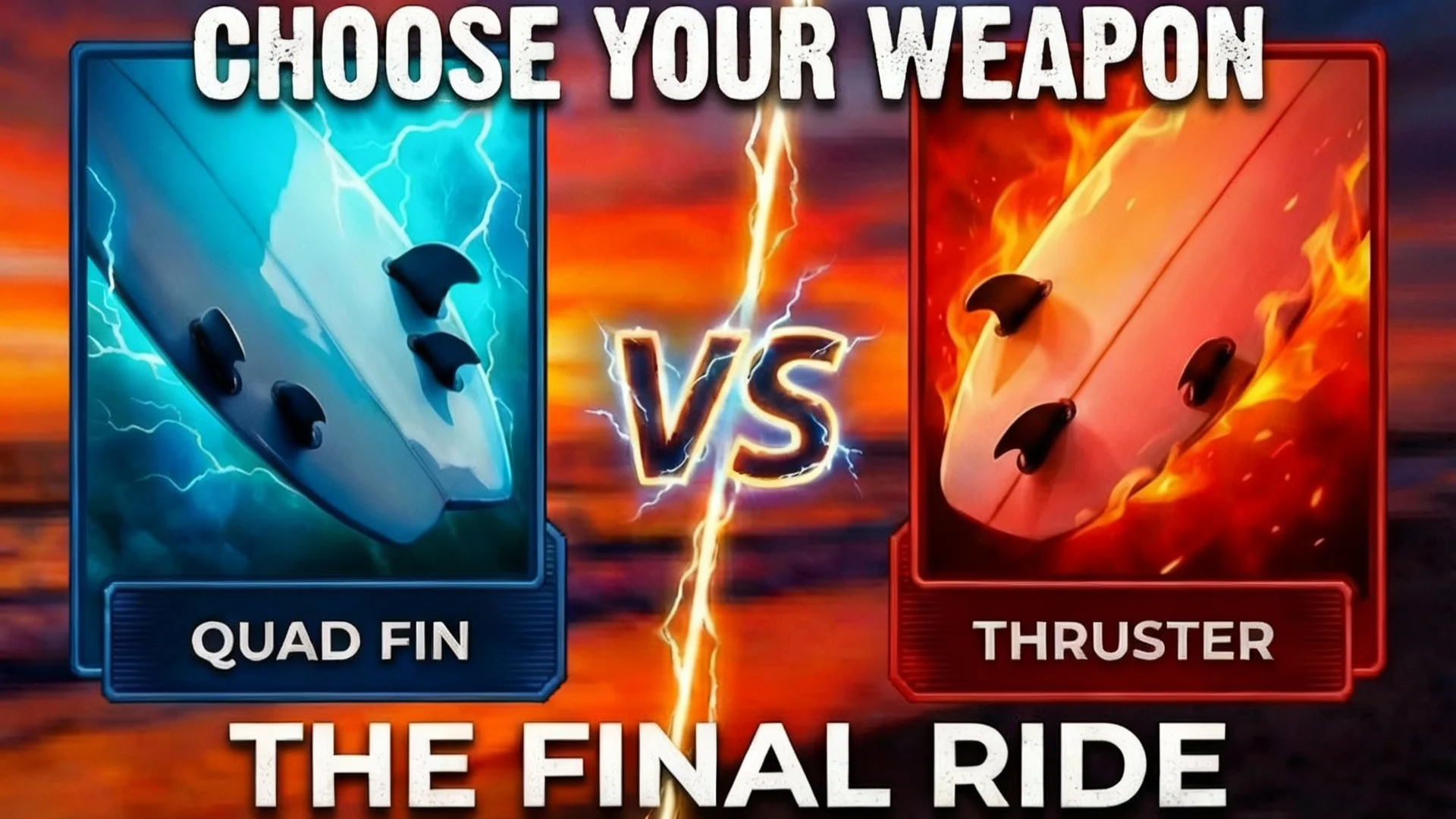
Ewing rides the Futures Ethan Ewing Signature thruster, released in 2025. It sits in the Rake template family, the same drawn-out outline that suits power surfers who live off the rail rather than off the tail.
The boards under him are DHD, shaped by Darren Handley, mostly the model called the Juliette. That's the same file he rode to the Bells win and out to a World No. 2 finish at the 2023 Finals at Trestles. Different events, same two-part recipe: a Handley shortboard and that one signature fin.
Rewind to the 2022 J-Bay Open, the win that announced him as a real title threat, and the through-line holds. Long, fast, open walls where a fin that grips a rail is everything.
Futures makes it in Medium, for surfers roughly 125 to 175 pounds, and Large, for 165 and up. Ewing rides the Large. Not because he's huge, but because he loads a fin harder than almost anyone on tour and needs something that won't fold under him.
He Picked One Fin and Refused to Switch
Here's the part that makes gear nerds sit up. Ewing's signature fin only comes one way: solid fiberglass.
That's a deliberate snub. The template was offered in Honeycomb first, the lighter, livelier construction most pros chase. Ewing tried it, then went the other direction and committed to fiberglass with fine-tuned foils because he wanted one thing above all else: a flex pattern that feels identical every single time.
Solid glass doesn't have the springy pop of a honeycomb core. What it has is consistency. The fin loads and releases the same on a two-foot reform as it does on a six-foot Bells wall, so there's no guessing and no recalibrating between waves.
Compare that to Jack Robinson, who swaps between Honeycomb and stiffer Techflex depending on the day. Ewing went the opposite way. One fin, every condition, three straight seasons of Final 5 finishes on the same Large set. In a sport obsessed with quiver-tweaking, picking one fin and trusting it completely might be the most underrated flex on tour.
What a 3.3 Ride Number Tells You
Futures rates every fin with a Ride Number, their shorthand for where it lands on the scale from drivey control to loose, skatey speed. Ewing's sits at 3.3, down in the control-and-drive zone.
Low number, big meaning. It tells you this fin is built to hold a line and turn your weight into forward drive, not to break the tail free for a snap. That's the entire Ewing program in one number.
The Rake template backs it up. More rake means a longer, more swept outline, and a turn that draws out into a long arc instead of pivoting tight. We went deep on the geometry in our guide to fin rake, but the short version is simple. Rake equals drive and hold, and Ewing's whole game is drive and hold.
Why Glass and Rail Surfing Belong Together
Think about what a long carve actually asks of a fin. You set the rail at the bottom of the wave and hold it there, under load, for a full second or more while the board arcs across the face.
A nervous, super-lively fin fights you in that moment. It wants to release, to skip, to let go right when you need it locked. Ewing's solid-glass set does the opposite. You lean in and the fin just grips, steady and predictable, like a handshake that doesn't flinch.
Then there's the drive off the bottom. You come out of that carve and the board accelerates up the face, the raked foils feeding speed into the turn so you reach the lip with more than you started with. It's the feeling people mean when they say a board "goes." No pump, no scramble, just clean speed pouring out of the rail.
That's why this setup wouldn't suit Italo Ferreira's air game. Italo wants a fin that releases on command so he can throw the tail and rotate. Ewing wants a fin that never lets go. Same tour, opposite philosophies, and the fins tell the whole story.
Should You Ride Ethan Ewing's Fins?
Honest answer: maybe, and probably not in the Large.
If you're a rail surfer, someone who'd rather draw a long carve on a clean wall than boost a punt over the whitewater, the template is a genuinely great match. Points, reefs, peeling beach-break walls. Anywhere flow beats flash, a raked, control-leaning fin makes your surfing feel better the first session.
But size by your body, not by Ewing's name. He runs the Large because he's a powerful adult who surfs serious waves and pushes harder than you do. Bolt that Large under a 145-pound surfer and it feels stiff and stuck, like the board is towing an anchor. The Medium suits most surfers in the 125-to-175 range, and our fin sizing guide spells out the weight ranges so you're not guessing.
And if you mostly surf gutless summer mush and chase the occasional air, be real with yourself. You want something looser and more upright. The fiberglass build also runs a little pricier and a touch heavier than entry-level molded fins, which is a fair trade for the consistency but worth knowing. Our breakdown of carbon, fiberglass, and plastic covers what you're actually paying for.
Key Takeaways
- Ethan Ewing rides the Futures Ethan Ewing Signature thruster, a Rake-template fin made only in solid fiberglass, on DHD boards shaped by Darren Handley.
- He deliberately chose fiberglass over the livelier Honeycomb for one reason: a flex pattern that feels identical in every wave, big or small.
- The 3.3 Ride Number puts it in Futures' control-and-drive zone, not the loose, skatey end. It's built to hold a rail, not break the tail free.
- This is a power and rail-surfing setup. It's the opposite of an air-focused, release-happy fin like Italo Ferreira's.
- Ewing rides the Large because he's a strong adult on heavy waves. Pick your size by your weight, and most surfers want the Medium.
The lesson in Ewing's setup isn't "buy the signature fin." It's that the right template and flex for how you actually surf beats the prettiest sticker on the rack every time. If you're not sure whether your style wants drive or release, tell our fin recommender your board, your weight, and your home break, and it'll point you at the right template in about a minute. Want to see how each setup trades drive for looseness first? Our fin setups guide lays it all out.
Helpful Resources
Ready to Find Your Perfect Fins?
Use our expert fin recommender tool to get personalized suggestions based on your needs.
Try Fin Recommender