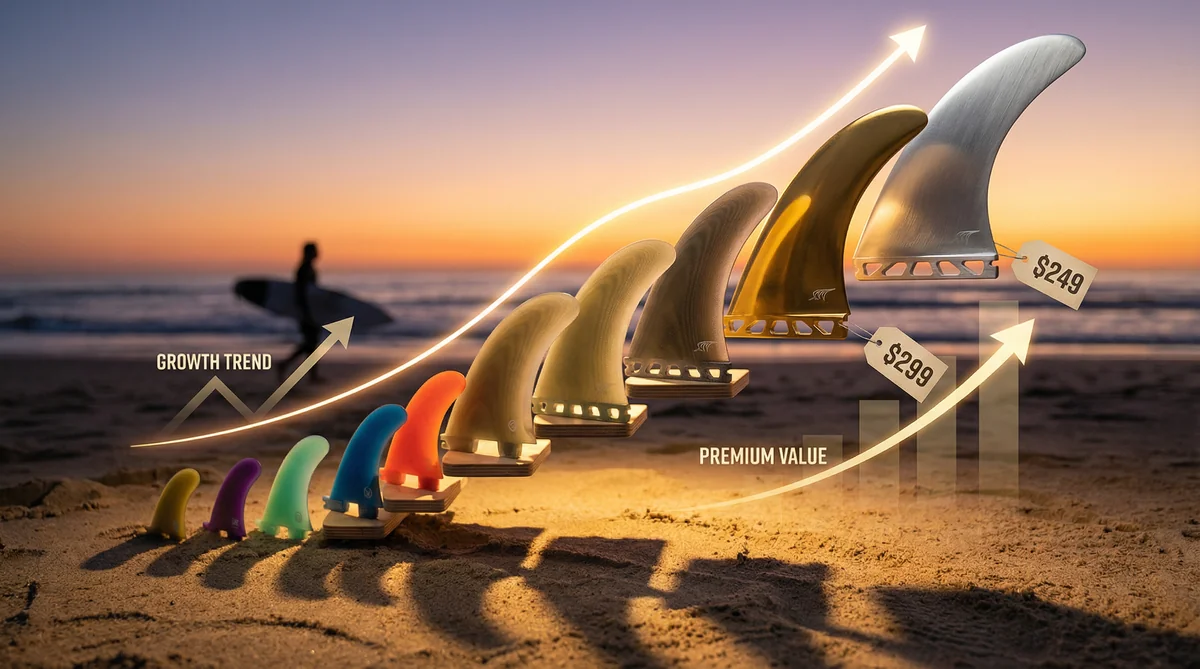
You're at the surf shop holding two thruster sets. Left hand: an FCS II Performer Neo Glass at $78. Right hand: the same template in PC Carbon at $180. The carbon set is lighter.
Not by a lot, but enough that your fingers notice. The guy behind the counter says the lighter ones will make your snaps feel sharper. You hand him your card anyway.
A week later you're paddling out at Blacks wondering if you just spent an extra hundred bucks on a placebo.
Fin weight is the most marketed and least examined variable in the fin world. Every brand lists gram counts. Nobody stops to ask whether those grams actually change how your board surfs. So let's do that.
What a Thruster Set Actually Weighs
A full set of three fins weighs between 170 and 230 grams total. That's roughly a can of Red Bull with a few sips missing.
Plastic fins like Futures Thermotech sit at the heavy end. Fiberglass composites land in the middle, around 200 grams. Honeycomb and foam-core constructions like FCS AirCore cut grams by replacing resin with hollow structure. Full 3K carbon fins like the NVS NV-5.0 are the lightest common option.
The spread between the cheapest plastic set and the most expensive carbon set is roughly 40 to 80 grams. On a shortboard that weighs about 3 kilos, ridden by a surfer who might weigh 75 kilos. Fins represent about 0.27% of the rider-plus-board system mass.
The weight difference between your stockers and those premium carbons is a rounding error on a bathroom scale.
The Physics Nobody Wants to Do
Rotational inertia is mass times distance from the axis squared. The distance part matters. Fins sit at the tail, as far from the yaw rotation center as the board gets. So their mass does have some effect on how fast the board rotates.
Here's the catch. Lighter fins rotate faster into a turn. Heavier fins carry more momentum through it.
Neither is inherently better. It's a preference, not a performance upgrade.
A 2024 paper in Nature Scientific Reports on surfboard dynamics used a Power-to-Inertia ratio to measure turning performance in bottom turns and cutbacks. The ratio doesn't even try to isolate fin mass. It can't. The rider's body movements dwarf any contribution from a few grams at the tail.
When a shaper tells you fins account for 40% of performance, they're talking about template, foil, rake, cant, and flex. Not grams.
What Fin Weight Does Change
Here's the honest list of what losing 40 grams of fin weight does for your surfing.
A barely perceptible bump in pivot speed. You might feel it on a snap at the lip if you're surfing at a high level. If you're still working on your bottom turn, you won't notice.
A slight reduction in swing weight at the tail. Real, but subtle. Most surfers who report feeling "lighter" fins are feeling the flex pattern change, not the mass.
Nothing else. Not speed down the line. Not hold in a bottom turn.
Not drive off the top. Those come from foil and flex pattern, not mass.
What surfers often attribute to lighter fins is usually the flex pattern coming along for the ride. Carbon fins don't just weigh less. They're stiffer at the base with controlled flex in the tip. The responsiveness people praise is coming from that flex distribution, not from the grams saved.
What Marketing Sells vs What Matters
FCS describes PC Carbon as "the feeling of traditional fibreglass with reduced weight." AirCore is pitched as "air pockets reducing weight without sacrificing structural integrity." Futures Honeycomb sells "lighter while keeping the fin stiff where it counts."
Notice what all three have in common. They pair weight with stiffness. Because stiffness is the actual story. Weight is the headline.
Kelly Slater's Endorfins aren't marketed primarily on grams. Channel Islands describes them as "not incredibly stiff but offering more hold the harder you push, plus bounce-back reaction out of turns." That's flex and response language. Not gram counts. Slater has designed multiple fin templates across his career and weight has never been the lead feature.
Read enough fin marketing and you start seeing the pattern. Weight is easy to measure and easy to print on a spec sheet. Flex patterns are hard to quantify and harder to sell. So the industry keeps pushing the number that fits on the label.
The Water Test
Take two fins and hold one in each hand. Wave them through the air like you're doing a cutback. You'll feel the weight difference. That's what convinces people lighter is better.
Now put those fins in water. Water is roughly 800 times denser than air. Once the fin is submerged and moving, hydrodynamic forces against the foil are huge compared to the gravitational pull on 30 grams of mass.
The fin isn't fighting gravity anymore. It's fighting the ocean.
In the water, a 60-gram fin and a 90-gram fin feel nearly identical. What the surfer feels is the flex pattern, the foil, the way the fin bends and releases under load. Which is why every honest review of the FCS Performer PC Carbon talks about base stiffness and tip bounce, not about how it feels light.
When Lighter Fins Do Pay Off
All this skepticism aside, there are three situations where paying for weight reduction is worth it.
Small-wave performance boards. When you're on a 5'6 groveler in 2-foot mush, every bit of tail responsiveness helps. Lighter fins with sharper flex wake up a board that's already low on energy. This is the clearest case for carbon in a groveler setup.
Light surfers. If you're 120 pounds, fin mass is a bigger percentage of your system mass. The effect scales down with your body weight. Groms and smaller surfers get more out of lighter fins than a 200-pound adult will.
Competition. Pros ride lighter fins because at the top of the sport, a 2% edge compounds across a heat. Filipe Toledo's fin choice isn't your equation. He's optimizing for margins you'll never experience in a free surf.
For everyone else, a properly matched fiberglass or Neo Glass set will outperform a mismatched carbon set every time. The weight isn't the variable that decides your session. The match is.
So What Should You Buy
If you've narrowed your choice down to two sets with the same template and you're choosing between a $78 Neo Glass and a $180 PC Carbon, don't let the grams decide. Ask yourself how you surf. If you're working on progressive shortboard turns in clean conditions, the stiffer flex of a carbon set will help. If you're riding mushy beach breaks or still finding your rhythm, the softer, forgiving flex of fiberglass is often the better call.
If you're comparing two different templates, pick the template. Always. A Futures AM1 at 80 grams per fin will feel nothing like an AM2 at 80 grams per fin.
The weight is the same. The surfing experience is completely different. That's your answer.
Fin weight is a feature the industry can print on a box. Template, foil, and flex are what make a fin work. Spend your money there.
Key Takeaways
- A full thruster set weighs 170 to 230 grams. The difference between the cheapest plastic and the most expensive carbon is 40 to 80 grams.
- Fin mass represents about 0.27% of the surfer-plus-board system. Physics-wise, the effect is small.
- Flex pattern and foil do the real work. Most "lighter feeling" fins feel better because of stiffness distribution, not grams saved.
- Lighter fins help most on small-wave boards, for lighter surfers, and in competition.
- If you're choosing between template match and weight savings, pick the template match every time.
The harder question isn't whether lighter fins are better. It's whether a specific fin is better for your board, your size, and the waves you surf. That's the match that moves your surfing forward.
Our fin recommender runs that match for you in about a minute. No gram counting required.
While you're thinking about flex vs weight, the material breakdown guide and the fin fundamentals guide cover the variables that actually matter.
Helpful Resources
Ready to Find Your Perfect Fins?
Use our expert fin recommender tool to get personalized suggestions based on your needs.
Try Fin Recommender