Bells Beach, Easter weekend, 1981. The swell that shows up is one of the biggest, cleanest runs of right-handers anyone's ever seen pump through a contest. The locals still call it Big Saturday. And paddling out into it is a 6'2", 200-pound goofyfoot from Narrabeen who'd spent two years getting smoked by guys half his size on twin fins.
His name was Simon Anderson. Under his arm was a board nobody had really seen before. Square tail, three fins, all the same size.
He won the contest. Then he flew to Hawaii and won the Pipeline Masters too. Surfing was never the same again.
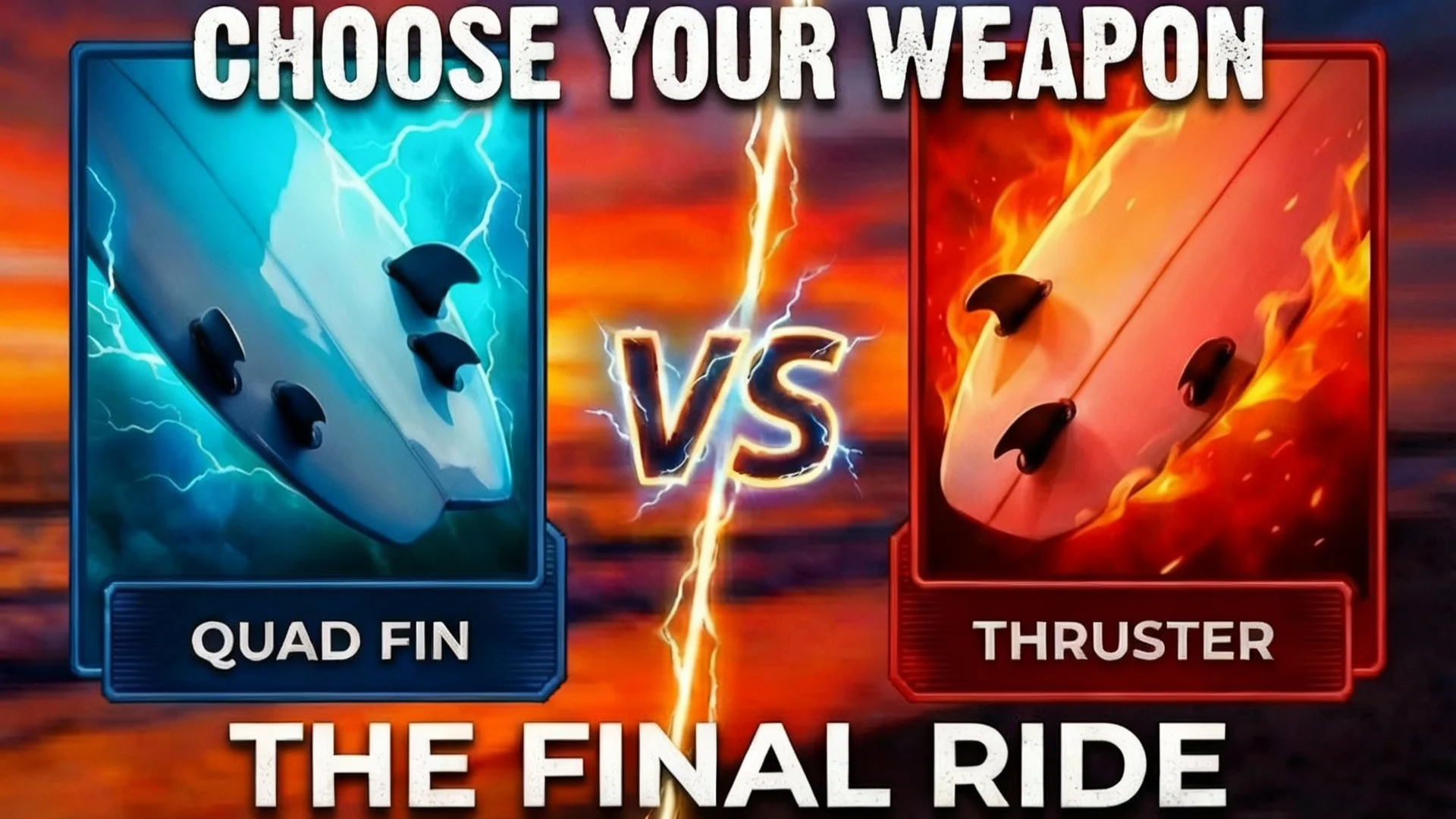
That board was the thruster. If you ride a three-fin setup today, and odds are you do, you're riding Simon Anderson's idea. Here's how it happened and why it stuck for over 40 years.
Why the Twin Fin Was Killing Simon Anderson
To understand the thruster you have to understand what came before it. In the late 70s, the twin fin ruled. Mark Richards won four straight world titles on them.
The twin was loose, fast, and skatey in small waves. For a lightweight surfer doing tight little carves in two-foot beachbreak, it was perfect.
Anderson was not a lightweight surfer. He was a big unit with a powerful, drawn-out style, and the twin fin betrayed him every time the waves got serious. The tail would let go with no warning. You'd commit to a hard bottom turn and the board would just spin out from under you, like trying to corner a shopping cart with one bad wheel.
No hold. No drive off the back foot. Just slide.
He needed something that held a rail through a big turn but didn't bog like the old single fins did. Twin fins were too loose. Singles were too stiff. There was a gap in the middle, and nobody had filled it.
The Idea: Add a Third Fin, Keep Them All the Same Size
Other shapers had bolted extra fins onto boards before. The bonzer crew was running five-fin clusters years earlier. But those designs used a big center fin with small side runners, or vice versa. The boards either pivoted hard or tracked stiff.
Anderson's move was simpler and smarter. Three fins, roughly equal size, with the two front fins toed in toward the nose and the rear fin centered behind them. He squared off the tail to give the back fin room to bite.
He called it the thruster because of what it did off a turn. The thrust.
The geometry matters more than it sounds. The two side fins give you rail-to-rail drive and hold. The center fin kills the spin-out the twin couldn't fix. Put them together and you get a board that's loose enough to throw around but locked in when you need it.
If you want the deeper breakdown of how that cluster actually works, we covered it in our guide to fin setups and the all about fins rundown.
What the Thruster Feels Like Under Your Feet
Here's the part the history books skip. The reason the thruster won wasn't the spec sheet. It was the feeling.
On a twin, a big vertical hit at the top of the wave was a gamble. You'd go up, the tail would break free, and you'd pray it came back around.
On the thruster, you drive off the bottom, set the rail, and the board climbs the face with this planted, no-drama confidence. You hit the lip, the center fin holds the pivot, and you come down still pointing where you wanted to go. The board does what your back foot tells it.
That's why the footage from Bells in '81 looks so different from what came before. Anderson was throwing buckets off the top, tucking into barrels, drawing these long powerful lines and then snapping vertical out of nowhere. He beat Cheyne Horan in the final at Cheyne's own game. Radical surfing, on a board that finally let a power surfer be powerful without getting punished.
Why Simon Anderson Never Got Rich Off the Thruster
This is the part that makes surfers love the guy. Anderson never patented the thruster. He could have. He had the most important board design since the foam-and-fiberglass shortboard, and within a couple seasons nearly every pro on tour was riding a copy of it.
He shaped under his Energy Surfboards label and just let the design spread. No royalties. No lawsuit.
The most influential fin setup in surfing history is essentially open source because the man who invented it didn't lock it up. That's not naivety. That's a surfer who cared more about the surfing than the money.
Forty-plus years later, the three-fin thruster is still the default setup on most performance shortboards. John John Florence rides one. Gabriel Medina rides one. The tail shapes change, the fin templates get fancier, the materials go full carbon, but the core idea is still Anderson's: three fins, equal-ish size, drive plus hold.
Is the Thruster Still the Best Setup? Honest Answer
For most surfers in most conditions, yes. The thruster is the most versatile fin setup ever made, and that's exactly why it took over. It works in two-foot slop and overhead reef. It does a little of everything well.
But "best at everything" means "best at nothing in particular." In gutless small waves, a quad will out-glide a thruster every time because there's no center fin dragging. And the twin fin Anderson abandoned? It came roaring back as a small-wave specialty board, because that skatey looseness is a blast when the waves don't have power. We dug into that revival in our twin fin comeback piece.
So the honest take: the thruster isn't the fastest or the loosest setup. It's the one that does the most things competently. That's a different kind of winning, and it's the reason Anderson's idea outlasted every trend that tried to replace it.
Key Takeaways
- Simon Anderson invented the thruster in 1980-81 and proved it by winning Bells Beach and the Pipeline Masters in 1981, the same year.
- The thruster solved the twin fin's biggest flaw: spin-out in powerful waves. The center fin adds hold, the side fins add drive.
- Anderson, a big and powerful surfer, built it because twin fins couldn't hold a rail for a guy his size in serious surf.
- He never patented it, which is why three-fin boards became the global standard with no one owning the rights.
- It's still the most versatile setup, but quads beat it in small waves and twins beat it for pure looseness.
If you're trying to figure out whether the classic thruster is right for what you ride and where you surf, that's the exact question our fin recommender sorts out in about a minute. Tell it your board and your waves, and it'll tell you whether to stick with Anderson's three or branch off.
Helpful Resources
Ready to Find Your Perfect Fins?
Use our expert fin recommender tool to get personalized suggestions based on your needs.
Try Fin Recommender