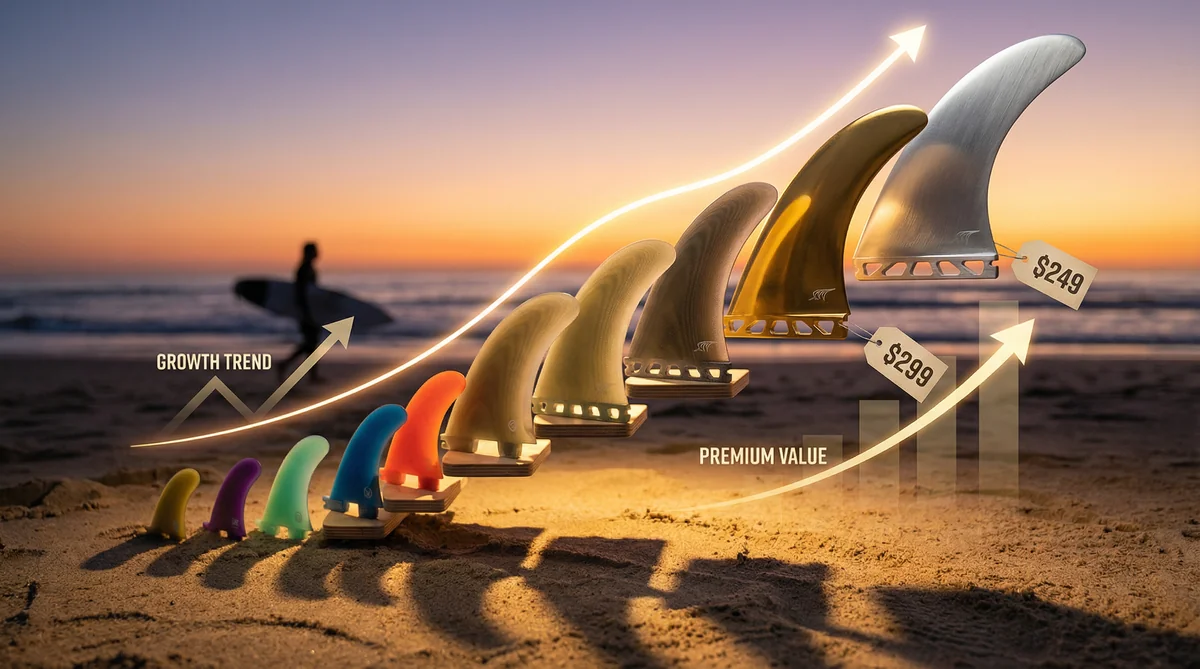
You're sitting in the lineup at Cardiff, watching two guys trade waves on near-identical boards. Same shaper. Same dimensions. Same thruster setup.
One draws long, leaning arcs that connect the whole wave. The other stomps the tail into three vertical snaps and a closeout hack. Same gear, completely different surfing.
The difference isn't the board. It's where their weight lives.
That's stance. And it's the one variable almost nobody factors in when they buy fins.
We obsess over rake, base length, and flex like they exist in a vacuum. They don't. A fin only matters in relation to the foot pressing it into the water. Figure out whether you surf off your front foot or your back foot, and the whole fin-buying conversation gets a lot simpler.
Stance Is the Setting Nobody Adjusts
Every surfer uses both feet. The question is which one runs the show.
Most coaches start beginners around 60/40, roughly 60 percent of your weight over the front foot for balance, 40 over the back for control. But that number is a starting line, not a style. It shifts constantly. You might load 70/30 to the front through a bottom turn, then dump it back to 40/60 to throw a top turn.
Your natural resting bias, the place your weight drifts when you're not thinking, is what actually defines you.
Back-foot surfers live over the tail. They initiate from the back, they pivot, they hit. Think Andy Irons stomping a closeout section into oblivion, or the way Mick Fanning loaded the tail and detonated.
These are the surfers Taylor Knox calls power surfers. Lead foot. Heavy on the fins.
Front-foot surfers ride forward. They generate speed through flow and pumping instead of brute tail pressure, drawing longer lines and keeping the board gliding.
Tom Curren built a career on it. Rob Machado still does. The board looks like it's doing the work because the surfer isn't fighting it.
Neither is better. But they ask completely different things from the four pieces of plastic bolted to your tail.
What Back Foot Surfing Asks of Your Fins
When you surf off your back foot, you're concentrating load directly over the fin cluster. Every hard turn dumps your bodyweight onto the tail. That does two things to your fins: it demands grip, and it punishes anything that can't hold.
Stomp a bottom turn with all your weight on the tail and an undersized fin will let go. You feel it as that stomach-drop half-second where the tail washes sideways and you're suddenly a passenger. If you spin out a lot, your stance is probably the reason, not bad luck.
So back-foot surfers should size up, not down. Don't run the small template because it looks fast on the rack. Get enough fin area to grab under heavy load.
Favor more rake and hold so the tail tracks through a power carve instead of breaking free. Lean toward stiffer fins too, because a noodle-flexy fin folds under that kind of pressure and gives you a vague, disconnected feel right when you need bite.
Here's what dialed feels like for a back-foot surfer. You set your rail, drop everything onto the tail, and the fins just grip. Not sticky. Confident.
The board holds a tight, drivey arc and fires you out the other side with speed you can feel in your chest. That's a bigger, raked template doing its job under a heavy back foot.
What Front Foot Surfing Asks of Your Fins
Front-foot surfers have the opposite problem. You're rarely planting your full weight on the tail, so you don't need a fin built to survive that. You need a fin that keeps the board alive and skatey while you generate speed up front.
Too much fin and a front-foot surfer feels glued to the wave. The board wants to track straight and drive when you want it loose and playful. Every redirect becomes a negotiation. It's like the fins are surfing a different wave than you are.
Go a little smaller. Favor flex, which gives you that whip and snap-back as you pump down the line. A more upright template with less rake releases quicker and pivots tighter, so the board responds to subtle front-foot weight shifts instead of demanding a full tail stomp. Less fin in the water also means less drag, which matters a lot when your speed comes from flow rather than from beating the tail.
When it's right, a front-foot surfer feels the board come alive under the lead foot. You shift forward, the board surges, and you're three sections down the line on glide alone. The tail feels light and willing, ready to slide and recover the instant you ask.
That loose, buttery feel is a smaller, flexier, more upright setup matched to a forward stance. It's why so many flow surfers gravitate toward twin fins, which delete the center fin's drag entirely.
How to Tell Which One You Are
Most people guess wrong about themselves, so use evidence instead of ego.
Watch a clip of your own surfing. Where does the spray come from? Back-foot surfers throw buckets off the tail in tight, vertical bursts. Front-foot surfers leave longer, lower fans and connect sections other people would close out on.
Check your wear, too. Pull your board out and look at the deck. A worn-out, compressed patch over the tail and a beat-up tail pad scream back foot. Wear spread further forward points to a front-foot stance.
And listen to your sessions. If you spin out and slide the tail a lot, you're a back-foot surfer who's underfinned. If you bog and feel like the board won't accelerate, you might be a front-foot surfer fighting too much fin, or one who needs more base for drive. The symptom tells you the fix.
Translating Stance Into a Fin Template
Here's the cheat sheet, built from how rake, base, and flex actually behave under weight.
Back foot, power surfer
Size up or stay true to size, with more rake for hold through long power carves. Larger base for drive off the bottom. Stiffer flex so the fin holds its line when you load it. You want grip and drive, because you generate the snap yourself.
Front foot, flow surfer
Size down a touch, with a more upright, lower-rake template for quick release and tight pivots. Medium to softer flex for whip and a lively feel. Less overall area to cut drag. You want looseness and glide, because you generate speed without stomping.
The neutral caveat
Plenty of surfers genuinely sit in the middle, shifting weight deliberately to find different lines. If that's you, a balanced stock template like an all-around mid-rake set is exactly what it's designed for. Don't overthink it. The neutral stance is the one the factory tuned for.
One honest caveat: stance is one input, not the only one. Your weight, board, and the waves you actually surf all stack on top of it.
A heavy back-foot surfer in two-foot mush still has different needs than a light front-foot surfer in overhead reef. Stance narrows the field. It doesn't pick the exact set by itself.
Key Takeaways
- Stance is the hidden variable in fin choice. Where your weight rests changes what every spec does in the water.
- Back-foot power surfers load the tail, so they need more fin: size up, add rake and hold, run stiffer flex to avoid spinning out.
- Front-foot flow surfers ride forward, so they want less fin: size down, go more upright and flexier, cut drag to keep the board skatey.
- Diagnose yourself with evidence. Spray pattern, deck wear, and whether you spin out or bog tell you more than a gut feeling.
- Stance narrows your options fast, but weight, board, and conditions still finish the decision.
If you've never thought about your stance before, this is the part where it changes how you shop. Tell our fin recommender what you ride and how you surf, and let it weigh stance against your weight and conditions instead of you eyeballing a wall of templates at the shop. And if you want the spec background behind all this, the all about fins guide breaks down what rake and base are actually doing under your feet.
Helpful Resources
Ready to Find Your Perfect Fins?
Use our expert fin recommender tool to get personalized suggestions based on your needs.
Try Fin Recommender